MCQ
Which of the following aqueous solution will exhibit highest boiling point
- A$0.01\, M$ $Na_2SO_4$
- B$0.01\, M$ $KNO_3$
- ✓$0.015\, M$ urea
- D$0.015\, M$ glucose
$\Longrightarrow 3.72=1 \times 1.86 \times i$
$\Longrightarrow i=2,$ hence complex is binary.
Also, $C N$ of $P t$ is $6$ and complex is hydrated.
so complex is $\left[ Pt \left( H _{2} O \right)_{3} Cl _{3}\right] Cl \cdot 3 H _{2} O$
Generate a complete, print-ready paper with questions like this in minutes — across 16+ boards, with answer keys.
Complete copolymerization of 500 moles of $Q$ and $500$ moles of $R$ gives one mole of a single acyclic copolymer $U$.
[Given, atomic mass: $H=1, C=12, O=16$ ]
($1$) Sum of number of oxygen atoms in $S$ and $T$ is. . . . . .
($2$) The molecular weight of $U$ is
Give the answer or quetion $(1)$ and $(2)$
$Z{n^{2 + }} + 2e \to Zn,{E^o} = - 0.762\,V$
$M{g^{2 + }} + 2e \to Mg,{E^o} = - 2.37\,V$
When zinc dust is added to the solution of $MgC{l_2}$
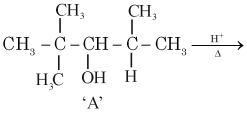
The total number of possible products formed by tertiary carbocation of $A$ is $.........$.