Question
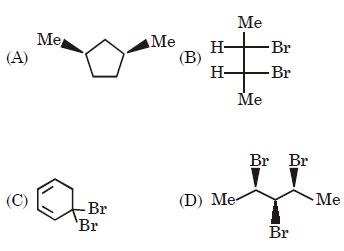
Which of the following are meso compound?
Generate a complete, print-ready paper with questions like this in minutes — across 16+ boards, with answer keys.

Assertion $A :$- Carbon forms two important oxides $- CO$ and $CO _2 . CO$ is neutral whereas $CO _2$ is acidic in nature.
Reason $R :$- $CO _2$ can combine with water in a limited way to form carbonic acid, while $CO$ is sparingly soluble in water.
In the light of the above statements, choose the most appropriate answer from the options given below :-
$\mathrm{I}_2+2 \mathrm{e}^{-} \rightarrow 2 \mathrm{I}\ \ \ \mathrm{E}^{\circ}=0.54 $
$\mathrm{Cl}_2+2 \mathrm{e}^{-} \rightarrow 2 \mathrm{Cl}^{-} \ \ \ \mathrm{E}^{\circ}=1.36 $
$\mathrm{Mn}^{3+}+\mathrm{e}^{-} \rightarrow \mathrm{Mn}^{2+} \ \ \ \mathrm{E}^{\circ}=1.50 $
$\mathrm{Fe}^{3+}+\mathrm{e}^{-} \rightarrow \mathrm{Fe}^{2+} \ \ \ \mathrm{E}^{\circ}=0.77 $
$\mathrm{O}_2+4 \mathrm{H}^{+}+4 \mathrm{e}^{-} \rightarrow 2 \mathrm{H}_2 \mathrm{O} \ \ \ \mathrm{E}^{\circ}=1.23$
$1.$ Among the following, identify the correct statement.
$(A)$ Chloride ion is oxidized by $\mathrm{O}_2$
$(B)$ $\mathrm{Fe}^{2+}$ is oxidized by iodine
$(C)$ Iodide ion is oxidized by chlorine
$(D)$ $\mathrm{Mn}^{2+}$ is oxidized by chlorine
$2.$ While $\mathrm{Fe}^{3+}$ is stable, $\mathrm{Mn}^{3+}$ is not stable in acid solution because
$(A)$ $\mathrm{O}_2$ oxidises $\mathrm{Mn}^{2+}$ to $\mathrm{Mn}^{3+}$
$(B)$ $\mathrm{O}_2$ oxidises both $\mathrm{Mn}^{2+}$ and $\mathrm{Fe}^{2+}$ to $\mathrm{Fe}^{3+}$
$(C)$ $\mathrm{Fe}^{3+}$ oxidizes $\mathrm{H}_2 \mathrm{O}$ to $\mathrm{O}_2$
$(D)$ $\mathrm{Mn}^{3+}$ oxidises $\mathrm{H}_2 \mathrm{O}$ to $\mathrm{O}_2$
$3.$ Sodium fusion extract, obtained from aniline, on treatment with iron $(II)$ sulphate and $\mathrm{H}_2 \mathrm{SO}_4$ in presence of air gives a Prussian blue precipitate. The blue colour is due to the formation of
$(A)$ $\mathrm{Fe}_4\left[\mathrm{Fe}(\mathrm{CN})_6\right]_3$ $(B)$ $\mathrm{Fe}_3\left[\mathrm{Fe}(\mathrm{CN})_6\right]_2$
$(C)$ $\mathrm{Fe}_4\left[\mathrm{Fe}(\mathrm{CN})_6\right]_2$ $(D)$ $\mathrm{Fe}_3\left[\mathrm{Fe}(\mathrm{CN})_6\right]_3$
Give the answer question $1,2$ and $3.$