MCQ
Which of the following are mixed anhydride?
- A$Cl_2O$
- B$ClO_2$
- ✓$ClO_3$
- DBoth $(B)$ and $(C)$
Generate a complete, print-ready paper with questions like this in minutes — across 16+ boards, with answer keys.
$1.\,Zn|Z{n^{2 + }}\,\left( {1\,M} \right)||C{u^{2 + }}\left( {1\,M} \right)|Cu$
$2.\,Zn|Z{n^{2 + }}\,\left( {0.1\,M} \right)||C{u^{2 + }}\left( {1\,M} \right)|Cu$
$3.\,Zn|Z{n^{2 + }}\,\left( {1\,M} \right)||C{u^{2 + }}\left( {0.1\,M} \right)|Cu$
are represented by $E_1,\,E_2,\,E_3$. Which of the following statement is true?
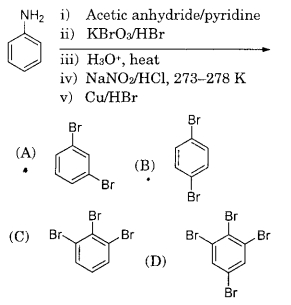
Assertion $(A)$ and the other is labeled as Reason $(R)$. Assertion $(A)$: $\mathrm{CH}_2=\mathrm{CH}-\mathrm{CH}_2-\mathrm{Cl}$ is an example of allyl halide
Reason$(R)$: Allyl halides are the compounds in which the halogen atom is attached to $\mathrm{sp}^2$ hybridised carbon atom.
In the light of the two above statements, choose the $most \ appropriate$ answer from the options given below: