MCQ
Which of the following are mixed anhydride?
  • A
    $Cl_2O$
  • B
    $ClO_2$
  • $ClO_3$
  • D
    Both $(B)$ and $(C)$

Answer

Correct option: C.
$ClO_3$
c
Fluorine is most electronegative element in periodic table and exhibits $O.S.$ value of $- 1$ only.

Need a full question paper?

Generate a complete, print-ready paper with questions like this in minutes — across 16+ boards, with answer keys.

Start Generating Free

Similar questions

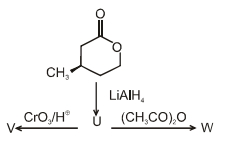
With reference to the scheme given, which of the given statments$(s)$ about $T , U , V$ and $W$ is (are) correct?

$(A)$ $T$ is soluble in hot aqueous $NaOH$

$(B)$ $U$ is optically active

$(C)$ Molecular formula of $W$ is $C _{10} H _{18} O _4$

$(D)$ $V$ gives effervescence on treatment with aqueous $NaHCO _3$
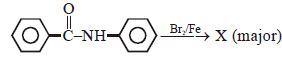
$X$ is
An example of sulphur containing amino acid is

$(a)$ Methionine            $(b)$ Isoleucine

$(c)$ Valine                    $(d)$ Cysteine
In an electrochemical reaction of lead, at standard temperature, if $E _{\left( Pb ^{2+} / Pb \right)}^0= m$ Volt and $E _{\left( Pb ^{4+} / Pb \right)}^0= n$ Volt, then the value of $E _{\left( Pb ^{2+} / Pb ^{4+}\right)}^0$ is given by $m-x n$. The value of $x$ is $...........$. (Nearest integer)
Which of the following compound show sublimation
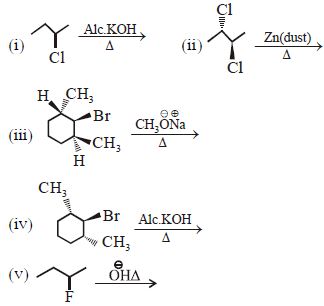
Identify total number of $'\beta '$ elimination reaction
$\begin{matrix}
   {{H}_{2}}C=CH-C{{H}_{2}}-C{{H}_{2}}-CH-C{{H}_{3}}\xrightarrow[Pyridine]{SOC{{l}_{2}}}  \\
   \,\,\,\,\,\,\,\,\,\,\,\,\,\,\,\,\,\,\,\,\,\,\,\,\,\,\,\,\,\,\,\,\,\,\,\,\,\,\,| \,\,\,\,\,\,\,\, \\
   \,\,\,\,\,\,\,\,\,\,\,\,\,\,\,\,\,\,\,\,\,\,\,\,\,\,\,\,\,\,\,\,\,\,\,\,\,\,\,\,\,\,OH\,\,\,\,\,\,  \\
\end{matrix}$  $(A)\xrightarrow[({{H}_{2}}O)]{{{O}_{3}}/Zn}\underset{{{C}_{5}}{{H}_{9}}ClO}{\mathop{(B)}}\,\xrightarrow{NaB{{H}_{4}}}(C)$

Compound $(C)$ is

Consider the following reactions

$(a)\;\left(\mathrm{CH}_{3}\right)_{3} \mathrm{CCH}(\mathrm{OH}) \mathrm{CH}_{3} \stackrel{\mathrm{conc.H}, \mathrm{SO}_{4}}{\longrightarrow}$

$(b)\;\left(\mathrm{CH}_{3}\right)_{2} \mathrm{CHCH}(\mathrm{Br}) \mathrm{CH}_{3} \stackrel{\text { alc.KOH }}{\longrightarrow}$

$(c)\;\left(\mathrm{CH}_{3}\right)_{2} \mathrm{CHCH}(\mathrm{Br}) \mathrm{CH}_{3} \xrightarrow[\text { It should be }\left(\mathrm{CH}_{3}\right)_{3} \mathrm{CO}^{-} \mathrm{K}^{+}]{\text { given by } \mathrm{NTA}\left(\mathrm{CH}_{3}\right)_{3} \mathrm{O}^{-} \mathrm{K}^{+}}$

$(d)\;\begin{array}{*{20}{c}}
  {{{(C{H_3})}_2}C - C{H_2} - CHO} \\ 
  {|\,\,\,\,\,\,\,\,\,\,\,\,\,\,\,\,\,\,} \\ 
  {OH\,\,\,\,\,\,\,\,\,\,\,\,\,\,} 
\end{array}\xrightarrow{\Delta }$

Which of these reaction(s) will not produce Saytzeff product ?

$\begin{matrix}
   O\,\,\,\,\,\,  \\
   ||\,\,\,\,\,\,  \\
   R-C-N{{H}_{2}}  \\
\end{matrix}$ $+xNaOH+B{{r}_{2}}\to $ $R-N{{H}_{2}}+2NaBr$ $+N{{a}_{2}}C{{O}_{3}}+{{H}_{2}}O$

Number of moles of $NaOH $ used in above Hoffmann bromamide reaction is

$HO-CH_2CH_2CH_2CH_2-Br  \xrightarrow{{KOH}} Product$, product is