MCQ
Which of the following are non polar molecules:
  • A
    $O ^2$
  • B
    $H ^2$.
  • Both $a$ and $b.$
  • D
    None.

Answer

Correct option: C.
Both $a$ and $b.$

Need a full question paper?

Generate a complete, print-ready paper with questions like this in minutes — across 16+ boards, with answer keys.

Start Generating Free

Similar questions

The resistance ofeach arm of the Wheatstone's bridge is $10\; ohm$. A resistance of $10 \;ohm$ is connected in series with a galvanometer then the equivalent resistance across the battery will be
In a diode valve, the state of saturation can be obtained easily by
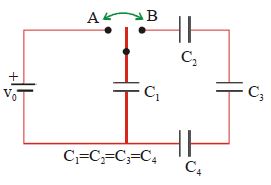
The four identical capacitors in the circuit shown below are initially uncharged. The switch is then thrown first to position $A$, and then to position $B$. After this is done: 

Note: $V_{1,2,3,4}$ are the potential differences across $C_{1,2,3,4}$ and $Q_{1,2,3,4}$ are the final charges stored in $C_{1,2,3,4}$ respectively.
The electric field due to a dipole at a distance r on its axis is
The variation of magnetic susceptibility (x) with temperature for a diamagnetic substance is best represented by
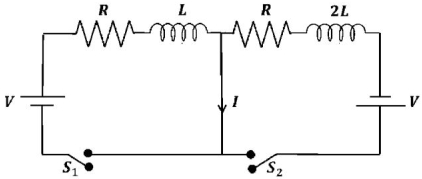
In the figure below, the switches $S_1$ and $S_2$ are closed simultaneously at $t=0$ and a current starts to flow in the circuit. Both the batteries have the same magnitude of the electromotive force (emf) and the polarities are as indicated in the figure. Ignore mutual inductance between the inductors. The current $I$ in the middle wire reaches its maximum magnitude $I_{\max } a x$ at time $t=T$. Which of the following statements is (are) true?

(Image)

$(A)$ $I_{\max }=\frac{V}{2 R}$ $(B)$ $I_{\max }=\frac{V}{4 R}$ $(C)$ $\tau=\frac{L}{R} \ln 2$ $(D)$ $\tau=\frac{2 \mathrm{~L}}{\mathrm{R}} \ln 2$
The atomic number of silicon is $14$. Its ground state electron configuration is
Half life of radioactive element depends upon
A biconvex lens with equal radii curvature has refractive index $1.6$ and focal length $10 cm.$ Its radius of curvature will be.......$cm$
If a dielectric substance is introduced between the plates of a charged air-gap capacitor. The energy of the capacitor will