Question
Which of the following are not electromagnetic waves
|
(a) Cosmic rays |
(b) Gamma rays |
(c) b-rays |
(d) X-rays |
Which of the following are not electromagnetic waves
|
(a) Cosmic rays |
(b) Gamma rays |
(c) b-rays |
(d) X-rays |
(c) b-rays
Generate a complete, print-ready paper with questions like this in minutes — across 16+ boards, with answer keys.
A proton of mass 1.67  and charge 1.6
  is projected with a speed of 2
  m/s at an angle of 60° to the X - axis. If a uniform magnetic field of 0.104 Tesla is applied along Y - axis, the path of proton is
|
(a) A circle of radius = 0.2 m and time period |
|
(b) A circle of radius = 0.1 m and time period 2 |
|
(c) A helix of radius = 0.1 m and time period 2 |
|
(d) A helix of radius = 0.2 m and time period 4 |
A heating coil is labelled 100 W, 220 V. The coil is cut in half and the two pieces are joined in parallel to the same source. The energy now liberated per second is
|
(a) 200 J |
(b) 400 J |
(c) 25 J |
(d) 50 J |
The voltage V and current I graph for a conductor at two different temperatures  and
and  are shown in the figure. The relation between and is

|
(a) |
(b) |
(c) |
(d) |
Four charges +Q, -Q, +Q, -Q are placed at the corners of a square taken in order. At the centre of the square
|
(a) E = 0, V = 0 |
(b) E = 0, V ≠ 0 |
(c) E ≠ 0, V = 0 |
(d) E = 0, V ≠ 0 |
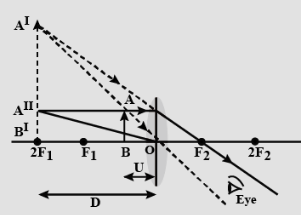
Figure shows the ray diagram of a:
If a current is passed in a spring, it
|
(a) Gets compressed |
(b) Gets expanded |
(c) Oscillates |
(d) Remains unchanged |


