MCQ
Which of the following cannot be hydrolysed
  • A
    A salt of weak acid and strong base
  • B
    A salt of strong acid and weak base
  • C
    A salt of weak acid and weak base
  • A salt of strong acid and strong base

Answer

Correct option: D.
A salt of strong acid and strong base
(d)A salt of strong acid and strong base cannot be hydrolysed. In this case the equilibrium cannot shifted towards the backward.

Need a full question paper?

Generate a complete, print-ready paper with questions like this in minutes — across 16+ boards, with answer keys.

Start Generating Free

Similar questions

The solution of $N{a_2}C{O_3}$ has $pH$
$\text{E}^\ominus$ values of some redox couples are given below. On the basis of these values choose the correct option : $\text{E}^\ominus\text{values} : \text{Br}_2/ \text{ Br}^-=+1.90;\text{ Ag}^+/\text{ Ag(S)}=+0.80 \text{Cu}^{2+}/\text{ Cu(s)}=+0.34;\text{I}_2\text{(s)}/\text{ I}^-=0.54$
The geometry around boron in the product ' $B$ ' formed from the following reaction is

$BF _{3}+ NaH \stackrel{450 K }{\longrightarrow} A + NaF$

$A + NMe _{3} \rightarrow B$

For preparing $0.1\, N$ solution of a compound from its impure sample of which the percentage purity is known, the weight of the substance required will be
Number of $\sigma$ bonds in
In Lassaigne’s test the organic compound is fused with $Na$ followed by extraction with distilled water. Which of the following is not the product of this fusion reaction
The number of atoms in $8\, \mathrm{~g}$ of sodium is $\mathrm{x} \times 10^{23}.$ The value of $\mathrm{x}$ is ...... .(Nearest integer)

$\left[\right.$ Given $: \mathrm{N}_{\mathrm{A}}=6.02 \times 10^{23}\, \mathrm{~mol}^{-1}$, Atomic mass of $\mathrm{Na}=23.0\, \mathrm{u}]$
Isostructural species are those which have the same shape and hybridization. Among the given species identify the isostructural pairs.
If the ionization potential of $Li^{+2}$ is $122.4\, eV.$ What is the $5^{th}$ $I.P.$ of carbon ........... $\mathrm{V}$
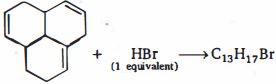
Which of the following bromides is the major product of the reaction shown below,  assuming that there are no carbocation rearrangement ?