MCQ
Which of the following cannot be polarised?
- ARadio waves
- B$\beta$ rays
- CInfrared rays
- D$\gamma$ rays
Explanation:
$\beta$ are stream of particles comprising of electrons moving with very high velocity, hence it cannot be polarized, while others can as they are electromagnetic waves.
Generate a complete, print-ready paper with questions like this in minutes — across 16+ boards, with answer keys.
In the nth orbit, the energy of an electron  for hydrogen atom. The energy required to take the electron from first orbit to second orbit will be
|
(a) 10.2 eV |
(b) 12.1 eV |
(c) 13.6 eV |
(d) 3.4 eV |
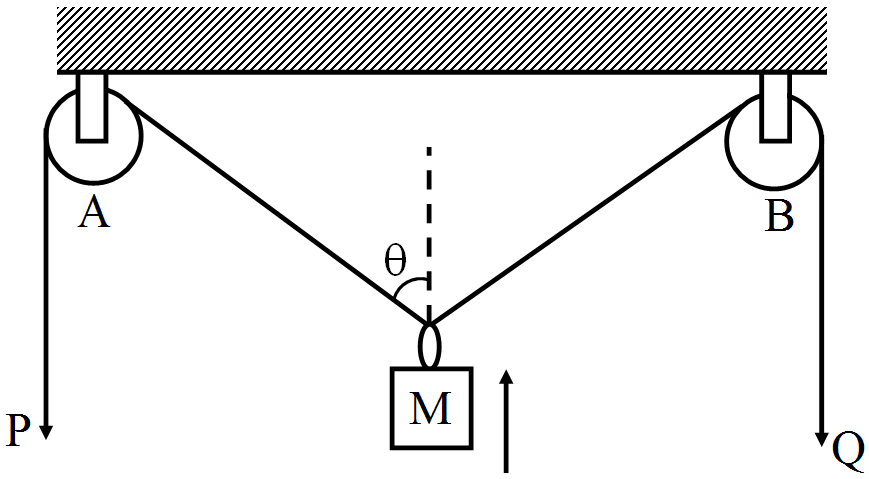
$2\text{u}\cos\theta$
$\frac{\text{u}}{\cos\theta}$
$\frac{\text{2u}}{\cos\theta}$
$\text{u}\cos\theta$
In an electric heater 4 amp current passes for 1 minute at potential difference of 250 volt, the power of heater and energy consumed will be respectively
|
(a) 1 kW, 60 kJ |
(b) 0.5 kW, 30 kJ |
(c) 10 kW, 600 kJ |
(d) None of these |
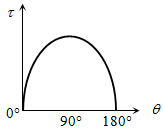
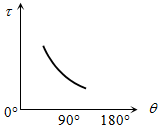
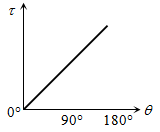
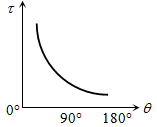
The (𝜏 – 𝜃) graph for a coil is
|
(a)
|
(b)
|
(c)
|
(d)
|
The sun radiates energy in all directions. The average radiations received on the earth surface from the sun is  .The average earth- sun distance is 1.5
  . The mass lost by the sun per day is (1 day = 86400 seconds)
|
(a) 4.4 |
(b) 7.6 |
(c) 3.8 |
(d) 3.8 |
The terminal potential difference of a cell when short-circuited is (E = E.M.F. of the cell)
|
(a) E |
(b) E/2 |
(c) Zero |
(d) E/3 |
The mutual characteristic of triode is
(a)

|
(a)
|
(c)

|
(d)

|