MCQ
Which of the following complex shows ionization isomerism
  • A
    $[Cr(NH_3)_6]Cl_3$
  • B
    $[Cr(en)_2 ]Cl_2$
  • C
    $[Cr(en)_3]Cl_3$
  • $[Co(NH_3)_5Br]SO_4$

Answer

Correct option: D.
$[Co(NH_3)_5Br]SO_4$
d

Need a full question paper?

Generate a complete, print-ready paper with questions like this in minutes — across 16+ boards, with answer keys.

Start Generating Free

Similar questions

$\begin{gathered}
  \begin{array}{*{20}{c}}
  {O\,\,\,\,\,\,\,\,\,\,\,\,\,\,\,\,\,\,\,\,\,\,\,\,\,\,\,\,\,\,\,\,\,\,\,\,\,\,\,\,\,\,\,\,\,\,\,\,\,\,\,\,\,\,\,\,\,\,\,\,\,\,\,\,\,\,\,\,\,\,\,\,\,\,} \\ 
  {||\,\,\,\,\,\,\,\,\,\,\,\,\,\,\,\,\,\,\,\,\,\,\,\,\,\,\,\,\,\,\,\,\,\,\,\,\,\,\,\,\,\,\,\,\,\,\,\,\,\,\,\,\,\,\,\,\,\,\,\,\,\,\,\,\,\,\,\,\,\,\,\,\,\,} \\ 
  {C{H_3} - {\text{  }}C - {\text{ }}O - H\xrightarrow{{NaH{{\mathop {CO}\limits^{14} }_3}}}\mathop {(A)}\limits_{(gas)} \xrightarrow[{(ii){H_3}{O^ \oplus }}]{{(i)PhMgBr}}(B)} 
\end{array} \hfill \\
  \begin{array}{*{20}{c}}
  {O\,\,\,\,\,\,\,\,\,\,\,\,\,\,\,\,\,\,\,\,\,\,\,\,\,\,\,\,\,\,\,\,\,\,\,\,\,\,\,\,\,\,\,\,\,\,\,\,\,\,\,\,\,\,\,\,\,\,\,\,\,\,\,\,\,\,\,\,\,\,\,\,\,\,} \\ 
  {||\,\,\,\,\,\,\,\,\,\,\,\,\,\,\,\,\,\,\,\,\,\,\,\,\,\,\,\,\,\,\,\,\,\,\,\,\,\,\,\,\,\,\,\,\,\,\,\,\,\,\,\,\,\,\,\,\,\,\,\,\,\,\,\,\,\,\,\,\,\,\,\,\,\,} \\ 
  {C{H_3} - S - O - H\xrightarrow{{NaH\mathop {C{O_3}}\limits^{14} }}\mathop {(C)}\limits_{(gas)} \xrightarrow[{(ii){H_3}{O^ \oplus }}]{{(i)PhMgBr}}(D)} \\ 
  {||\,\,\,\,\,\,\,\,\,\,\,\,\,\,\,\,\,\,\,\,\,\,\,\,\,\,\,\,\,\,\,\,\,\,\,\,\,\,\,\,\,\,\,\,\,\,\,\,\,\,\,\,\,\,\,\,\,\,\,\,\,\,\,\,\,\,\,\,\,\,\,\,\,\,\,} \\ 
  {O\,\,\,\,\,\,\,\,\,\,\,\,\,\,\,\,\,\,\,\,\,\,\,\,\,\,\,\,\,\,\,\,\,\,\,\,\,\,\,\,\,\,\,\,\,\,\,\,\,\,\,\,\,\,\,\,\,\,\,\,\,\,\,\,\,\,\,\,\,\,\,\,\,\,\,\,} 
\end{array} \hfill \\ 
\end{gathered}$

Product $(B)$ and $(D) $ in the above reaction are
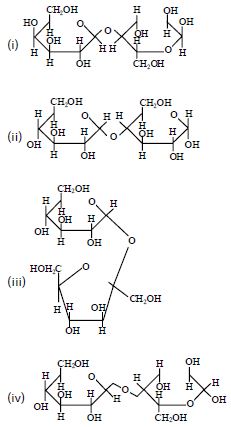
Which will have minimum Osmotic pressure?
Which of the following are non reducing sugars-
Vitamin A is known as:
The correct statement$(s)$ regarding, $(i)$ $HC1O$, $(ii)$ $HClO _2$, $(iii)$ $HClO _3$ and $(iv)$ $HClO _4$, is (are)

$(A)$ The number of $Cl = O$ bonds in $(ii)$ and $(iii)$ together is two

$(B)$ The number of lone pairs of electrons on $Cl$ in $(ii)$ and $(iii)$ together is three

$(C)$ The hybridization of $Cl$ in $(iv)$ is $sp ^3$

$(D)$ Amongst $(i)$ to $(iv)$, the strongest acid is $(i)$
The elements with atomic numbers $101$ and $104$ belong to, respectively
Cannizzaro reaction is not shown by
In the following members of transition elements, the lowest ionization energy is of
Knowing that the chemistry of lanthanoids $(Ln)$ isdominated by its $+3$ oxidation state, which of the following statements is incorrect ?
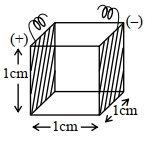
A conductivity cell with two electrodes (dark side) are half filled with infinitely dilute aqueous solution of a weak electrolyte. If volume is doubled by adding more water at constant temperature, the molar conductivity of the cell will -