MCQ
Which of the following compounds are optically active
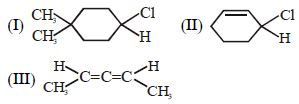
- A$(I)$ and $(III)$
- B$(I)$ and $(II)$
- ✓$(II)$ and $(III)$
- D$(I), (II)$ and $(III)$
Generate a complete, print-ready paper with questions like this in minutes — across 16+ boards, with answer keys.
$Cl_2(aq) + H_2S(aq) \to S(s) + 2H^+(aq) + 2Cl^-(aq)$
The rate equation for this reaction is rate $= k[Cl_2][H_2S]$ Which of these mechanisms is/are consistent with this rate equation ?
$A.\,C{l_2} + {H_2}S \to {H^ + } + C{l^ - } + C{l^ + } + H{S^- }$ (slow)
$C{l^ + } + H{S^ - } \to {H^ + } + C{l^ - } + {S}$ (fast)
$B.\, H_2S \Leftrightarrow H^+ + HS^-$ (fast equilibrium)
$Cl_2 + HS^-\to 2Cl^-+ H^+ + S$ (slow)

Kaushal's method : $\begin{array}{*{20}{c}}
{C{H_3} - CH - C{H_3}\xrightarrow{{KCl}}} \\
{|\,\,\,\,\,\,\,\,\,\,\,\,\,\,\,\,\,\,\,\,} \\
{OH\,\,\,\,\,\,\,\,\,\,\,\,\,\,\,\,\,\,}
\end{array}$
Preeti's method : $C{H_3} - CH = C{H_2}\xrightarrow{{C{l_2} + {H_2}O}}$
Raghav's method : $\begin{array}{*{20}{c}}
{C{H_3} - CH - C{H_3}\xrightarrow[{Pyridine}]{{SOC{l_2}}}} \\
{|\,\,\,\,\,\,\,\,\,\,\,\,\,\,\,\,\,\,\,\,\,\,\,\,\,\,\,} \\
{OH\,\,\,\,\,\,\,\,\,\,\,\,\,\,\,\,\,\,\,\,\,\,}
\end{array}$