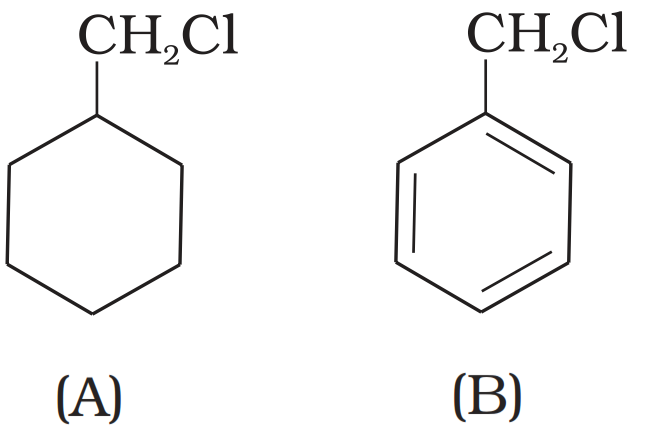
Which of the following compounds would undergo $S_N1$ reaction faster and why?
Download our app for free and get started
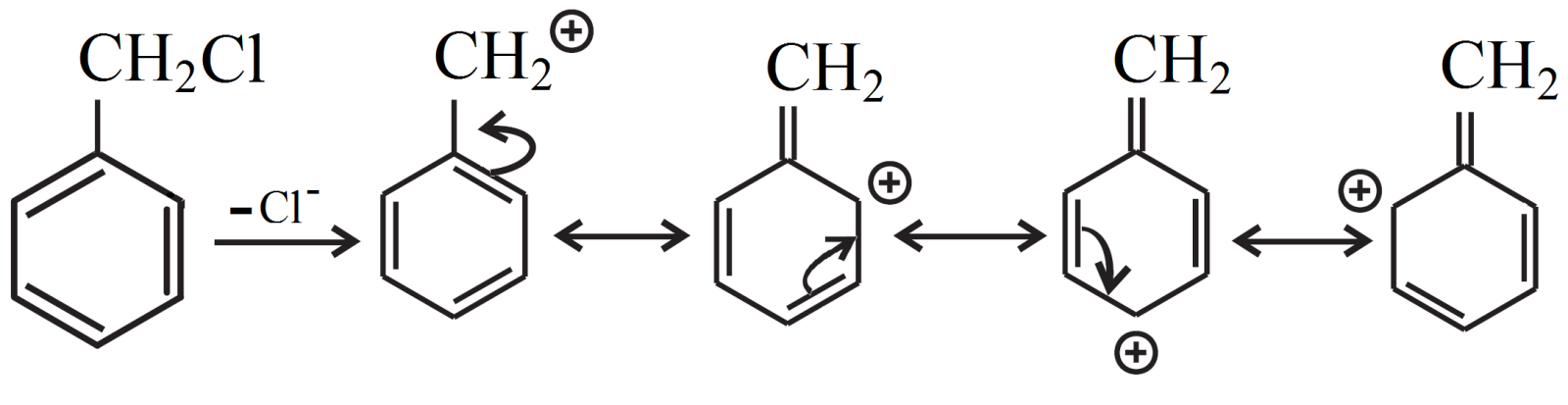
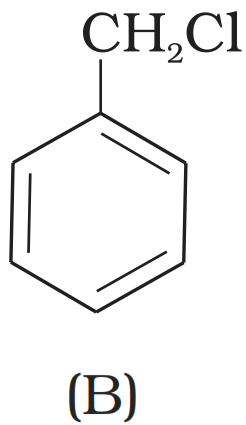 undergoes $S_N1$ reaction faster because the carbocation formed after the loss of $Cl$ is stabilized by resonance
 On the other hand, the carbocation formad during the reaction of $(A)$ is not resonance stabilized.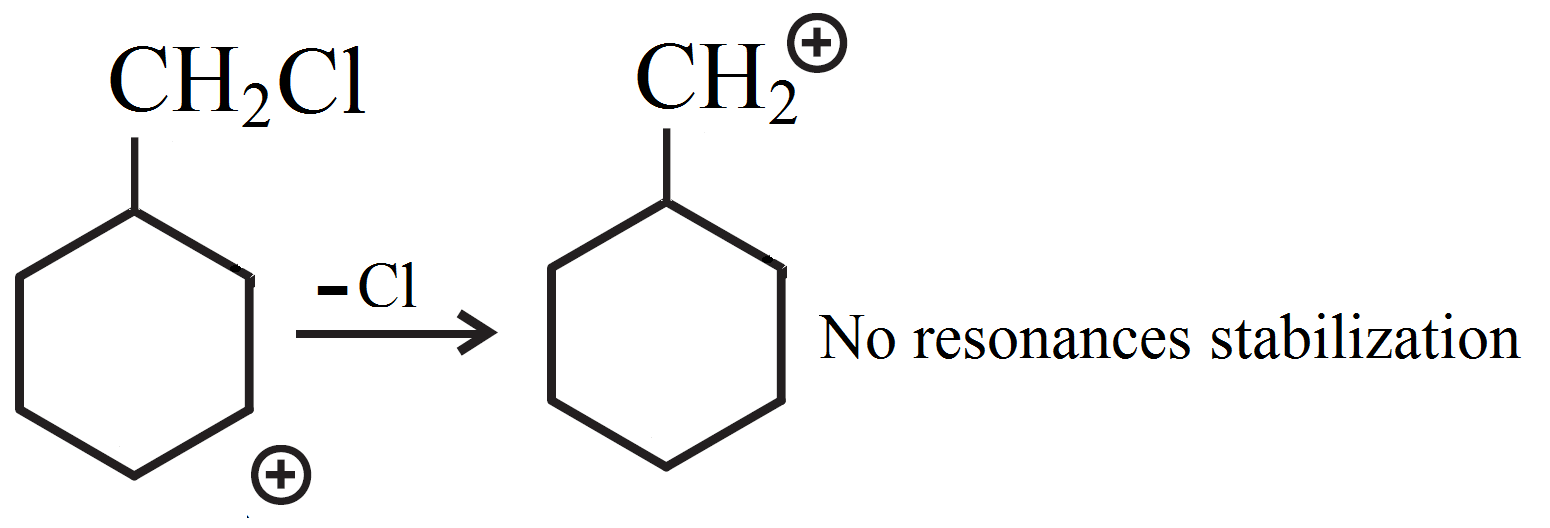

Download our appand get started for free
Experience the future of education. Simply download our apps or reach out to us for more information. Let's shape the future of learning together!No signup needed.*
Similar Questions
- 1Give the $\text{IUPAC}$ names of the following compound: $\ce{CH_3C(p-ClC_6H_4)_2CH(Br)CH_3}$View Solution
- 2Arrange the compounds of each set in order of reactivity towards $S_N2$ displacement: $1-$Bromo$-3-$methylbutane, $2-$Bromo$-2-$methylbutane, $3-$Bromo$-2-$methylbutane.View Solution
- 3View SolutionHow will you bring about the following conversion?
1-Chlorobutane to n-octane. - 4Give the $\ce{IUPAC}$ names of the following compound: $\ce{(CH_3)_3CCH=ClC_6H_4I-p}.$View Solution
- 5View SolutionWrite structures of the following compounds:
4-tert. Butyl-3-iodoheptane. - 6View SolutionAryl chlorides and bromides can be easily prepared by electrophilic substitution of arenes with chlorine and bromine respectively in the presence of Lewis acid catalysts. But why does preparation of aryl iodides requires presence of an oxidising agent?
- 7Write the $\ce{IUPAC}$ name of the following compound: $\ce{(CH_3)_3CCH_2Br}.$View Solution
- 8View SolutionOut of chlorobenzene and benzyl chloride, which one gets easily hydrolysed by aqueous NaOH and why?
- 9View Solution
 which is more reactive towards $\ce{S_N1}$ reaction and why?
 - 10Give the $\ce{IUPAC}$ names of the following compound: $\ce{CH_3CH(Cl)CH(Br)CH_3}$View Solution