MCQ
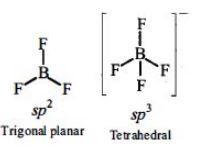
Which of the following conversions involves change in both shape and hybridisation?
  • A
    ${H_2}O\, \to \,{H_3}{O^ + }$
  • $B{F_3}\, \to \,BF_4^ - $
  • C
    $C{H_4}\, \to \,{C_2}{H_6}$
  • D
    $N{H_3}\, \to \,NH_4^ + $

Answer

Correct option: B.
$B{F_3}\, \to \,BF_4^ - $
b
$B{F_3}\, \to \,BF_4^ - $

Need a full question paper?

Generate a complete, print-ready paper with questions like this in minutes — across 16+ boards, with answer keys.

Start Generating Free

Similar questions

The compound $X\, (C_5H_8)$ reacts with ammonical $AgNO_3$ to give a white precipitate and reacts with excess of $KMnO_4$ to give the acid, $(CH_3)_2CH-COOH$, therefore $X$ is
Which of the following is not correct for ${N_2}O$
The solution from the following with highest depression in freezing point/lowest freezing point is
Assertion : Trans $-2-$ butene on reaction with $Br_2$ gives meso $-2, 3-$ dibromobutane.

Reason : The reaction involves syn-addition of bromine.

Given below are two statements :
Statement I : In the oxalic acid vs $\mathrm{KMnO}_{4}$ (in the presence of dil $\mathrm{H}_{2} \mathrm{SO}_{4}$ ) titration the solution needs to be heated initially to $60^{\circ} \mathrm{C}$, but no heating is required in Ferrous ammonium sulphate (FAS) vs $\mathrm{KMnO}_{4}$ titration (in the presence of dil $\mathrm{H}_{2} \mathrm{SO}_{4}$ )
Statement II : In oxalic acid vs $\mathrm{KMnO}_{4}$ titration, the initial formation of $\mathrm{MnSO}_{4}$ takes place at high temperature, which then acts as catalyst for further reaction. In the case of FAS vs $\mathrm{KMnO}_{4}$, heating oxidizes $\mathrm{Fe}^{2+}$ into $\mathrm{Fe}^{3-}$ by oxygen of air and error may be introduced in the experiment.
In the light of the above statements, choose the correct answer from the options given below :
$40 \,\,mg$ of pure sodium hydroxide is dissolved in $10$ litres of distilled water. The $pH$ of the solution is
Following order is not for : $HClO < HClO_2 < HClO_3 < HClO_4$
The main reaction during electrovalent bond formation is
In the formation of a molecule by an atom
Which of the following oxidation states are the most characteristic for lead and tin respectively ?