MCQ
Which of the following do not require medium for transmission
  • A
    Cathode ray
  • Electromagnetic wave
  • C
    Sound wave
  • D
    None of the above

Answer

Correct option: B.
Electromagnetic wave
b
(b) $EM$ waves do not requires medium for their propagation.

Need a full question paper?

Generate a complete, print-ready paper with questions like this in minutes — across 16+ boards, with answer keys.

Start Generating Free

Similar questions

An aeroplane moving horizontally with a speed of $720 \,km/h$ drops a food pocket, while flying at a height of $396.9\, m$. the time taken by a food pocket to reach the ground and its horizontal range is (Take $g = 9.8 m/sec^{2}$)
$Assertion :$ It is hotter over the top of a fire than at the same distance of the sides.

$Reason :$ Air surrounding the fire conducts more heat upwards.

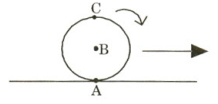
A sphere is rolling without slipping on a fixed horizontal plane surface. In the figure, $\mathrm{A}$ is the point of contact, $\mathrm{B}$ is the centre of the sphere and $\mathrm{C}$ is its topmost point. Then,

$(A)$ $\vec{V}_C-\vec{V}_A=2\left(\vec{V}_B-\vec{V}_C\right)$

$(B)$ $\vec{V}_C-\vec{V}_B=\vec{V}_B-\vec{V}_A$

$(C)$ $\left|\vec{V}_C-\vec{V}_A\right|=2\left|\vec{V}_B-\vec{V}_C\right|$

$(D)$ $\left|\vec{V}_C-\vec{V}_A\right|=4\left|\vec{V}_B\right|$
A binary star system consists of two stars one of which has double the mass of the other. The stars rotate about their common centre of mass :-
A body of mass $5\ kg$ undergoes a change in speed from $20$ to $0.20\ m/ s.$ The momentum of the body would:
Find the ratio of specific heat at constant pressure to the specific heat constant volume for $N{H_3}$
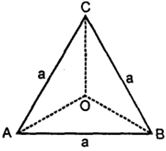
$ABC$ is an equilateral triangle. Length of each side is $a$ and centroid is point $O$. then $\overrightarrow{O A}+\overrightarrow{O B}+\overrightarrow{O C}=.......$
$Assertion :$ For the formation of stationary waves the medium must be bounded having definite boundaries.
$Reason :$ In the stationary wave, some particles of the medium remain permanently at rest.
A wire of length $L$ and radius $r$ is clamped rigidly at one end. When the other end of the wire is pulled by a force $f$, its length increases by $l$. Another wire of same material of length $2 L$ and radius $2 r$ is pulled by a force $2 f$. Then the increase in its length will be
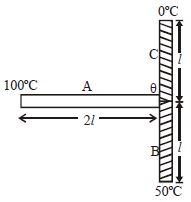
Three rods $A, B$ and $C$ of thermal conductivities $K, 2\,K$ and $4\,K$, cross-sectional  areas $A, 2\,A$ and $2\,A$ and lengths $2l, l$ and $l$ respectively are connected as shown  in the figure. If the ends of the rods are maintained at temperatures $100^o\,C, 50^o\,C$, and $0^o\,C$ respectively, then the temperature $\theta$ of the junction is ......... $^oC$