MCQ
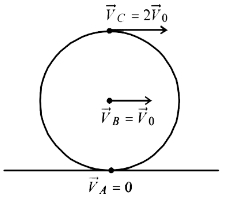
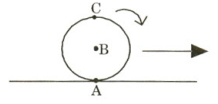
A sphere is rolling without slipping on a fixed horizontal plane surface. In the figure, $\mathrm{A}$ is the point of contact, $\mathrm{B}$ is the centre of the sphere and $\mathrm{C}$ is its topmost point. Then,

$(A)$ $\vec{V}_C-\vec{V}_A=2\left(\vec{V}_B-\vec{V}_C\right)$

$(B)$ $\vec{V}_C-\vec{V}_B=\vec{V}_B-\vec{V}_A$

$(C)$ $\left|\vec{V}_C-\vec{V}_A\right|=2\left|\vec{V}_B-\vec{V}_C\right|$

$(D)$ $\left|\vec{V}_C-\vec{V}_A\right|=4\left|\vec{V}_B\right|$
  • $(B,C)$
  • B
    $(B,D)$
  • C
    $(A,C)$
  • D
    $(A,D)$

Answer

Correct option: A.
$(B,C)$
a
If $\vec{V}_0$ is the velocity of centre of the sphere, then

$\vec{V}_C=2 \vec{V}_0, \vec{\rightarrow} B=\vec{V}_0 \text { and } \rightarrow A=0$

$\therefore \vec{V}_C-\vec{V}_B=2 \vec{V}_0-\vec{V}_0=\vec{V}_0$

$\vec{V}_B-\vec{V}_A=\vec{V}_0-\overrightarrow{0}=\vec{V}_0$

$\therefore \vec{V}_C-\vec{V}_B=\vec{V}_B-\vec{V}_A$

$(b)$ is the correct opton.

Now, $\left|\vec{V}_C-\vec{V}_A\right|=\left|2 \vec{V}_0-0\right|=\left|2 \vec{V}_0\right|=2\left|\vec{V}_0\right|$

and $\left|\vec{V}_C-\vec{V}_A\right|=2\left|\vec{V}_B-\vec{V}_C\right|$

$(c)$ is the correct option.

Need a full question paper?

Generate a complete, print-ready paper with questions like this in minutes — across 16+ boards, with answer keys.

Start Generating Free

Similar questions

$1 \,\,kg$ of a gas does $20\,\, kJ$ of work and receives $16 \,\,kJ$ of heat when it is expanded between two states. $A$ second kind of expansion can be found between the initial and final state which requires a heat input of $9\,\, kJ$. The work done by the gas in the second expansion is  ....... $kJ$
A cubical block of side $‘a’$ and density $‘\rho ’$ slides over a fixed inclined plane with constant velocity $‘v’$. There is a thin film of viscous fluid of thickness $‘t’$ between the plane and the block. Then the coefficient of viscosity of the thin film will be:
In the Young’s experiment, If length of wire and radius both are doubled then the value of $Y$ will become
A body of mass m is attached to a spring and oscillates. If the force constant of the spring is K, then the period of oscillation of the body will be:
The internal energy change in a system that has absorbed $2 \;k cal$ of heat and done $500 \;J $ of work is ...... $J$
Which of the following expression does not represent simple harmonic motion?
A wire suspended vertically from one of its ends is stretched by attaching a weight of $200\ N$ to the lower end. The weight stretches the wire by $1\ mm$. Then the elastic energy stored in the wire ......... $J$
The escape velocity of a body on an imaginary planet which is thrice the radius of the earth and double the mass of the earth is $({v_e}$ is the escape velocity of earth)
Two identical pendulums oscillate with a constant phase difference $\frac{\pi}{4}$ and same amplitude. If the maximum velocity of one is $v$, the maximum velocity of the other will be ........
Water rise in a capillary upto an extension height such that upward force of surface tension balances the force of $75 \times 10^{-4}\,N$ due to weight of water. If surface tension of water is $12 \times 10^{-2}\,N/m$. The internal circumference of the capillary must be