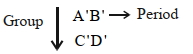
- A

- B

- ✓$\begin{array}{*{20}{c}}
{C{H_3}\,\,\,\,\,\,\,\,\,\,\,\,}\\
{\,\,\,|\,\,\,\,\,\,\,\,\,\,\,\,\,\,\,\,\,\,\,}\\
{C{H_3} - C - CH = C{H_2}}\\
{\,\,\,|\,\,\,\,\,\,\,\,\,\,\,\,\,\,\,\,\,\,\,\,}\\
{C{H_3}\,\,\,\,\,\,\,\,\,\,\,\,\,}
\end{array}$ - D



Generate a complete, print-ready paper with questions like this in minutes — across 16+ boards, with answer keys.
Which of the following is/are true about $\mathrm{A}^{\prime}, \mathrm{B}^{\prime}, \mathrm{C}^{\prime}$ and $\mathrm{D}^{\prime}$ ?
$A$. Order of atomic radii: $\mathrm{B}^{\prime}<\mathrm{A}^{\prime}<\mathrm{D}^{\prime}<\mathrm{C}^{\prime}$
$B$. Order of metallic character: $\mathrm{B}^{\prime}<\mathrm{A}^{\prime}<\mathrm{D}^{\prime}<\mathrm{C}^{\prime}$
$C$. Size of the element : $\mathrm{D}^{\prime}<\mathrm{C}^{\prime}<\mathrm{B}^{\prime}<\mathrm{A}^{\prime}$
$D$. Order of ionic radii : $\mathrm{B}^{\prime+}<\mathrm{A}^{\prime+}<\mathrm{D}^{\prime+}<\mathrm{C}^{\prime+}$
Choose the correct answer from the options given below :
$(i)\, H_3PO_4+H_2O \rightarrow H_3O^+ + H_2PO_4^-$
$(ii)\, H_2PO 4^- + H_2O \rightarrow HPO_4^{2-} + H_3O^+$
$(iii)\, H_2PO_4^-+ OH^- \rightarrow H_3PO_4 + O^{2-}$
In which of the above does $H_2PO_4^-$ act as an acid ?