MCQ
Which of the following does not contain copper
  • A
    Brass
  • B
    Bronze
  • C
    Azurite
  • Calamine

Answer

Correct option: D.
Calamine
d

Need a full question paper?

Generate a complete, print-ready paper with questions like this in minutes — across 16+ boards, with answer keys.

Start Generating Free

Similar questions

The total number of dirpotic acids among the following is

$\mathrm{H}_3 \mathrm{PO}_4 \ \ \ \ \mathrm{H}_2 \mathrm{SO}_4 \ \ \ \ \mathrm{H}_3 \mathrm{PO}_3 \ \ \ \ \mathrm{H}_2 \mathrm{CO}_3 \ \ \ \ \mathrm{H}_2 \mathrm{~S}_2 \mathrm{O}_7 $

$ \mathrm{H}_3 \mathrm{BO}_3 \ \ \ \ \mathrm{H}_3 \mathrm{PO}_2 \ \ \ \ \mathrm{H}_2 \mathrm{CrO}_4 \ \ \ \ \mathrm{H}_2 \mathrm{SO}_3 $
$CH _3 CHO$ and $C _6 H _5 CH _2 CHO$ can be distinguished chemically by :
Which halide will be least reactive in respect to hydrolysis
The cell constant of a given cell is $0.47\,cm^{-1}$. The resistance of a solution placed in this cell is measured to be $31.6\,ohm$. The conductivity of the solution (in $S\,cm^{-1}$ where $S$ has usual meaning) is
Standard reduction electrode potentials of three metals $ A, B$  and $ C$ are respectively $ + 0.5\,V, \,-\, 3.0\,V$  and $-\,1.2\, V$. The reducing powers of these metals are
Two solutions of $X$ and $Y$ electrolytes are taken in two beakers and diluted by adding  $500\, mL$ of water. $\Lambda_m$ of $X$ increases by $1.5$ times while that of $Y$ increases by $20$  times, what could be the electrolytes $X$ and $Y$ ?
Diazo-coupling is useful to prepare some
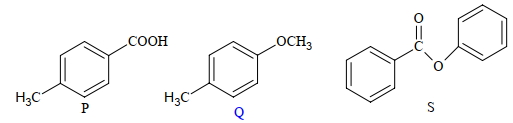
The compounds $\mathrm{P}, \mathrm{Q}$ and $\mathrm{S}$ $Image$ were separately subjected to nitration using $\mathrm{HNO}_3 / \mathrm{H}_2 \mathrm{SO}_4$ mixture. The major product formed in each case respectively, is
Which one has the highest boiling point ?
$5$ milli-moles of a solid $A$ was dissolved in $5$ moles of $H_2O$ . On adding to the solvent, $A$  starts polymerising into another insoluble solid following zero order kinetics. On adding $6$ milli-moles of another solid solute $C$ (after $20$ minute) the polymerisation completely stops. The  nsoluble solid polymer is removed and the resulting solution was cooled to a temperature less  than $- 0.186\,^oC$ (melting point of solution) to cause solidification of some liquid water. Calculate the value of $'X'$ if rate constant for polymerisation reaction is represented as $10^{-X}\,moles/minute$ . $[K_f(H_2O) = 1.86\, K\,- Kg\,mole^{-1}]$