MCQ
Which of the following electronic configuration represent representative elements
- A$ns^{1,2}\,\,np^{1-5}$
- ✓$ns^{1,2}\,\,np^{0-5}$
- C$ns^{1,2}\,\,np^{0-6}$
- D$ns^{1,2}\,\,np^{1-6}$
Generate a complete, print-ready paper with questions like this in minutes — across 16+ boards, with answer keys.
${A_2}\left( g \right) + {B_2}\left( g \right) \rightleftharpoons 2AB\left( g \right)$
${\Delta _r}{G^o}$ and ${\Delta _r}{S^o}$ are $20\, kJ/mol$ and $-20\, JK^{-1}\, mol^{-1}$ respectively at $200\, K$.
If ${\Delta _r}{C_P}$ is $20\, JK^{-1}\, mol^{-1}$ then ${\Delta _r}{H^o}$ at $400\, K$ is.....$kJ/mol$
Which one of the following options represents identical molecules?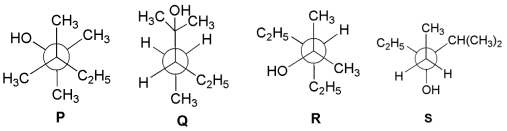
$1.$ The compounds $\mathrm{P}$ and $\mathrm{Q}$ respectively are
MCQ $Image$
$2.$ The compound $R$ is
MCQ $Image$
$3.$ The compound $\mathrm{S}$ is
MCQ $Image$
Give the answer question $1,2$ and $3.$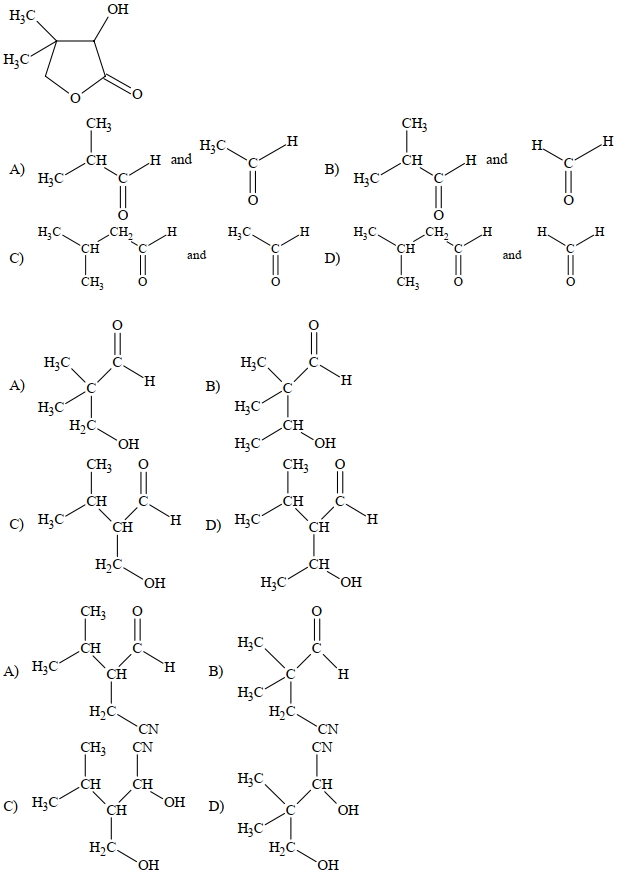
| Column $-I$ | Column $-II$ |
| (Atomic number) | (Position of element in Periodic table) |
| $(A)$ $Z = 37$ | $(P)$ $p-$ block |
| $(B)$ $Z = 42$ | $(Q)$ $f-$ block |
| $(C)$ $Z = 34$ | $(R)$ $d-$ block |
| $(D)$ $Z = 92$ | $(S)$ $s-$ block |
