MCQ
Which of the following equations represents a travelling wave ?
  • $y=A \sin (15 x-2 t)$
  • B
    $y=\operatorname{Ae}^{-x^{2}}(v t+\theta)$
  • C
    $y=A e^{x} \cos (\omega t-\theta)$
  • D
    $y=A \sin x \cos \omega t$

Answer

Correct option: A.
$y=A \sin (15 x-2 t)$
a
$y = F ( x , t )$

For travelling wave $y$ should be linear function of $x$ and $t$ and they must exist as $(x \pm v t)$

$y = A \sin (15 x-2 t) \rightarrow$ linear function in $x$ and $t.$

Need a full question paper?

Generate a complete, print-ready paper with questions like this in minutes — across 16+ boards, with answer keys.
Start Generating Free

Similar questions

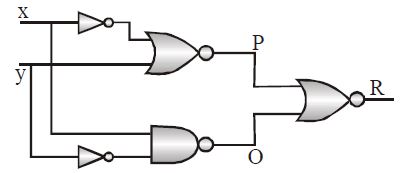
Figure gives a system of logic gates. From the study of truth table it can be found that to produce a high output $(1)$ at $R$, we must have
A satellite is orbiting the earth in a circular orbit of radius $r.$ Its
To obtain electrons as majority charge carriers in a semiconductor, the impurity mixed is
The depletion layer in silicon diode is $11\mu m$ wide and the knee potential is $0.6\, V$, then the electric field in the depletion layer will be
Add vectors $\overrightarrow{ A }, \overrightarrow{ B }$ and $\overrightarrow{ C }$ each having magnitude of $50$ unit and inclined to the $X$-axis at angles $45^{\circ}, 135^{\circ}$ and $315^{\circ}$ respectively.
$A$ rectangular coil of single turn, having area $A$, rotates in a uniform magnetic field $B$ an angular velocity $\omega$ about an axis perpendicular to the field. If initially the plane of coil is perpendicular to the field, then the average induced $e.m.f.$ when it has rotated through $90^o$ is
Indium impurity in germanium makes
An object is placed infront of a convex mirror at a distance of $50\, cm$. A plane mirror is introduced covering the lower half of the convex mirror. If the distance between the object and plane mirror is $30\, cm$, it is found that there is no parallax between the images formed by two mirrors. magnification of convex mirror will be......
The isotope ${ }_5^{12} \mathrm{~B}$ having a mass $12.014 \mathrm{u}$ undergoes $\beta$-decay to ${ }_6^{12} \mathrm{C} .{ }_6^{12 .}$ has an excited state of the nucleus $\left({ }_6^{12} \mathrm{C}^*\right)$ at $4.041 \mathrm{MeV}$ above its ground state. If ${ }_5^{12} \mathrm{~F}$ decays to ${ }_6^{12} \mathrm{C}^*$, the maximum kinetic energy of the $\beta$-particle in units of $\mathrm{MeV}$ is ( $1 \mathrm{u}=931.5 \mathrm{MeV} / c^2$, where $c$ is the speed of light in vacuum).
A long straight wire along the $z$-axis carries a current $I$ in the negative $z$ direction. The magnetic vector field $\mathop B\limits^ \to $ at a point having coordinates $(x, y)$ in the $z = 0$ plane is