MCQ
Which of the following exhibits only $+ 3$ oxidation state ?
- A$U$
- B$Th$
- ✓$Ac$
- D$Pa$
Configuration $=[\mathrm{Rn}] 6 \mathrm{d}^{17} \mathrm{s}^{2}$
stable oxidation state $\Rightarrow+3$
$\mathrm{Th}=+3,\,+4$
$\mathrm{Pa}=+3,\,+4,\,+5$
$U=+3,\,+4,\,+5,\,+6$
Generate a complete, print-ready paper with questions like this in minutes — across 16+ boards, with answer keys.
($1$) Which of the following options has correct combination considering $List-I$ and $List-II$?
$(1) (III), (S), (R)$ $(2) (IV), (Q), (R)$ $(3) (III), (T), (U)$ $(4) (IV), (Q), (U)$
($2$) Which of the following options has correct combination considering $List-I$ and $List-II$?
$(1) (I), (Q), (T), (U)$ $(2) (II), (P), (S), (U)$ $(3) (II), (P), (S), (T)$ $(4) (I), (S), (Q), (R)$
Give the answer quetion ($1$) and ($2$)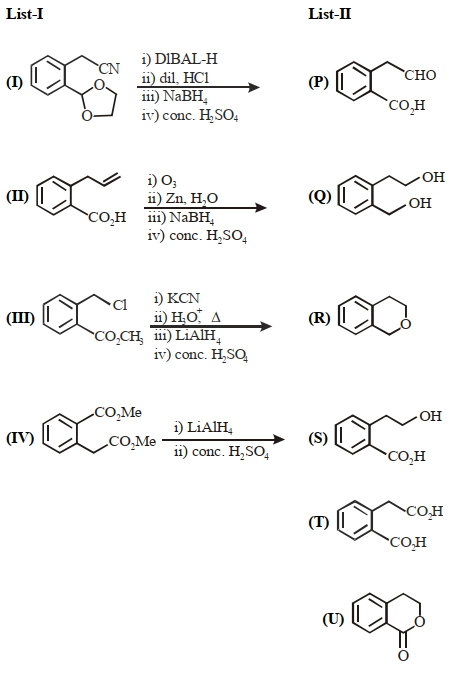
What is structure of $(A)$ ?
The original compound showed these properties also :
$\mathop {{C_9}{H_{12}}{O_2}}\limits_{(A)} \,\xrightarrow{{Na}}\,{H_2}$ liberated
$\mathop {{C_9}{H_{12}}{O_2}}\limits_{(A)} \,\xrightarrow{{Br}}$ no rapid reaction
$\mathop {{C_9}{H_{12}}{O_2}}\limits_{(A)} \,\xrightarrow[{cool}]{{Cr{O_3}\,/\,{H^ + }}}{C_9}{H_8}{O_3}$
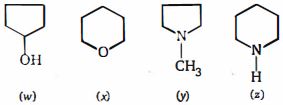
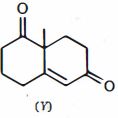
$B + {H_2}O \to C + HCl$
Compound $(A),\,(B)$ and $(C)$ will be respectively