MCQ
Which of the following formulae is wrong
  • A
    ${C_V} = \frac{R}{{\gamma - 1}}$
  • B
    ${C_P} = \frac{{\gamma \,R}}{{\gamma - 1}}$
  • C
    ${C_p}/{C_v} = \gamma $
  • ${C_P} - {C_V} = 2R$

Answer

Correct option: D.
${C_P} - {C_V} = 2R$
d
The difference between $C_P$ and $C_V$ is $R$, not $2R$.

Need a full question paper?

Generate a complete, print-ready paper with questions like this in minutes — across 16+ boards, with answer keys.

Start Generating Free

Similar questions

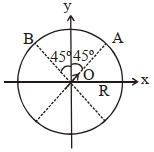
An electric dipole with dipole moment $\frac{p_0}{\sqrt{2}}(\hat{i}+\hat{j})$ is held fixed at the origin $O$ in the presence of an uniform electric field of magnitude $E_0$. If the potential is constant on a circle of radius $R$ centered at the origin as shown in figure, then the correct statement($s$) is/are:

( $\varepsilon_0$ is permittivity of free space, $R \gg$ dipole size)

$(1)$ $R =\left(\frac{ p _0}{4 \pi \varepsilon_0 E _0}\right)^{1 / 3}$

$(2)$ The magnitude of total electric field on any two points of the circle will be same

$(3)$ Total electric field at point $A$ is $\vec{E}_A=\sqrt{2} E_0(\hat{i}+\hat{j})$

$(4)$ Total electric field at point $B$ is $\vec{E}_B=0$
If the length of a pendulum is made $9$ times and mass of the bob is made $4$ times then the value of time period becomes
The contrast in the fringes in interference pattern depends on
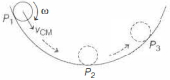
A small ring is rolling without slipping on the circumference of a large bowl as shown below in the figure. The ring is moving down at $P_{1}$, comes down to the lower most point $P_{2}$ and is climbing up at $P_{3}$. Let $v _{ CM }$ denote the velocity of the centre of mass of the ring. Choose the correct statement regarding the frictional force on the ring.edClass-Data Entry
A student measures the focal length of a convex lens by putting an object pin at a distance '$u$' from the lens and measuring the distance '$v$' of the image pin. The graph between '$u$' and '$v$' plotted by the student should look like
The force on a hemisphere of radius $1\, cm$ if a parallel beam of monochromatic light of wavelength $500\, nm$. falls on it with an intensity of $0.5\, W/cm^2$, striking the curved surface in a direction which is perpendicular to the flat face of the hemisphere is (assume the collisions to be perfectly inelastic)
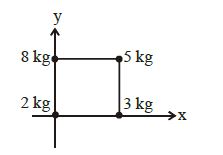
Four bodies of masses $2, 3, 5$ and $8\,kg$ are placed at the four corners of a square of side $2\,m$ as shown. The position of $CM$ will be
Dimensions of $\frac{1}{{{\mu _0}{\varepsilon _0}}}$, where symbols have their usual meaning, are 
A healthy adult of height $1.7 \,m$ has an average blood pressure $( BP )$ of $100 \,mm$ of $Hg$. The heart is typically at a height of $1.3 \,m$ from the foot. Take, the density of blood to be $10^3 \,kg / m ^3$ and note that $100 \,mm$ of $Hg$ is equivalent to $13.3 \,kPa$ (kilo pascals). The ratio of $BP$ in the foot region to that in the head region is close to
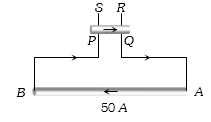
A long wire $AB$ is placed on a table. Another wire $PQ$ of mass $1.0\, g$ and length $50\, cm$ is set to slide on two rails $PS$ and $QR$. A current of $50\,A$ is passed through the wires. At what distance above $AB$, will the wire $PQ$ be in equilibrium.....$mm$