MCQ
Which of the following halogens is solid at room temperature
  • A
    Chlorine
  • Iodine
  • C
    Bromine
  • D
    Fluorine

Answer

Correct option: B.
Iodine
b
(b) As we go down the group Vander Waal forces increases. Hence, physical state changes.

$\,\underbrace {{F_2}\,\,\,\,\,C{l_{_2}}}_{gases}\,\,\,\,\,\,\underbrace {B{r_2}}_{liquid}\,\,\,\,\,\underbrace {{I_2}}_{solid}$

Need a full question paper?

Generate a complete, print-ready paper with questions like this in minutes — across 16+ boards, with answer keys.
Start Generating Free

Similar questions

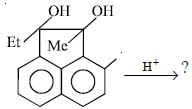
Product of the following equation is :
For ionising an excited hydrogen atom, the required in $eV$ will be -
$Fe(OH)_2$ is precipitated from $Fe(II)$ solutions as a while solid but turns dark green and then brown due to the formation of
From Kirchhoff's equation which factor affects the heat of reaction
$\mathrm{NaCl}$ reacts with conc. $\mathrm{H}_2 \mathrm{SO}_4$ and $\mathrm{K}_2 \mathrm{Cr}_2 \mathrm{O}_7$ to give reddish fumes $(B),$ which react with $\mathrm{NaOH}$ to give yellow solution $(C)$. $(B)$ and $(C)$ respectively are ;
Nucleic acid is a polymer of
The standard potential of a $Co^{+2}| Co$  electrode is $-0.28\,V$  and the standard potential of the cell  $Pt|Ti^{2+} (aq),\, Ti^{3+} (aq)||Co^{2+} (aq)|Co(s)$ is $0.09\,\,V$.  What is the standard oxidation potential of the $Ti_{{\text{(aq}}.)}^{2 + }\,\,|\,\,Ti_{{\text{(aq}}.)}^{3 + }$ electrode ? ............. $\mathrm{V}$
Which of the statements about "Denaturation" given below are correct ?

$(A)$ Denaturation of proteins causes loss of secondary and tertiary structures of the protein

$(B)$ Denturation leads to the conversion of double strand of $DNA$ into single strand

$(C)$ Denaturation affects primary structure which gets distorted

Which of the following oxides will not give $O{H^ - }$ in aqueous solution
One mole of an ideal gas is allowed to expand reversibly and adiabatically from a  temperature of $27\,^oC$. If the work done during the process is $3\, kJ$, then final  temperature of  the gas is $(C_v = 20\, J/K)$ .....$K$