MCQ
Which of the following has zero valency
  • A
    Sodium
  • B
    Beryllium
  • C
    Aluminium
  • Krypton

Answer

Correct option: D.
Krypton
d
Noble Gases have zero valencies. Among the given options, only krypton is a noble gas.

Need a full question paper?

Generate a complete, print-ready paper with questions like this in minutes — across 16+ boards, with answer keys.

Start Generating Free

Similar questions

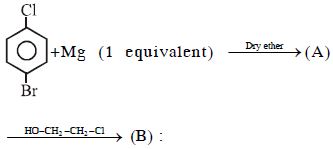
$B$ is?
$298 \mathrm{~K}$. It could be increased by :
(image) $\xrightarrow[{(2)\,{H_2}O/Zn}]{{(1)\,{O_3}}}\mathop X\limits_{\left( {{C_2}{H_4}O} \right)}  + \mathop Y\limits_{\left( {{C_3}{H_6}O} \right)} $ 

$X\xrightarrow[{\left( 2 \right)\,{H_2}O}]{{\left( 1 \right)\,LiAl{H_4}}}P$

$Y\xrightarrow[{\left( 2 \right)\,{H_2}O}]{{\left( 1 \right)\,LiAl{H_4}}}Q$

Incorrect statement for $X, Y, P$ and $Q$ is

Which of following compound will rotate the plane polarized light at room temperature?
$\left( 1 \right)\,{N_2}\left( g \right) + 3{H_2}\left( g \right) \rightleftharpoons 2N{H_3}\left( g \right)\,,\,{K_1}$

$\left( 2 \right)\,{N_2}\left( g \right) + {O_2}\left( g \right) \rightleftharpoons 2NO\left( g \right)\,,\,{K_2}$

$\left( 3 \right)\,{H_2}\left( g \right) + \frac{1}{2}{O_2}\left( g \right) \rightleftharpoons {H_2}O\left( g \right)\,,\,{K_3}$

The equation for the equilibrium constart of the reaction

$2N{H_3}\left( g \right) + \frac{5}{2}{O_2}\left( g \right) \rightleftharpoons 2NO\left( g \right) + 3{H_2}O\left( g \right)$

$(K_4)$ in terms of $K_1 , K_2$ , and $K_3$ is

The correct sequence of ligands in the order of decreasing field strength is:
Iron is protected by coating it with a thin layer of
Assertion : Benzene diazonium chloride does not give test for nitrogen.
Reason : Loss of $N_2$ gas takes place during heating
Two elements whose electronegativities are $1.2$ and $3.0$ the bond formed between them would be
${E^o}_{H{g^{2 + }}|Hg_2^{2 + }} = 0.9\, V$ , ${E^o}_{Hg_2^{2 + }|Hg} = 0.8\,V$ The value of ${\Delta _r}{G^o}$ at $25\,^oC$ is .............. $\mathrm{kJ/mol}$

$Hg_2^{2 + } \to \,H{g^{2 + }}+ Hg\left( l \right)$