MCQ
Which of the following have zero average value in a plane electromagnetic wave?
- AElectric field.
- BMagnetic field.
- CElectric energy.
- DMagnetic energy.
Explanation:
In a plane electromagnetic wave, the electric and the magnetic fields oscillate sinusoidally. For an electromagnetic wave propagating in the z-direction, the electric and magnetic fields are given by,
$\text{E}_\text{x}=\text{E}_0\sin(\text{kz}-\omega\text{t})$
$\text{B}_\text{y}=\text{B}_0\sin(\text{kz}-\omega\text{t})$
These are sinusoidal functions. Therefore, for a fixed value of z. the average value of the electric and magnetic fields are zero.
Generate a complete, print-ready paper with questions like this in minutes — across 16+ boards, with answer keys.
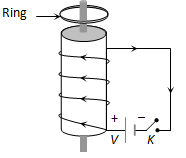
A conducting ring is placed around the core of an electromagnet as shown in fig. When key K is pressed, the ring
|
(a) Remain stationary |
|
(b) Is attracted towards the electromagnet |
|
(c) Jumps out of the core |
|
(d) None of the above |
Assertion : The colour of the green flower seen through red glass appears to be dark.
Reason : Red glass transmits only red light.
|
(a) If both assertion and reason are true and the reason is the correct explanation of the assertion. |
|
(b) If both assertion and reason are true but reason is not the correct explanation of the assertion. |
|
(c) If assertion is true but reason is false. |
|
(d) If the assertion and reason both are false. |
In Fresnel diffraction, if the distance between the disc and the screen is decreased, the intensity of central bright spot will
|
(a) Increase |
(b) Decrease |
(c) Remain constant |
(d) None of these |
The minimum energy required to remove an electron is called
|
(a) Stopping potential |
(b) Kinetic energy |
(c) Work function |
(d) None of these |