MCQ
Which of the following hydrocarbons cannot be obtained by Sabatier and Senderen's reaction
- ✓$C{H_4}$
- B${C_2}{H_6}$
- C${C_3}{H_8}$
- DAll
$C{H_2} = C{H_2} + {H_2} \xrightarrow{Ni}C{H_3} - C{H_3}$
$CH \equiv CH + 2{H_2} \xrightarrow{Ni} C{H_3} - C{H_3}$
Generate a complete, print-ready paper with questions like this in minutes — across 16+ boards, with answer keys.
(IMAGE)
$[A]$ ( $M$ and $O)$ and ( $N$ and $P$ ) are two pairs of diastereomers
$[B]$ Bromination proceeds through trans-addition in both the reactions
$[C]$ $O$ and $P$ are identical molecules
$[D]$ (M and $O)$ and ( $N$ and $P)$ are two pairs of enantiomers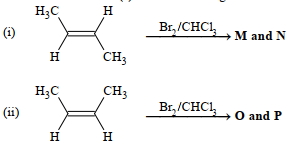
$\mathrm{Fe}_2 \mathrm{O}_{3(\mathrm{~s})}+3 \mathrm{CO}_{(\mathrm{g})} \rightleftharpoons \mathrm{Fe}_{(1)}+3 \mathrm{CO}_{2(\mathrm{~g})}$
Using the Le-chatelier's principle, predict which one of the following will not disturb the equilibrium.

$(i)$ Atomic radius $(ii)$ Ionisation energy $(iii)$ Nuclear charge