MCQ
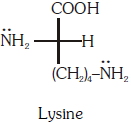
Which of the following is a basic amino acid :
  • Lysine
  • B
    Serine
  • C
    Alanine
  • D
    Tyrosine

Answer

Correct option: A.
Lysine
a
Since it contains more number of $- NH _{2}$ groups as compared to $- COOH$ groups hence it is basic amino acid.

Need a full question paper?

Generate a complete, print-ready paper with questions like this in minutes — across 16+ boards, with answer keys.

Start Generating Free

Similar questions

$2.7 \mathrm{Kg}$ of each of water and acetic acid are mixed, The freezing point of the solution will be $-\mathrm{x}^{\circ} \mathrm{C}$. Consider the acetic acid does not dimerise in water, nor dissociates in water $\mathrm{x}=$ . . . . . . . (nearest integer)

[Given : Molar mass of water $=18 \mathrm{~g} \mathrm{~mol}^{-1}$, acetic acid $=60 \mathrm{~g} \mathrm{~mol}^{-1}$ ]

${ }^{\mathrm{K}_{\mathrm{f}}} \mathrm{H}_2 \mathrm{O}: 1.86 \mathrm{~K} \mathrm{~kg} \mathrm{~mol}^{-1}$

$\mathrm{K}_{\mathrm{r}}$ acetic acid : $3.90 \mathrm{~K} \mathrm{~kg} \mathrm{~mol}^{-1}$

freezing point: $\mathrm{H}_2 \mathrm{O}=273 \mathrm{~K}$, acetic acid $=290 \mathrm{~K}$ ]

$A + 2B \to C + D$. If $ - \frac{{d[A]}}{{dt}} = 5 \times {10^{ - 4}}\,mol\,{l^{ - 1}}{s^{ - 1}}$1, then $ - \frac{{d[B]}}{{dt}}$ is
Consider the following relations for $emf$ of an electrochemical cell

$(i)\, EMF$ of cell = (Oxidation potential of anode) $-$ (Reduction potential of cathode)

$(ii)\,EMF$ of cell = (Oxidation potential of anode) $+$ (Reduction potential of cathode)

$(iii)\,EMF$ of cell = (Reductional potential of anode) $+$ (Reduction potential of cathode)

$(iv)\,EMF$ of cell = (Oxidation potential of anode) $-$ (Oxidation potential of cathode)

Which of the above relations are correct?
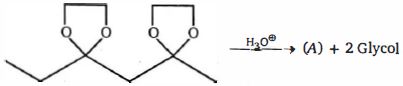
Product $(A)$ of the reaction will be
Iron may be rendered passive by treatment with a concentrated solution of
The correct name for the complex ion $[CoCl(ONO)(en)_2]^+$ is
In electrolysis of a fused salt, the weight of the deposit on an electrode will not depend on
Which of the following compounds will most readily be dehydrated to give alkene under acidic condition?
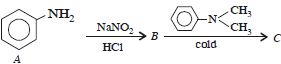
In a reaction of aniline a coloured product $C$ was obtained.

The structure of $C$ would be

A biological catalyst is essentially