MCQ
Which of the following is a correct statement
  • Beta rays are same as cathode rays
  • B
    Gamma rays are high energy neutrons
  • C
    Alpha particles are singly ionized helium atoms
  • D
    Protons and neutrons have exactly the same mass

Answer

Correct option: A.
Beta rays are same as cathode rays
a
(a) Both the $\beta$- rays and the cathode rays are made up of electrons. $\gamma$- rays are $EM$ waves,

$\alpha$- particles are doubly ionized helium atoms and protons and neutrons have approximately the same mass.

Need a full question paper?

Generate a complete, print-ready paper with questions like this in minutes — across 16+ boards, with answer keys.
Start Generating Free

Similar questions

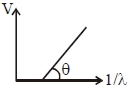
In a photoelectric effect experiment, the graph of stopping potential $V$ versus reciprocal of wavelength obtained is shown in the figure. As the intensity of incident radiation is increased
In a regular polygon of $n$ sides, each corner is at a distance $r$ from the centre. Identical charges are placed at $(n - 1)$ corners. At the centre, the intensity is $E$ and the potential is $V$. The ratio $V/E$ has magnitude.
If the energy released in the fission of one nucleus is $200\, MeV$. Then the number of nuclei required per second in a power plant of $16\, kW$ will be
The refractive index of water is $1.33.$ What will be the speed of light in water
Electric potential at any point is $V = -5x + 3y + \sqrt {15} z$, then the magnitude of the electric field is
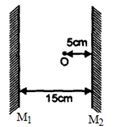
Two plane mirrors are parallel to each other and an object $O$ is placed between them. Then the distance of the first three images from the mirror $M_2$ ​ will be (in $cm$)
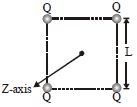
Four point $+ve$ charges of same magnitude $(Q)$ are placed at four corners of a rigid square frame as shown in figure. The plane of the frame is perpendicular to $Z-$ axis. If a $ -ve$ point charge is placed at a distance $z$ away from centre along axis $(z << L )$ then
For continuous $X-$ rays produced wavelength is
A plane electromagnetic wave of frequency $25 \;MHz$ travels in free space along the $x$ -direction. At a particular point in space and time, $E = 6.3\,\hat j\;\,V/m$. What is $B$ at this point? 
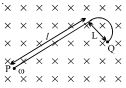
When a $‘J’$ shaped conducting rod is rotating in its own plane with constant angular velocity $w$, about one of its end $P$, in a uniform magnetic field $\vec B\,$ directed normally into the plane of paper) then magnitude of emf induced across it will be