MCQ
Which of the following is a polar compound
  • $HF$
  • B
    $HCl$
  • C
    $HN{O_3}$
  • D
    ${H_2}S{O_4}$

Answer

Correct option: A.
$HF$
(a) We know that greater the difference in electronegativity of two atoms forming a covalent bond. More is its polar nature.

In $HF$ there is a much difference in the electronegatives of hydrogen and flourine. Therefore $(HF)$ is a polar compound.

Need a full question paper?

Generate a complete, print-ready paper with questions like this in minutes — across 16+ boards, with answer keys.

Start Generating Free

Similar questions

A mixture of potassium chlorate, oxalic acid and sulphuric acid is heated. During the reaction which element undergoes maximum change in the oxidation number ?
Which of the following statement about the reactivity of $1-$ chloro apocamphane toward $AgNO_3$ is true.
In a gaseous reaction 

${A_{2\left( g \right)}} \longrightarrow {B_{\left( g \right)}} + \frac{1}{2}\,{C_{\left( g \right)}}$ the increase in pressure from $100\, mm$ to $120\, mm$ is noticed in $5\,\min$. The rate of dissappearence of $A_2$ in $mm\, min^{-1}$ is

Equal volumes of $0.1\, M$ $AgNO_3$ and $0.2\, M$ $NaCl$ mixed. The concentration of $NO_3^-$ ion in the mixture will be ............ $\mathrm{M}$
In which of the following cases, the stability of two oxidation states is correctly represented
If the order of the reaction $x+y\xrightarrow{hv}x\,y$ is zero, it means that the rate of            
Assertion : Boron is metalloid.

Reason : Boron shows metallic nature.

Consider following two reaction,

$A \to {\text{Product ;}}\,\, - \frac{{d[A]}}{{dt}} = {k_1}{[A]^o}$

$B \to {\text{Product ;}}\,\, - \frac{{d[B]}}{{dt}} = {k_2}{[B]}$

Units of $k_1$ and $k_2$ are expressed in terms of molarity $(M)$ and time $(sec^{-1})$ as
For there action of $H_2$ with $I_2,$ the rate constant is $2.5\times 10^{-4}\,dm^3\,mol^{-1}\,s^{-1}$ at $327\,^oC$ and $1.0\,dm^3\,mol^{-1}\,s^{-1}$ at $527\,^oC$. The activation energy for the reaction, in $kJ\,mol^{-1}$ is: $(R = 8.314\,J\,K^{-1}\,mol^{-1} )$
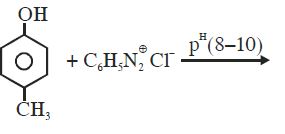
What will be product of reaction