MCQ
Which of the following is an electron deficient molecule?
- A$LiH$
- ✓$B_2H_6$
- C$LiBH_4$
- D$B_3N_3H_6$
The structure of $\mathrm{B}_{2} \mathrm{H}_{6}$ is represented as follows:
In it, two electrons of $\mathrm{B}$ -H bond are involved in the formation of three centre bond, these bonds are represented by a dotted line.
Hence, option A is correct.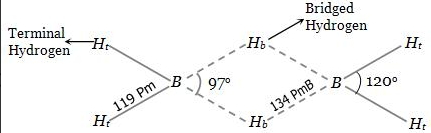
Generate a complete, print-ready paper with questions like this in minutes — across 16+ boards, with answer keys.
$O\left( g \right) + {e^ - } \to O_{\left( g \right)}^ - \,\,\,\,;\,\,\,\,{\Delta _f}{H^\Theta } = - 141\,kJ\,mo{l^{ - 1}}$
${O^ - }\left( g \right) + {e^ - } \to O_{\left( g \right)}^{2 - }\,\,\,\,;\,\,\,\,{\Delta _f}{H^\Theta } = + 780\,kJ\,mo{l^{ - 1}}$
Thus process of formation of $O_2^-$ in gas phase is unfavourable even thought $O_2^-$ is isoelectronic with neon. It is due to the fact that,
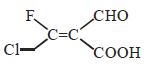
$MgO(s) + C(s) \to Mg(s) + CO(g)$, for which $\Delta _r{H^o} = + 491.1\,kJ\,mo{l^{ - 1}}$ and $\Delta _r{S^o} = 198.0\,Jk^{-1}\,mo{l^{ - 1}}$ is not feasible at $298\, K$. Temperature above which reaction will be feasible is.....$K$
If $T _2> T _1$, the correct statement(s) is (are)
(Assume $\Delta H ^{\ominus}$ and $\Delta S ^{\ominus}$ are independent of temperature and ratio of $\ln K$ at $T _1$ to $\ln K$ at $T_2$ is greater than $T_2 / T_1$. Here $H, S, G$ and $K$ are enthalpy, entropy, Gibbs energy and equillibrium constant, respectively.)
$(A)$ $\Delta H ^{\ominus}<0, \Delta S ^{\ominus}<0$ $(B)$ $\Delta G ^{\ominus}<0, \Delta H ^{\ominus}>0$ $(C)$ $\Delta G ^{\ominus}<0, \Delta S ^{\ominus}<0$ $(D)$ $\Delta G ^{\ominus}<0, \Delta S ^{\ominus}>0$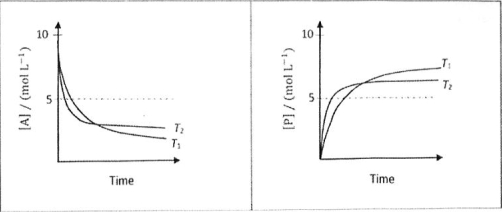
$Sn{O_2}(s) + 2{H_2}\left( g \right) \rightleftharpoons 2{H_2}O\left( g \right) + Sn\left( l \right)$
At equilibrium, the mixture of steam and hydrogen contains $40\%$ $H_2$ by volume then find $K_p$ for the reaction