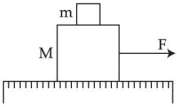
Which of the following is correct, when a person walks on a rough surface
IIT 1981, Easy
Download our app for free and get started
(c) By Newton's third law of motion, the ground exerts back an equal and opposite force along the line of action of the force we exert on the ground. The vertical component of this reaction force balances our weight (so we do not have any motion perpendicular to the ground), and the horizontal component pushes us forward. So we move
Hence $C$ option is correct

Download our appand get started for free
Experience the future of education. Simply download our apps or reach out to us for more information. Let's shape the future of learning together!No signup needed.*
Similar Questions
- 1One end of string of length $l$ is connected to a particle of mass $'m'$ and the other end is connected to a small peg on a smooth horizontal table. If the particle moves in circle with speed $'v',$ the net force on the particle (directed towards centre) will be ($T$ represents the tension in the string)View Solution
- 2View SolutionThe limiting friction between two bodies in contact is independent of
- 3A boy is sitting on the horizontal platform of a joy wheel at a distance of $5 \,m$ from the center. The wheel begins to rotate and when the angular speed exceeds $1 \,rad / s$, the boy just slips. The coefficient of friction between the boy and the wheel is $\left(g=10 \,m / s ^2\right)$View Solution
- 4A body of mass $2 \,kg$ is kept by pressing to a vertical wall by a force of $100\, N$. The coefficient of friction between wall and body is $0.3.$ Then the frictional force is equal to ........ $N$View Solution
- 5A body is sliding down an inclined plane having coefficient of friction $0.5$. If the normal reaction is twice that of the resultant downward force along the incline, the angle between the inclined plane and the horizontal is ....... $^o$View Solution
- 6View SolutionWhich is a suitable method to decrease friction
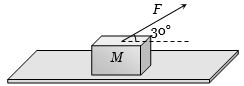
- 7A block of mass $M = 5\,kg$ is resting on a rough horizontal surface for which the coefficient of friction is $0.2$. When a force $F = 40\,\,N$ is applied, the acceleration of the block will be ........ $m/\sec^2$ $(g = 10\,\,m/{\sec^2})$View Solution
- 8View SolutionA stone tied to a string is rotated in a circle. If the string is cut, the stone flies away from the circle because
- 9An object of mass $1 \,kg$ moving on a horizontal surface with initial velocity $8 \,m / s$ comes to rest after $10 \,s$. If one wants to keep the object moving on the same surface with velocity $8 \,m / s$ the force required is ...... $N$View Solution
- 10A system of two blocks of masses $m =2 \; kg$ and $M=8 \; kg$ is placed on a smooth table as shown in figure. The coefficient of static friction between two blocks is $0.5$. The maximum horizontal force $F$ that can be applied to the block of mass $M$ so that the blocks move together will be $\dots \; N$View Solution