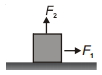
A body of mass $2 \,kg$ is kept by pressing to a vertical wall by a force of $100\, N$. The coefficient of friction between wall and body is $0.3.$ Then the frictional force is equal to ........ $N$
Easy
Download our app for free and get started
(b) For the given condition,
Static friction = Applied force = Weight of body
$ = 2 \times 10 = 20\;N$

Download our appand get started for free
Experience the future of education. Simply download our apps or reach out to us for more information. Let's shape the future of learning together!No signup needed.*
Similar Questions
- 1A motorcycle is going on an overbridge of radius $R$. The driver maintains a constant speed. As the motorcycle is ascending on the overbridge, the normal forces on it isView Solution
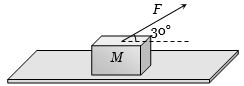
- 2A block of mass $M = 5\,kg$ is resting on a rough horizontal surface for which the coefficient of friction is $0.2$. When a force $F = 40\,\,N$ is applied, the acceleration of the block will be ........ $m/\sec^2$ $(g = 10\,\,m/{\sec^2})$View Solution
- 3The retarding acceleration of $7.35\, ms^{-2}$ due to frictional force stops the car of mass $400\, kg$ travelling on a road. The coefficient of friction between the tyre of the car and the road isView Solution
- 4A road is $10\, m$ wide. Its radius of curvature is $50\, m$. The outer edge is above the lower edge by a distance of $1.5\, m$. This road is most suited for the velocity .......... $m/\sec$View Solution
- 5A block slides down an inclined plane of slope of angle $\theta $ with a constant velocity. It is then projected up the plane with an initial velocity $u$. The distance upto which it will rise before coming to rest isView Solution
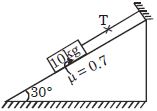
- 6The tension $T$ in the string shown in figure isView Solution
- 7View SolutionWhich of the following is correct, when a person walks on a rough surface
- 8A small block starts slipping down from a point $B$ on an inclined plane $A B,$ which is making an angle $\theta$ with the horizontal section $BC$ is smooth and the remaining section $CA$ is rough with a coefficient of friction $\mu .$ It is found that the block comes to rest as it reaches the bottom (point $A)$ of the inclined plane. If $B C=2A C$, the coefficient of friction is given by $\mu=k \tan \theta$ .The value of $k$ isView Solution
- 9Two blocks $A$ and $B$ of masses $5 \,kg$ and $3 \,kg$ respectively rest on a smooth horizontal surface with $B$ over $A$. The coefficient of friction between $A$ and $B$ is $0.5$. The maximum horizontal force (in $kg$ wt.) that can be applied to $A$, so that there will be motion of $A$ and $B$ without relative slipping, isView Solution
- 10In the figure shown, horizontal force $F_1$ is applied on a block but the block does not slide. Then as the magnitude of vertical force $F_2$ is increased from zero the block begins to slide; the correct statement isView Solution