MCQ
Which of the following is correct
  • Gun metal :$Cu + Zn + Sn$
  • B
    Duralumin : $Al + Cu + Mg + Ag$
  • C
    German silver : $Cu + Zn + C$
  • D
    Solder : $Pb + Al$

Answer

Correct option: A.
Gun metal :$Cu + Zn + Sn$
a
(a)Gun metal contains $Cu (88\%), Zn (2\%), Sn(10\%), Pb (0.5\%)$ 

Need a full question paper?

Generate a complete, print-ready paper with questions like this in minutes — across 16+ boards, with answer keys.

Start Generating Free

Similar questions

Transition elements are usually characterised by variable oxidation states but $Zn$ does not show this property because of
At equilibrium, the rate of dissolution of a solid solute in a volatile liquid solvent is:
The presence of $Si$ in steel gives it
Some amount of dichloromethane $\left( CH _2 Cl _2\right)$ is added to $671.141\,mL$ of chloroform $\left( CHCl _3\right)$ to prepare $2.6 \times 10^{-3}\,M$ solution of $CH _2 Cl _2( DCM )$. The concentration of $DCM$ is $.........ppm$ (by mass).Given: Atomic mass : $C =12 ; H : 1 ; Cl =35.5$ density of $CHCl _3=1.49\,g\,cm ^{-3}$
Action of hydrogen chloride on $\begin{array}{*{20}{c}}
  {C{H_3} - C = C{H_2}} \\ 
  |\,\,\, \\ 
  \,\,\,{C{H_3}} 
\end{array}$ and on $CH \equiv CH$ will predominantly give the compounds, respectively :-
Which of the following oxide does not react with $NaOH$ as well as with $HCl$ ?
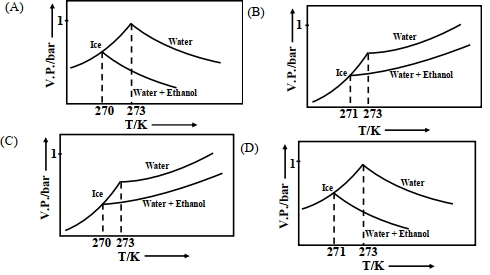
Pure water freezes at $273 \mathrm{~K}$ and $1$ bar. The addition of $34.5 \mathrm{~g}$ of ethanol to $500 \mathrm{~g}$ of water changes the freezing point of the solution. Use the freezing point depression constant of water as $2 \mathrm{~K} \mathrm{~kg} \mathrm{~mol}^{-1}$. The figures shown below represent plots of vapour pressure ($V.P$.) versus temperature ($T$). [molecular weight of ethanol is $46 \mathrm{~g} \mathrm{~mol}^{-1}$ ]

Among the following, the option representing change the freezing point is

(IMAGE)
The $[Fe(CN)_6 ]^{3-}$ complex ion
The yellow solution of $Na_2CrO_4$ changes to orange red on passing $CO_2$ gas due to the formation of
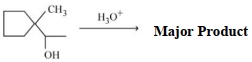
Find out the major product for the following reaction.