Which of the following is different from others
Easy


Download our appand get started for free
Experience the future of education. Simply download our apps or reach out to us for more information. Let's shape the future of learning together!No signup needed.*
Similar Questions
- 1Two tuning forks $A$ and $B$ produce $8\ beats/s$ when sounded together. A gas column $37.5\ cm$ long in a pipe closed at one end resonate to its fundamental mode with fork $A$ whereas a column of length $38.5\ cm$ of the same gas in a similar pipe is required for a similar resonance with fork $B$. The frequencies of these two tuning forks, areView Solution
- 2The diagram below shows an instantaneous position of a string as a transverse progressive wave travels along it from left to right.View Solution
Which one of the following correctly shows the direction of the velocity of the points $1, 2$ and $3$ on the string

- 3A string in musical instrument is $50 cm$ long and its fundamental frequency is $800 Hz.$ If a frequency of $1000 Hz$ is to be produced, then required length of string is ..... $cm$View Solution
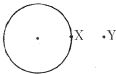
- 4A motorcyclist going around a circular track of radius $50\ m$ with a speed of $25\ m/s$ , is at a point $X$. A static siren at $Y$ is emitting sound of frequency $n$. How many times (approximately) in an hour will the motor cyclist hear the sound of actual frequency $Y$ ?View Solution
- 5Two vibrating tuning forks produce progressive waves given by $y_1= 4 \sin (500 \, \pi t)$ and $y_2= 2 \sin (506 \, \pi t)$. These tuning forks are held near the ear of a person. The person will hearView Solution
- 6A car $'A'$ chasing another car $'B'$ with a speed of $20\, m/s$ sounding a horn of $180\, Hz$. While both cars are moving towards a stationary siren of frequency $170\, Hz$. What is the speed of car $B$ so that it can't hear any beat ....$m/s$ (speed of sound $= 340\, m/s$)View Solution
- 7View SolutionVelocity of sound in air is
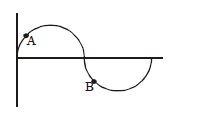
- 8Consider the snapshot of a wave traveling in positive $x$ -directionView Solution
- 9Two waves are approaching each other with a velocity of $16 m/s$ and frequency $n.$ The distance between two consecutive nodes isView Solution
- 10A source is moving towards an observer with a speed of $20 m/s$ and having frequency of $240 Hz.$ The observer is now moving towards the source with a speed of $20 m/s$. Apparent frequency heard by observer, if velocity of sound is $340 m/s$, is ... $Hz$View Solution