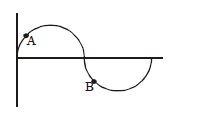
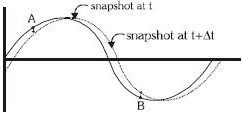
Consider the snapshot of a wave traveling in positive $x$ -direction
Medium


Download our appand get started for free
Experience the future of education. Simply download our apps or reach out to us for more information. Let's shape the future of learning together!No signup needed.*
Similar Questions
- 1Two sinusoidal waves given below are superposedView Solution
$y_1=A \sin \left(k x-\omega t+\frac{\pi}{6}\right), \quad y_2=A \sin \left(k x-\omega t-\frac{\pi}{6}\right)$
The equation of resultant wave is
- 2An air column in a pipe, which is closed at one end, will be in resonance with a vibrating body of frequency $166 \,Hz$, if the length of the air column is .... $m$View Solution
- 3The equation of a wave on a string oflinear mass density $0.04$ $kgm^{-1}$ is given byView Solution
$y = 0.02sin\left[ {2\pi \left( {\frac{t}{{0.04\left( s \right)}} - \frac{x}{{0.50\left( m \right)}}} \right)} \right]m$ The tension in the string is .... $N$
- 4The wave described by $y=0.25 \,sin\left[ {10\pi x - 2\pi t} \right]$, where $x$ and $y$ are in meters and $t$ in seconds, is a wave travelling along theView Solution
- 5View SolutionIn a simple harmonic wave, minimum distance between particles in same phase always having same speed, is ..........
- 6View SolutionIf the temperature increases, then what happens to the frequency of the sound produced by the organ pipe
- 7$A$ is singing a note and at the same time $B$ is singing a note with exactly one-eighth the frequency of the note of $A$. The energies of two sounds are equal, the amplitude of the note of $B$ isView Solution
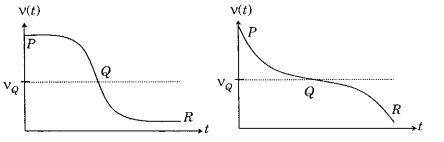
- 8Two loudspeakers $M$ and $N$ are located $20 \mathrm{~m}$ apart and emit sound at frequencies $118 \mathrm{~Hz}$ and $121 \mathrm{~Hz}$, respectively. $A$ car is initially at a point $P, 1800 \mathrm{~m}$ away from the midpoint $Q$ of the line $M N$ and moves towards $Q$ constantly at $60 \mathrm{~km} / \mathrm{hr}$ along the perpendicular bisector of $M N$. It crosses $Q$ and eventually reaches a point $R, 1800(m$ away from $Q$. Let $v(t)$ represent the beat frequency measured by a person sitting in tlie car at time $t$. Let $v_P, v_Q$ and $v_R$ be the beat frequencies measured at locations $P . Q$ and $R$, respectively. The speed of sound in air is $330 \mathrm{~m} \mathrm{~s}^{-1}$. Which of the following statement($s$) is(are) true regarding the sound heard by the person?View Solution
($A$) $v_P+v_R=2 v_Q$
($B$) The rate of change in beat frequency is maximum when the car passes through $Q$
($C$) The plot below represents schematically the variation of beat frequency with time
(image)
($D$) The plot below represents schematically the variation of beat frequency with time
(image)
- 9An open organ pipe of length $L$ vibrates in second harmonic mode. The pressure vibration is maximumView Solution
- 10Oxygen is $16$ times heavier than hydrogen. Equal volumes of hydrogen and oxygen are mixed. The ratio of speed of sound in the mixture to that in hydrogen isView Solution