MCQ
Which of the following is incorrect about $K _{2} Cr _{2} O _{7} ?$
- AIt can be prepared from $K _{2} Cr _{2} O _{7}$.
- BIt is used in redox titrations.
- ✓It is stable in both acid $\&$ base
- DIt is orange in colour
$2 CrO _{4}^{2-} \frac{\text { In acidic medium }}{ H ^{+}} \rightarrow Cr _{7} O _{7}^{2-}+ H _{2} O$
Potassium dichromate is orange in color and used in redox titrations. But it is not stable in both acid and base.
Generate a complete, print-ready paper with questions like this in minutes — across 16+ boards, with answer keys.
$CH_3 - CH_3, CH_3 - CH_2 $$- CH_3, (CH_3)_2CH - CH_3,$
$ CH_3 - CH_2 - CH(CH_3)_2.$
Increasing order of stability of the radicals is
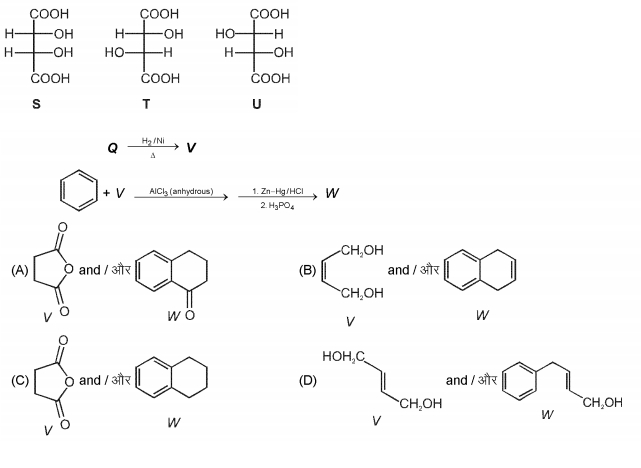
Upon treatment with dilute alkaline $KMnO _4, P$ as well as $Q$ could produce one or more than one from $S , T$ and $U$.$Image$
$1.$ Compounds formed form $P$ and $Q$ are, respectively
$(A)$ Optically active $S$ and optically active pair $(T, U)$
$(B)$ Optically inactive $S$ and optically inactive pair $(T, U)$
$(C)$ Optically active pair $(T, U)$ and optically active $S$
$(D)$ Optically inactive pair $(T, U)$ and optically inactive $S$
$2.$ In the following reaction sequences $V$ and $W$ are respectively :$Image$
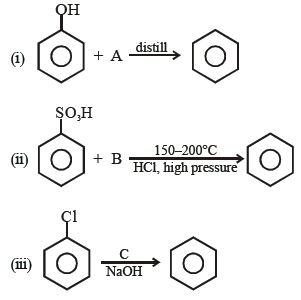
mcq $Image$
Give the answer question $1$ and $2.$