MCQ 11 Mark
Which reaction is $NOT$ a redox reaction?
- A
$2 \mathrm{KClO}_3+\mathrm{I}_2 \rightarrow 2 \mathrm{KIO}_3+\mathrm{Cl}_2$
- B
$\mathrm{H}_2+\mathrm{Cl}_2 \rightarrow 2 \mathrm{HCl}$
- ✓
$\mathrm{BaCl}_2+\mathrm{Na}_2 \mathrm{SO}_4 \rightarrow \mathrm{BaSO}_4+2 \mathrm{NaCl}$
- D
$\mathrm{Zn}+\mathrm{CuSO}_4 \rightarrow \mathrm{ZnSO}_4+\mathrm{Cu}$
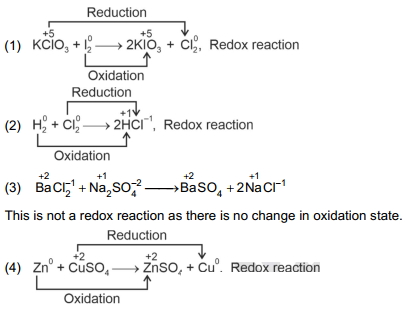
AnswerCorrect option: C. $\mathrm{BaCl}_2+\mathrm{Na}_2 \mathrm{SO}_4 \rightarrow \mathrm{BaSO}_4+2 \mathrm{NaCl}$
c
View full question & answer→MCQ 21 Mark
On balancing the given redox reaction,
$aCr _2 O _7^{2-}+ bSO _3^{2-}( aq )+ cH ^{+}( aq ) \rightarrow 2 aCr ^{3+}( aq )+ bSO _4^{2-}( aq )+\frac{ c }{2} H _2 O ( l )$
the coefficients a, b and $c$ are found to be, respectively-
- A
$8,1,3$
- ✓
$1,3,8$
- C
$3,8,1$
- D
$1,8,3$
AnswerCorrect option: B. $1,3,8$
b
Using Ion electron method :
Reduction Half reaction : $Cr _2 O _7^{2-}+6 e ^{-} \longrightarrow 2 Cr ^{3+}$
Oxidation Half reaction: $SO _3^{2-} \longrightarrow SO _4^{2-}+2 \overline{ e } \times 3$
Overall reaction : $Cr _2 O _7^{2-}+3 SO _3^{2-} \longrightarrow 2 Cr ^{3+}+3 SO _4^{2-}$
- To balance 'O' atoms, adding $H _2 O$ on LHS
$Cr _2 O _7^{2-}+3 SO _3^{2-} \longrightarrow 2 Cr ^{3+}+3 SO _4^{2-}+4 H _2 O$
- To balance 'H' atoms, adding $H ^{+}$on $RHS$
$Cr _2 O _7^{2-}+3 SO _3^{2-}+8 H ^{+} \longrightarrow 2 Cr ^{3+}+3 SO _4^{2-}+4 H _2 O$
$\therefore \quad a =1$
$b =3$
$c =8$
View full question & answer→MCQ 31 Mark
Which of the following reactions is the metal displacement reaction? Choose the right option.
- A
$2 \mathrm{KClO}_{3} \stackrel{\Delta}{\longrightarrow} 2 \mathrm{KCl}+3 \mathrm{O}_{2}$
- ✓
$\mathrm{Cr}_{2} \mathrm{O}_{3}+2 \mathrm{Al} \stackrel{\Delta}{\longrightarrow} \mathrm{Al}_{2} \mathrm{O}_{3}+2 \mathrm{Cr}$
- C
$\mathrm{Fe}+2 \mathrm{HCl} \rightarrow \mathrm{FeCl}_{2}+\mathrm{H}_{2} \uparrow$
- D
$2 \mathrm{~Pb}\left(\mathrm{NO}_{3}\right)_{2} \rightarrow 2 \mathrm{PbO}+4 \mathrm{NO}_{2}+\mathrm{O}_{2} \uparrow$
AnswerCorrect option: B. $\mathrm{Cr}_{2} \mathrm{O}_{3}+2 \mathrm{Al} \stackrel{\Delta}{\longrightarrow} \mathrm{Al}_{2} \mathrm{O}_{3}+2 \mathrm{Cr}$
b
$\mathrm{Cr}_{2} \mathrm{O}_{3}+2 \mathrm{Al} \stackrel{\Delta}{\longrightarrow} \mathrm{Al}_{2} \mathrm{O}_{3}+2 \mathrm{Cr}$
View full question & answer→MCQ 41 Mark
What is the change in oxidation number of carbon in the following reaction $?$
$CH_4\, _{( g )}+4 Cl _{2}\,_{( g )} \rightarrow CCl _{4}\,_{( l )}+4 HCl\,_ {( g )}$
- A
$0$ to $-4$
- B
$+4$ to $+4$
- C
$0$ to $+4$
- ✓
$-4$ to $+4$
AnswerCorrect option: D. $-4$ to $+4$
d
$CH _{4( g )}+4 Cl _{2( g )} \rightarrow CCl _{4( \ell )}+4 HCl _{g}$
$\underline CH _{4}(-4)$
$\underline CCl _{4}(+4)$
$-4$ to $+4$
View full question & answer→MCQ 51 Mark
The oxidation state of $Cr$ in $Cr_2O_6$ is
Answerc
$CrO _6$ does not exist but theoretically we can say that the oxidation state of $Cr$ in $CrO _6$ is $+6$ as maximum oxidation state of $Cr$ is $+6$ and it has its maximum oxidation state in $CrO _6$.
View full question & answer→MCQ 61 Mark
When neutral or faintly alkaline $KMnO_4$ is treated with potassium iodide, iodide ion is converted into '$X$'. '$X$' is
- A
$I_2$
- B
$IO_4^-$
- ✓
$IO_3^-$
- D
$IO^-$
AnswerCorrect option: C. $IO_3^-$
c
$\mathrm{KMnO}_{4}+\mathrm{I}^{-}+\mathrm{OH}^{-} \longrightarrow \mathrm{MnO}_{2}+{(\mathrm{IO_3^-})}+\mathrm{H}_{2} \mathrm{O}$
View full question & answer→MCQ 71 Mark
For the redox reaction
$\mathrm{MnO}_{4}^{-}+\mathrm{C}_{2} \mathrm{O}_{4}^{2-}+\mathrm{H}^{+} \longrightarrow \mathrm{Mn}^{2+}+\mathrm{CO}_{2}+\mathrm{H}_{2} \mathrm{O}$
the correct coefficients of the reactants for the balanced equation are
$\mathrm{MnO}_{4}^{-} \quad \mathrm{C}_{2} \mathrm{O}_{4}^{2-}\quad \mathrm{H}^{+}$
- A
$16\quad \quad 5\quad \quad 2$
- ✓
$2\quad \quad 5\quad \quad 16$
- C
$2\quad \quad 16\quad \quad 5$
- D
$5\quad \quad 16\quad \quad 2$
AnswerCorrect option: B. $2\quad \quad 5\quad \quad 16$
b
$\mathrm{MnO}_{4}^{-} \longrightarrow \mathrm{Mn}^{+2} ; 5 \mathrm{e}^{-} \mathrm{gain}\dots (1)$
$C_2O_4^{-2}\rightarrow CO_2\; 2e^-\; loss\dots(2)$
multiplying $( 1 )$ by $2$ and $( 2 )$ by $5$ to balance $e^-$
$2 \mathrm{MnO}_{4}^{-}+5 \mathrm{C}_{2} \mathrm{O}_{4}^{-2} \longrightarrow 2 \mathrm{Mn}^{+2}+10 \mathrm{CO}_{2}$
on balancing charge;
$2 \mathrm{MnO}_{4}^{-}+5 \mathrm{C}_{2} \mathrm{O}_{4}^{-2}+16 \mathrm{H}^{+} \longrightarrow 2 \mathrm{Mn}^{+2}+10 \mathrm{CO}_{2}+8 \mathrm{H}_{2} \mathrm{O}$
View full question & answer→MCQ 81 Mark
$HgCl_2$ and $I_2$ both when dissolved in water containing $I^-$ ions, the pair of species formed is
- A
$HgI_2 , I^-$
- ✓
$HgI_4^{2-}, I^-_3$
- C
$Hg_2I_2, I^-$
- D
$HgI_2 , I_3^-$
AnswerCorrect option: B. $HgI_4^{2-}, I^-_3$
b
$\mathrm{HgCl}_{2}+2 \mathrm{I}^{-} \longrightarrow \mathrm{HgI}_{2}+2 \mathrm{Cl}^{-} $$\stackrel{+2I^-}{\longrightarrow}\left[\mathrm{HgI}_{4}\right]^{-2}$
Soluble complex
$\mathrm{I}_{2}+\mathrm{I}^{-} \longrightarrow \mathrm{I}_{3}$ water soluble
View full question & answer→MCQ 91 Mark
Hot concentrated sulphuric acid is a moderately strong oxidizing agent. Which of the following reactions does not show oxidizing behaviour?
- A
$Cu + 2H_2SO_4 \rightarrow CuSO_4 + SO_2 + 2H_2O$
- B
$S + 2H_2SO_4 \rightarrow 3SO_2 + 2H_2O$
- C
$C + 2H_2SO_4 \rightarrow CO_2 + 2SO_2 + 2H_2O$
- ✓
$CaF_2 + H_2SO_4 \rightarrow CaSO_4 + 2HF$
AnswerCorrect option: D. $CaF_2 + H_2SO_4 \rightarrow CaSO_4 + 2HF$
d
$\mathrm{CaF}_{2}+2 \mathrm{H}_{2} \mathrm{SO}_{4} \rightarrow \mathrm{CaSO}_{4}+2 \mathrm{HF}$
Here, the oxidation state of every atom remains the same so, it is not a redox reaction.
View full question & answer→MCQ 101 Mark
Which of the following processes does not involve oxidation of iron?
- ✓
Formation of $Fe(CO)_5$ from $Fe.$
- B
Liberation of $H_2$ from steam by iron at high temperature.
- C
- D
Decolourisation of blue $CuSO_4$ solution by iron.
AnswerCorrect option: A. Formation of $Fe(CO)_5$ from $Fe.$
a
$\stackrel{0}{\mathrm{Fe}}+\mathrm{H}_{2} \mathrm{O}+\mathrm{O}_{2} \rightarrow \stackrel{+3}{\mathrm{Fe}_{2} \mathrm{O}_{3}} \cdot \mathrm{xH}_{2} \mathrm{O}$
$\stackrel{0}{\mathrm{Fe}}+\mathrm{CuSO}_{4} \rightarrow \stackrel{+2}{\mathrm{FeSO}_{4}}+\mathrm{Cu}$
$\stackrel{0}{\mathrm{Fe}}+5 \mathrm{CO} \rightarrow \stackrel{0}{\mathrm{Fe}}(\mathrm{CO})_{5}$
$\stackrel{0}{Fe}+\mathrm{H}_{2} \mathrm{O} \rightarrow \stackrel{+3}{\mathrm{Fe}_{2} \mathrm{O}_{3}}+\mathrm{H}_{2}$
above reactions shows the oxdiation state of iron for all given condition.
View full question & answer→MCQ 111 Mark
Assuming complete ionisation, same moles of which of the following compounds will require the least amount of acidified $KMnO_4$ for complete oxidation?
- A
$FeSO_3$
- B
$FeC_2O_4$
- C
$Fe(NO_2)_2$
- ✓
$FeSO_4$
AnswerCorrect option: D. $FeSO_4$
d
${\text{KMn}}{{\text{O}}_4}({\text{M}}{{\text{n}}^{7 + }})$ changes to $\mathrm{Mn}^{2+}$ l.e., c
$\mathrm{KMnO}_{4}$ is $5$
$(a)$ For $\mathrm{FeSO}_{3}$
$\mathrm{Fe}^{2+} \longrightarrow \mathrm{Fe}^{3+}$ (No. of $e^-$ $s$ involved $=1$ )
$\mathrm{SO}_{3}^{2-} \longrightarrow \mathrm{SO}_{4}^{2-}$ (No. of $e^-$ $s$ involved $=2$ )
Total number of $e^{-}$ $s$ involved $=1+2=3$
$(b)$ For $\mathrm{FeC}_{2} \mathrm{O}_{4}$
$\mathrm{Fe}^{2+} \longrightarrow \mathrm{Fe}^{3+}$ (No. of $e^-$ $s$ involved $=1$ )
$\mathrm{C}_{2} \mathrm{O}_{4}^{2-} \longrightarrow 2 \mathrm{CO}_{2}$ (No. of $e^-$ $s$ involved $=2$)
Total number of $e^{-}$ $s$ involved $=1+2=3$
$(c)$ For $\mathrm{Fe}\left(\mathrm{NO}_{2}\right)_{2}$
$\mathrm{Fe}^{2+} \longrightarrow \mathrm{Fe}^{3+}$ (No. of $e^-$ $s$ involved $=1$ )
$2 \mathrm{NO}_{2} \rightarrow 2 \mathrm{NO}_{3}^{-}$ (No. of $e^{-}$ $s$ involved $=4$)
Total number of $e^-$ $s$ involved $=1+4=5$
(d) For $FeSO_4$,
$\mathrm{Fe}^{2+} \longrightarrow \mathrm{Fe}^{3+}$ (No. of $e^-$ $s$ involved $=1$)
Total number of $e^-$ $s$ involved $= 1$
As $FeSO_4$, requires least number of electrons thus, it will require least amount of $\mathrm{KMnO}_{4}$.
View full question & answer→MCQ 121 Mark
$(I)\,\, H_2O_2 + O_3 \rightarrow H_2O + 2O_2$
$(II)\,\, H_2O_2 + Ag_2O \rightarrow 2Ag + H_2P + O_2$
Role of hydrogen peroxide in the above reactions is respectively
- A
oxidizing in $(I)$ and reducing in $(II)$
- B
reducing in $(I)$ and oxidizing in $(II)$
- ✓
reducing in $(I)$ and $(II)$
- D
oxidizing in $(I)$ and $(II)$
AnswerCorrect option: C. reducing in $(I)$ and $(II)$
c
Increase in oxidation state (reducing agent)
$\mathrm{H}_{2} \mathrm{O}_{2}+\mathrm{O}_{3} \longrightarrow \mathrm{H}_{2} \mathrm{O}+2 \mathrm{O}_{2}$
$\mathrm{H}_{2} \mathrm{O}_{2}+\mathrm{Ag}_{2} \mathrm{O} \longrightarrow 2 \mathrm{Ag}+\mathrm{H}_{2} \mathrm{O}+\mathrm{O}_{2}$
$\mathrm{H}_{2} \mathrm{O}_{2}$ acts as reducing agent in all those reactions in which $\mathrm{O}_{2}$ is evolved.
View full question & answer→MCQ 131 Mark
In acidic medium, $H_2O_2$ changes $Cr_2O_7^{2-}$ to $CrO_5$ which has two $(-O-O-)$ bonds. Oxidation state of $Cr$ in $CrO_5$ is
Answerc
When $H_{2} O_{2}$ is added to an acidified solution of a dichromate $C r_{2} O_{7}^{2-},$ a deep blue coloured complex, chromic peroxide $C r O_{5}\left[o r C r O\left(O_{2}\right)_{2}\right]$ is formed. $C r_{2} O_{7}^{2-}+2 H^{+}+4 H_{2} O_{2} \rightarrow$$\underbrace{2 C r O\left(O_{2}\right)_{2}}_{\text {Chromic peroxide }}+5 H_{2} O$
This deep blue coloured complex has the following structure
Oxidation state of $Cr$ is $+6$ due to the presence of two peroxide linkages which can be calculated as $Cr$ peroxide normal $x+(-1) 4+(-2)=0, x-6=0$ and $x=+6$
View full question & answer→MCQ 141 Mark
The pair of compounds that can exist together is
- A
$FeCl_3, SnCl_2$
- B
$HgCl_2, SnCl_2$
- ✓
$FeCl_2, SnCl_2$
- D
$FeCl_3, KI$
AnswerCorrect option: C. $FeCl_2, SnCl_2$
c
The compounds with lower oxidation number and which cannot reduced by one another can exist together. Thus, $F e C l_{2}$ and $S n C l_{2}$ can exist together as $F e^{2+}$ cannot be reduced by $S n^{2+}$
View full question & answer→MCQ 151 Mark
${H^ + } + C{r_2}O_7^{2 - } + SO_3^{2 - } \to C{r^{ + 3}} + SO_4^{2 - } + {H_2}O$ In balance reaction coefficient of $H^+$ and $SO_4^{2-}$ will be respectively
- A
$3, 8$
- B
$3, 4$
- C
$4, 1$
- ✓
$8, 3$
AnswerCorrect option: D. $8, 3$
d
$8{H^ + } + 3SO_4^{2 - } + C{r_2}O_7^{2 - } \to 2C{r^{ + 3}} + 3SO_4^{2 - } + 4{H_2}O$
View full question & answer→MCQ 161 Mark
Which is not the true statement about $KMnO_4$ ?
- A
Its solution is unstable in acidic medium
- B
It gets reduced to $MnO_2$ in neutral medium
- ✓
$MnO_4^-$ changes to $Mn^{+2}$ in basic medium
- D
It is self indicator in $Fe^{+2}$ or $C_2O_4^{ -2}$ titration
AnswerCorrect option: C. $MnO_4^-$ changes to $Mn^{+2}$ in basic medium
c
$MnO_{4}^{-}\xrightarrow[medium]{basic}MnO_{4}^{-2}$ or $MnO_2$
View full question & answer→MCQ 171 Mark
How many moles of $H_2SO_3$ is required to reduce one mol of $KMnO_4$ in acidic medium ................ $\mathrm{mol}$
Answerc
$6H^+ + 2MnO_4^-+ 5SO_3^{2-} \longrightarrow 2Mn^{+2} + 5SO_4^{2-} + 3H_2O$
View full question & answer→MCQ 181 Mark
The number of moles of sodium sulphite $(Na_2SO_3)$ needed to react with one mole of $KMnO_4$ in acidic solution
Answerb
Reaction:
$5 \mathrm{Na}_{2} \mathrm{SO}_{3}+3 \mathrm{H}_{2} \mathrm{SO}_{4}+2 \mathrm{KMnO}_{4} \rightarrow 5 \mathrm{Na}_{2} \mathrm{SO}_{4}+2 \mathrm{MnSO}_{4}+\mathrm{K}_{2} \mathrm{SO}_{4}+3 \mathrm{H}_{2} \mathrm{O}$
So, number of moles of sodium sulphite that reacts with one mole of $\mathrm{KM} \mathrm{nO}_{4}=\frac{5}{2}$
View full question & answer→MCQ 191 Mark
$aIO_3^-+ bI^-+ 6H^+ \to cI_2 + 3H_2O$
In above reaction coefficient $a,\, b$ and $c$ are respectively
- ✓
$1,\,5,\, 3$
- B
$3,\,1,\,5$
- C
$1, \,3,\, 5$
- D
$5, \,3, \,1$
AnswerCorrect option: A. $1,\,5,\, 3$
a
$IO_3^-+ 5I^-+ 6H^+ \to 3I_2 + 3H_2O$
View full question & answer→MCQ 201 Mark
Colour of acidified $K _2Cr_2O_7$ is not changed by
- A
$H_2O_2$
- B
$Sn^{2+}(aq.)$
- ✓
$HF$
- D
$HBr$
Answerc
The color of acidified $K _2 Cr _2 O _7$ is not changed if after reacting with a substance, the oxidation state of the transition metal, $Cr$, in the compound remains the same.
The oxidation state of $Cr$ in $K _2 Cr _2 O _7$ is calculated as :
$2+2 x +(-2) \times 7=0$
$\Rightarrow 2+2 x -14=0$
$\Rightarrow 2 x -12=0$
$\Rightarrow 2 x =+12$
$\Rightarrow x =+6$
$\therefore$ Oxidations state of $Cr =+3$
Potassium dichromate reacts with hydrogen fluoride to produce potassium fluorotrioxochromate $(VI)$ and water. The reaction involved is :
$K _2 Cr _2 O _7+2 HF \rightarrow 2 K \left[ CrO _3 F \right]+ H _2 O$
The oxidation state of $Cr$ in $K \left[ CrO _3 F \right]$ can be calculated as follows:
$+1+ x +(-2) \times 3+(-1)=0$
$\Rightarrow+1+ x -6-1=0$
$\Rightarrow x -6=0$
$\Rightarrow x =+6$
$\therefore$ Oxidations state of $Cr =+3$
Since, there is no change in the oxidation state of $Cr$ in the reactant and in the product, the color of the solution doesn't change. Therefore, the color of acidified $K _2 Cr _2 O _7$ is not changed by $HF$.
View full question & answer→MCQ 211 Mark
$Cu^{2+}(aq.)$ does not undergo redox reaction with solution of
- ✓
$(NH_4)_2S$
- B
$Na_2S_2O_3$
- C
$KI$
- D
$NH_4SCN$
AnswerCorrect option: A. $(NH_4)_2S$
a
$Cu^{2+}(aq.)$ do not undergo redox reaction with $(NH_4)_2S$
View full question & answer→MCQ 221 Mark
Which of the following reaction is incorrect ?
- A
$PCl_3 +3H_2O\to H_3PO_3 +3HCl$
- B
$NCl_3 +3H_2O\to NH_3 +3HOCl$
- ✓
$SbCl_3 +3H_2O\to H_2SbO_3 +3HCl$
- D
$BiCl_3 +H_2O\to BiOCl +2HCl$
AnswerCorrect option: C. $SbCl_3 +3H_2O\to H_2SbO_3 +3HCl$
c
$SbCl_3 +H_2O \Rightarrow SbOCl +2HCl$
View full question & answer→MCQ 231 Mark
Colour of $CrO_4^{^{2 - }}(aq.)$ is not changed by
- A
dil. $HCl$
- ✓
$NH_3$ solution
- C
$CH_3COOH$
- D
$NO_2$ gas
AnswerCorrect option: B. $NH_3$ solution
b
$\mathop {CrO_4^{2 - }(aq.)}\limits_{(yellow)} \underset{\begin{subarray}{l}
pH > 7 \\
(Basic)
\end{subarray} }{\overset{\begin{subarray}{l}
(Acidic) \\
pH < 7
\end{subarray} }{\longleftrightarrow}}\mathop {C{r_2}O_7^{2 - }(aq.}\limits_{(Orange)} )$
$NH_3$ being basic in solution, does not change yellow colour of $CrO_4\,^{2-}(aq.)$ .
View full question & answer→MCQ 241 Mark
Which of the following combination of reagents does not undergo redox reaction in aqueous medium?
- A
$SnCl_2+HgCl_2$
- B
$CuSO_4+KCN$
- ✓
$Pb(CH_3COO)_2+KI$
- D
$Ag_2O+SO_2$
AnswerCorrect option: C. $Pb(CH_3COO)_2+KI$
c
$(a)\,{\text{SnC}}{{\text{l}}_2} + {\text{HgC}}{{\text{l}}_2}\xrightarrow{{\operatorname{Re} dox}}{\text{Hg}} \downarrow + {\text{SnC}}{{\text{l}}_4}$
$(b)\,\,CuS{O_4} + {\text{KCN}} \to {{\text{K}}_2}{\text{S}}{{\text{O}}_4} + {\text{Cu}}{({\text{CN}})_2} \downarrow \xrightarrow[\begin{subarray}{l}
Intramolecular \\
\operatorname{Re} dox
\end{subarray} ]{\begin{subarray}{l}
Spon\tan eous \\
(R.T.)
\end{subarray} }{\text{Cu}}({\text{CN}}) \downarrow + {({\text{CN}})_2} \uparrow $
$(c)\,{\text{Pb}}{\left( {{\text{C}}{{\text{H}}_3}{\text{COO}}} \right)_2} + {\text{KI}}\xrightarrow[{{\text{Non - redox}}\,reaction}]{{Ion\,Exchange\,reaction}}{\text{Pb}}{{\text{I}}_2} \downarrow + {\text{C}}{{\text{H}}_3}{\text{COOK}}$
$(d)\,{\text{A}}{{\text{g}}_2}{\text{O}} + {\text{S}}{{\text{O}}_2}\xrightarrow{{\operatorname{Re} dox}}{\text{Ag}} + {\text{S}}{{\text{O}}_3} \uparrow $
View full question & answer→MCQ 251 Mark
In which of the following redox reaction precipitate is not formed ?
- ✓
$C{{r}^{3+}}(aq.)\,+\,N{{a}_{2}}{{O}_{2}}(Solution)\,\to $
- B
$F{e^{3 + }}(aq.)\, + \,{(N{H_4})_2}S\, \to $
- C
$M{n^{2 + }}(aq.)\, + \,{H_2}{O_2} + N{H_3}(Solution)\, \to $
- D
$F{e^{2 + }}(aq.)\, + \,N{a_2}{O_2}(Solution)\, \to $
AnswerCorrect option: A. $C{{r}^{3+}}(aq.)\,+\,N{{a}_{2}}{{O}_{2}}(Solution)\,\to $
a
$\mathrm{Cr}^{3+}(a q .)+\mathrm{Na}_{2} \mathrm{O}_{2}$ sol. $\longrightarrow \mathrm{CrO}_{4}^{2-}(a q .)$
$\mathrm{Fe}^{3+}(a q .)+\left(\mathrm{NH}_{4}\right)_{2} \mathrm{S} \longrightarrow \mathrm{Fes} \downarrow$
$\mathrm{Mn}^{2 +}(a q .)+\mathrm{H}_{2} \mathrm{O}_{2}+\mathrm{NH}_{3} \longrightarrow \mathrm{MnO}(\mathrm{OH})_{2} \downarrow$ or $\mathrm{MnO}_{2} \downarrow .2 \mathrm{H}_{2} \mathrm{O}$
$\mathrm{Fe}^{2 +}(a q .)+\mathrm{Na}_{2} \mathrm{O}_{2} \mathrm{sol} \longrightarrow \mathrm{Fe}(\mathrm{OH})_{3} \downarrow$
View full question & answer→MCQ 261 Mark
Oxygen gas is not produced from the following decomposition reaction
- A
${K_2}C{r_2}{O_7}\,\xrightarrow{\Delta }$
- ✓
$A{g_2}C_2O_4\,\xrightarrow{\Delta }$
- C
$Pb{(N{O_3})_2}\,\xrightarrow{\Delta }$
- D
$A{g_2}C{O_3}\,\xrightarrow{\Delta }$
AnswerCorrect option: B. $A{g_2}C_2O_4\,\xrightarrow{\Delta }$
b
$2{K_2}C{r_2}{O_7}\xrightarrow{\Delta }2{K_2}Cr{O_4} + C{r_2}{O_3} + \frac{3}{2}{O_2}$
$A{g_2}{C_2}{O_4}\xrightarrow{\Delta }2Ag + 2C{O_2}$
$pb{(N{O_3})_2}\xrightarrow{\Delta }pbO + 2N{O_2} + \frac{1}{2}{O_2}$
$A{g_2}C{O_3}\xrightarrow{\Delta }2Ag + C{O_2} + \frac{1}{2}{O_2}$
View full question & answer→MCQ 271 Mark
Assign $A, B, C, D$ from given type of reaction.
$S + HNO_3\, (Dil.) \longrightarrow H_2SO_4 + NO \uparrow $
- A
for disproportionation reaction.
- B
for comproportionation reaction.
- ✓
for either intermolecular redox reaction or displacement reaction.
- D
for either thermal combination redox reaction or thermal decomposition redox reaction.
AnswerCorrect option: C. for either intermolecular redox reaction or displacement reaction.
View full question & answer→MCQ 281 Mark
Assign $A, B, C, D$ from given type of reaction.
$S{e_2}C{l_2}\xrightarrow{\Delta }SeC{l_4} + Se$
- A
for disproportionation reaction.
- B
for either thermal combination redox reaction or thermal decomposition redox reaction.
- C
for either intermolecular redox reaction or displacement reaction.
- ✓
Both $(A)$ and $(B)$
AnswerCorrect option: D. Both $(A)$ and $(B)$
View full question & answer→MCQ 291 Mark
Assign $A, B, C, D$ from given type of reaction.
${H_3}P{O_3}\xrightarrow{\Delta }{H_3}P{O_4} + P{H_3} \uparrow $
- A
for disproportionation reaction.
- B
for either thermal combination redox reaction or thermal decomposition redox reaction.
- C
for either intermolecular redox reaction or displacement reaction.
- ✓
Both $(A)$ and $(B)$
AnswerCorrect option: D. Both $(A)$ and $(B)$
View full question & answer→MCQ 301 Mark
Assign $A, B, C, D$ from given type of reaction.
${P_4} + 10C{l_2}\xrightarrow{\Delta }PC{l_5}$
- A
for disproportionation reaction.
- B
for either thermal combination redox reaction or thermal decomposition redox reaction.
- ✓
for either intermolecular redox reaction or displacement reaction.
- D
Both $(B)$ and $(C)$
AnswerCorrect option: C. for either intermolecular redox reaction or displacement reaction.
View full question & answer→MCQ 311 Mark
Assign $A, B, C, D$ from given type of reaction.
${P_4} + 6Cl_2\xrightarrow{\Delta }PC{l_3}$
- A
for disproportionation reaction.
- B
for either thermal combination redox reaction or thermal decomposition redox reaction.
- C
for either intermolecular redox reaction or displacement reaction.
- ✓
Both $(B)$ and $(C)$
AnswerCorrect option: D. Both $(B)$ and $(C)$
View full question & answer→MCQ 321 Mark
Assign $A, B, C, D$ from given type of reaction.
$NO + N{O_2}\xrightarrow{{ - 11\,{}^oC}}{N_2}{O_3}$
- A
for disproportionation reaction.
- B
for comproportionation reaction.
- C
for either thermal combination redox reaction or thermal decomposition redox reaction.
- ✓
Both $(B)$ and $(C)$
AnswerCorrect option: D. Both $(B)$ and $(C)$
View full question & answer→MCQ 331 Mark
Assign $A, B, C, D$ from given type of reaction.
$NaN{O_2} + FeS{O_4} + {H_2}S{O_4} \longrightarrow \mathop {\left[ {Fe{{\left( {{H_2}O} \right)}_5}NO} \right]S{O_4}}\limits_{{\text{(Ring complex)}}} $
- A
for disproportionation reaction.
- B
for comproportionation reaction.
- ✓
for either intermolecular redox reaction or displacement reaction.
- D
for either thermal combination redox reaction or thermal decomposition redox reaction.
AnswerCorrect option: C. for either intermolecular redox reaction or displacement reaction.
View full question & answer→MCQ 341 Mark
Assign $A, B, C, D$ from given type of reaction. $N{H_4}N{O_3} + \xrightarrow{\Delta }{N_2}O + {H_2}O$
- A
for disproportionation reaction.
- B
for comproportionation reaction.
- C
for either thermal combination redox reaction or thermal decomposition redox reaction.
- ✓
Both $(B)$ and $(C)$
AnswerCorrect option: D. Both $(B)$ and $(C)$
View full question & answer→MCQ 351 Mark
Assign $A, B, C, D$ from given type of reaction.
${N_2} + {O_2}\xrightarrow{{{\text{High temp}}{\text{.}}}}NO \uparrow - {\text{Heat}}$
- A
for either thermal combination redox reaction or thermal decomposition redox reaction.
- B
for comproportionation reaction.
- C
for either intermolecular redox reaction or displacement reaction.
- ✓
Both $(A)$ and $(C)$
AnswerCorrect option: D. Both $(A)$ and $(C)$
View full question & answer→MCQ 361 Mark
Assign $A, B, C, D$ from given type of reaction.
$Ba{\left( {{N_3}} \right)_2}\xrightarrow{\Delta }Ba + {N_2} \uparrow $
- A
for disproportionation reaction.
- B
for comproportionation reaction.
- C
for either intermolecular redox reaction or displacement reaction.
- ✓
for either thermal combination redox reaction or thermal decomposition redox reaction.
AnswerCorrect option: D. for either thermal combination redox reaction or thermal decomposition redox reaction.
View full question & answer→MCQ 371 Mark
Assign $A, B, C, D$ from given type of reaction.
$N{H_4}Cl + NaN{O_2}\xrightarrow{\Delta }{N_2} \uparrow + NaCl + {H_2}O$
- A
for disproportionation reaction.
- ✓
for comproportionation reaction.
- C
for either intermolecular redox reaction or displacement reaction.
- D
for either thermal combination redox reaction or thermal decomposition redox reaction.
AnswerCorrect option: B. for comproportionation reaction.
View full question & answer→MCQ 381 Mark
Assign $A, B, C, D$ from given type of reaction.
$(NH_4)_2 Cr_2O_7 \xrightarrow{\Delta }N_2 \uparrow + Cr_2O_3 \downarrow + H_2O \uparrow $
- A
for disproportionation reaction.
- B
for comproportionation reaction.
- C
for either intermolecular redox reaction or displacement reaction.
- ✓
for either thermal combination redox reaction or thermal decomposition redox reaction.
AnswerCorrect option: D. for either thermal combination redox reaction or thermal decomposition redox reaction.
View full question & answer→MCQ 391 Mark
Assign $A, B, C, D$ from given type of reaction.
${K_2}C{r_2}{O_7}\xrightarrow{\Delta }{K_2}Cr{O_4} + C{r_2}{O_3} + {O_2} \uparrow $
- A
for disproportionation reaction.
- B
for comproportionation reaction.
- C
for either intermolecular redox reaction or displacement reaction.
- ✓
for either thermal combination redox reaction or thermal decomposition redox reaction.
AnswerCorrect option: D. for either thermal combination redox reaction or thermal decomposition redox reaction.
View full question & answer→MCQ 401 Mark
Assign $A, B, C, D$ from given type of reaction
$KMn{O_4}\xrightarrow{\Delta }{K_2}Mn{O_4} + Mn{O_2} + {O_2} \uparrow $
- A
for disproportionation reaction.
- B
for comproportionation reaction.
- C
for either intermolecular redox reaction or displacement reaction.
- ✓
for either thermal combination redox reaction or thermal decomposition redox reaction.
AnswerCorrect option: D. for either thermal combination redox reaction or thermal decomposition redox reaction.
View full question & answer→MCQ 411 Mark
Assign $A, B, C, D$ from given type of reaction.
$CO + I_2O_5 (s) \longrightarrow CO_2 + I_2$
- A
for disproportionation reaction.
- B
for comproportionation reaction.
- ✓
for either intermolecular redox reaction or displacement reaction.
- D
for either thermal combination redox reaction or thermal decomposition redox reaction.
AnswerCorrect option: C. for either intermolecular redox reaction or displacement reaction.
View full question & answer→MCQ 421 Mark
Assign $A, B, C, D$ from given type of reaction.
${N_2}{O_3}\xrightarrow{{R.T.}}NO + N{O_2}$
- A
for disproportionation reaction.
- B
for comproportionation reaction.
- C
for either thermal combination redox reaction or thermal decomposition redox reaction.
- ✓
Both $(A)$ and $(C)$
AnswerCorrect option: D. Both $(A)$ and $(C)$
View full question & answer→MCQ 431 Mark
Assign $A, B, C, D$ from given type of reaction.
${H_3}P{O_2} + CuS{O_4} \longrightarrow Cu \downarrow + {H_3}P{O_4} + HN{O_3}$
- A
for disproportionation reaction.
- B
for comproportionation reaction.
- ✓
for either intermolecular redox reaction or displacement reaction.
- D
for either thermal combination redox reaction or thermal decomposition redox reaction.
AnswerCorrect option: C. for either intermolecular redox reaction or displacement reaction.
View full question & answer→MCQ 441 Mark
Assign $A, B, C, D$ from given type of reaction.
${H_3}P{O_2} + AgN{O_2} \longrightarrow Ag \downarrow + {H_3}P{O_4} + NO$
- A
for disproportionation reaction.
- B
for comproportionation reaction.
- ✓
for either intermolecular redox reaction or displacement reaction.
- D
for either thermal combination redox reaction or thermal decomposition redox reaction.
AnswerCorrect option: C. for either intermolecular redox reaction or displacement reaction.
View full question & answer→MCQ 451 Mark
Assign $A, B, C, D$ from given type of reaction.
$C{u^{2 + }}\left( {aq.} \right) + 2{I^ - } \longrightarrow CuI \downarrow + \frac{1}{2}{I_2}$
- A
for disproportionation reaction.
- B
for comproportionation reaction.
- ✓
for either intermolecular redox reaction or displacement reaction.
- D
for either thermal combination redox reaction or thermal decomposition redox reaction.
AnswerCorrect option: C. for either intermolecular redox reaction or displacement reaction.
View full question & answer→MCQ 461 Mark
Assign $A, B, C, D$ from given type of reaction.
${I_2} + {S_2}O_3^{2 - } \longrightarrow {I^ - } + {S_4}O_6^{2 - }$
- A
for disproportionation reaction.
- B
for comproportionation reaction.
- ✓
for either intermolecular redox reaction or displacement reaction.
- D
for either thermal combination redox reaction or thermal decomposition redox reaction.
AnswerCorrect option: C. for either intermolecular redox reaction or displacement reaction.
View full question & answer→MCQ 471 Mark
Assign $A, B, C, D$ from given type of reaction.
$F{e^{2 + }}\left( {aq.} \right) + C{r_2}O_7^{2 - } + {H^ + } \longrightarrow F{e^{3 + }}\left( {aq.} \right) + C{r^{3 + }}$
- A
for disproportionation reaction.
- B
for comproportionation reaction.
- ✓
for either intermolecular redox reaction or displacement reaction.
- D
for either thermal combination redox reaction or thermal decomposition redox reaction.
AnswerCorrect option: C. for either intermolecular redox reaction or displacement reaction.
View full question & answer→MCQ 481 Mark
Assign $A, B, C, D$ from given type of reaction.
A for disproportionation reaction.
B for comproportionation reaction.
C for either intermolecular redox reaction or displacement reaction.
D for either thermal combination redox reaction or thermal decomposition redox reaction.
$MnO_4^ - + {H^ + } + B{r^ - } \longrightarrow M{n^{2 + }}\left( {aq.} \right) + B{r_2} \uparrow $
- A
for disproportionation reaction.
- B
for comproportionation reaction.
- ✓
for either intermolecular redox reaction or displacement reaction.
- D
for either thermal combination redox reaction or thermal decomposition redox reaction.
AnswerCorrect option: C. for either intermolecular redox reaction or displacement reaction.
View full question & answer→MCQ 491 Mark
Assign $A, B, C, D$ from given type of reaction.
$C{r_2}O_7^{2 - } + {H^ + } + SO_3^{2 - } \longrightarrow C{r^{3 + }}\left( {aq.} \right) + SO_4^{2 - }$
- A
for disproportionation reaction.
- B
for comproportionation reaction.
- ✓
for either intermolecular redox reaction or displacement reaction.
- D
for either thermal combination redox reaction or thermal decomposition redox reaction.
AnswerCorrect option: C. for either intermolecular redox reaction or displacement reaction.
View full question & answer→MCQ 501 Mark
Assign $A, B, C, D$ from given type of reaction.
$Pb{O_2} + HCl\,\left( {dil} \right)\xrightarrow{{Warm}}PbC{l_2} \downarrow + C{l_2} \uparrow + {H_2}O$
- A
for disproportionation reaction.
- B
for comproportionation reaction.
- ✓
for either intermolecular redox reaction or displacement reaction.
- D
for either thermal combination redox reaction or thermal decomposition redox reaction.
AnswerCorrect option: C. for either intermolecular redox reaction or displacement reaction.
View full question & answer→MCQ 511 Mark
Assign $A, B, C, D$ from given type of reaction.
$P{b_3}{O_4} + HN{O_3}\,\left( {dil} \right)\xrightarrow{{R.T.}}Pb{\left( {N{O_3}} \right)_2} + Pb{O_2} \downarrow $
- A
for disproportionation reaction.
- B
for comproportionation reaction.
- ✓
for either intermolecular redox reaction or displacement reaction.
- D
for either thermal combination redox reaction or thermal decomposition redox reaction.
AnswerCorrect option: C. for either intermolecular redox reaction or displacement reaction.
View full question & answer→MCQ 521 Mark
Assign $A, B, C, D$ from given type of reaction.
${H_2}{O_2}\xrightarrow{{R.T}}{H_2}O + \frac{1}{2}{O_2}$
- A
for disproportionation reaction.
- B
for comproportionation reaction.
- C
for either thermal combination redox reaction or thermal decomposition redox reaction.
- ✓
Both $(A)$ and $(C)$
AnswerCorrect option: D. Both $(A)$ and $(C)$
View full question & answer→MCQ 531 Mark
Assign $A, B, C, D$ from given type of reaction.
$C{l_2}\left( g \right) + KI\left( {aq.} \right) \longrightarrow KCl + {I_2}$
- A
for disproportionation reaction.
- B
for comproportionation reaction.
- ✓
for either intermolecular redox reaction or displacement reaction.
- D
for either thermal combination redox reaction or thermal decomposition redox reaction.
AnswerCorrect option: C. for either intermolecular redox reaction or displacement reaction.
View full question & answer→MCQ 541 Mark
Assign $A, B, C, D$ from given type of reaction.
$Fe\left( s \right) + 2HCl \longrightarrow FeC{l_2} + {H_2}$
- A
for disproportionation reaction.
- B
for comproportionation reaction.
- ✓
for either intermolecular redox reaction or displacement reaction.
- D
for either thermal combination redox reaction or thermal decomposition redox reaction.
AnswerCorrect option: C. for either intermolecular redox reaction or displacement reaction.
View full question & answer→MCQ 551 Mark
Assign $A, B, C, D$ from given type of reaction.
$Mg\left( s \right) + 2HCl \longrightarrow MgC{l_2} + {H_2}$
- A
for disproportionation reaction.
- B
for comproportionation reaction.
- ✓
for either intermolecular redox reaction or displacement reaction.
- D
for either thermal combination redox reaction or thermal decomposition redox reaction.
AnswerCorrect option: C. for either intermolecular redox reaction or displacement reaction.
View full question & answer→MCQ 561 Mark
Assign $A, B, C, D$ from given type of reaction.
$Zn\left( s \right) + 2HCl \longrightarrow ZnC{l_2} + {H_2}$
- A
for disproportionation reaction.
- B
for comproportionation reaction.
- ✓
for either intermolecular redox reaction or displacement reaction.
- D
for either thermal combination redox reaction or thermal decomposition redox reaction.
AnswerCorrect option: C. for either intermolecular redox reaction or displacement reaction.
View full question & answer→MCQ 571 Mark
Assign $A, B, C, D$ from given type of reaction.
$Fe\left( s \right) + {H_2}O\left( l \right)\xrightarrow{{Boil}}F{e_3}{O_4} + {H_2} \uparrow $
- A
for disproportionation reaction.
- B
for comproportionation reaction.
- ✓
for either intermolecular redox reaction or displacement reaction.
- D
for either thermal combination redox reaction or thermal decomposition redox reaction.
AnswerCorrect option: C. for either intermolecular redox reaction or displacement reaction.
View full question & answer→MCQ 581 Mark
Assign $A, B, C, D$ from given type of reaction.
$Mg\left( s \right) + {H_2}O\left( l \right)\xrightarrow{{Warm}}Mg{\left( {OH} \right)_2} + {H_2} \uparrow $
- A
for disproportionation reaction.
- B
for comproportionation reaction.
- ✓
for either intermolecular redox reaction or displacement reaction.
- D
for either thermal combination redox reaction or thermal decomposition redox reaction.
AnswerCorrect option: C. for either intermolecular redox reaction or displacement reaction.
View full question & answer→MCQ 591 Mark
Assign $A, B, C, D$ from given type of reaction.
$Ca\left( s \right) + {H_2}O\left( l \right)\xrightarrow{{R.T.}}Ca{\left( {OH} \right)_2} + {H_2} \uparrow $
- A
for disproportionation reaction.
- B
for comproportionation reaction.
- ✓
for either intermolecular redox reaction or displacement reaction.
- D
for either thermal combination redox reaction or thermal decomposition redox reaction.
AnswerCorrect option: C. for either intermolecular redox reaction or displacement reaction.
View full question & answer→MCQ 601 Mark
Assign $A, B, C, D$ from given type of reaction.
$Na\left( s \right) + {H_2}O\left( l \right)\xrightarrow{{R.T.}}NaOH + {H_2} \uparrow $
- A
for disproportionation reaction.
- B
for comproportionation reaction.
- ✓
for either intermolecular redox reaction or displacement reaction.
- D
for either thermal combination redox reaction or thermal decomposition redox reaction.
AnswerCorrect option: C. for either intermolecular redox reaction or displacement reaction.
View full question & answer→MCQ 611 Mark
Assign $A, B, C, D$ from given type of reaction.
$NaH\left( s \right) + {H_2}O \longrightarrow NaOH + {H_2} \uparrow $
- A
for disproportionation reaction.
- B
for comproportionation reaction.
- C
for either intermolecular redox reaction or displacement reaction.
- ✓
Both $(B)$ and $(C)$
AnswerCorrect option: D. Both $(B)$ and $(C)$
View full question & answer→MCQ 621 Mark
Assign $A, B, C, D$ from given type of reaction.
$3Mg\left( s \right) + {N_2}\left( g \right) \longrightarrow M{g_3}{N_2}$
- A
for disproportionation reaction.
- B
for comproportionation reaction.
- C
for either intermolecular redox reaction or displacement reaction.
- ✓
for either thermal combination redox reaction or thermal decomposition redox reaction.
AnswerCorrect option: D. for either thermal combination redox reaction or thermal decomposition redox reaction.
View full question & answer→MCQ 631 Mark
Which of the following reaction is not a redox reaction ?
- A
$SO_2 + H_2S \longrightarrow 2H_2O + S$
- B
$4KClO_3 \longrightarrow 3KClO_4 + KCl$
- ✓
$Na_2O + H_2SO_4 \longrightarrow Na_2SO_4 + H_2O$
- D
$2Na + O_2 \longrightarrow Na_2O_2$
AnswerCorrect option: C. $Na_2O + H_2SO_4 \longrightarrow Na_2SO_4 + H_2O$
View full question & answer→MCQ 641 Mark
In the reaction
$xBrO_3\,^-+ yCr^{+3} + zH_2O \to Br_2 + CrO_4 ^{-2} + H^+$
the coefficients $x, y, z$ are
- A
$6, \,10,\, 11$
- B
$6,\, 10, \,20$
- C
$6, \,8, \,22$
- ✓
$6,\, 10,\, 22$
AnswerCorrect option: D. $6,\, 10,\, 22$
d
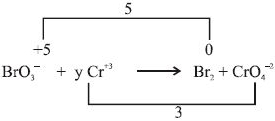
$6BrO_3^ - + \mathop {10C{r^{ + 3}}}\limits_{ + 22{H_2}O} \to 3B{r_2} + \mathop {10CrO_4^{ - 2}}\limits_{ + {{44}^{^ + }}} $
View full question & answer→MCQ 651 Mark
What will be the value of $x$ and $y$ by balancing the reaction
$C_2H_5OH + xI_2 + yOH^-\to CHI_3 + HCO_2\,^-+ 5I^-+ 5H_2O$
- ✓
$4, 6$
- B
$2, 6$
- C
$2, 4$
- D
$4, 4$
AnswerCorrect option: A. $4, 6$
a
Balanced reaction
$C_2H_5OH + 4I_2 + 6OH^-\to CHI_3 + HCO_2\,^-+ 5I^-+ 5H_2O$
View full question & answer→MCQ 661 Mark
Which of the following is not intramolecular redox reaction?
- A
$NH_4NO_2 \to N_2 + 2H_2O$
- B
$2Mn_2O_7 \to 4MnO_2 + 3O_2$
- C
$2KClO_3\to 2KCl + 3O_2$
- ✓
$2H_2O_2 \to 2H_2O + O_2$
AnswerCorrect option: D. $2H_2O_2 \to 2H_2O + O_2$
d
Intramolecular redox change involve oxidation of one atom and reduction of one atom within a molecule.
View full question & answer→MCQ 671 Mark
The set of coefficients of ${P_4},\,O{H^\Theta }$ and ${H_2}PO_2^\Theta $ in the reaction ${P_4} + O{H^\Theta } \to P{H_3} + {H_2}PO_2^\Theta $ is
- A
$2, 3, 3$
- B
$2, 4, 4$
- ✓
$1, 3, 3$
- D
$2, 5, 3$
AnswerCorrect option: C. $1, 3, 3$
c
In the reaction $\mathrm{P}_{4}+\mathrm{NaOH} \rightarrow \mathrm{PH}_{3}+\mathrm{NaH}_{2} \mathrm{PO}_{2},$ mole ratio of $\mathrm{NaH}_{2} \mathrm{PO}_{2}$ and $\mathrm{PH}_{3}$ is 3.
The balanced chemical reaction is as given below.
$\mathrm{P}_{4}+3 \mathrm{NaOH}+3 \mathrm{H}_{2} \mathrm{O} \rightarrow \mathrm{PH}_{3}+3 \mathrm{NaH}_{2} \mathrm{PO}_{2}$
View full question & answer→MCQ 681 Mark
In dilute alkaline solution, $MnO_4\,^-$ changes to
- A
$MnO_4\,^{2-}$
- ✓
$MnO_2$
- C
$Mn_2O_3$
- D
$MnO$
AnswerCorrect option: B. $MnO_2$
b
$MnO_4^- \overset{O{H^\Theta }}{\rightarrow} MnO_2$
View full question & answer→MCQ 691 Mark
In the given half reaction $Cr_2O_7^{2-} + ZH^+ + e^- \to Cr^{3+} + H_2O$ Find the value of $Z$ ?
View full question & answer→MCQ 701 Mark
Which of the following is a redox-reaction ?
- ✓
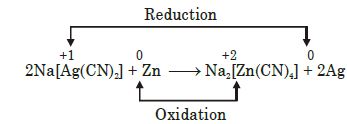
$2Na[Ag(CN)_2] + Zn \to Na_2[Zn(CN)_4] + 2Ag$
- B
$BaO_2 + H_2SO_4 \to BaSO_4 + H_2O_2$
- C
$N_2O_5 + H_2O \to 2HNO_3$
- D
$AgNO_3 + KI \to AgI + KNO_3$
AnswerCorrect option: A. $2Na[Ag(CN)_2] + Zn \to Na_2[Zn(CN)_4] + 2Ag$
a
View full question & answer→MCQ 711 Mark
For the redox reaction
$xP_4 + yHNO_3 \to H_3PO_4 + NO_2 + H_2O$
- A
$x = 1, y = 5$
- B
$x = 2, y = 10$
- ✓
$x = 1, y = 20$
- D
$x = 1, y = 15$
AnswerCorrect option: C. $x = 1, y = 20$
c
$P_4 + 20HNO_3 \to 4H_3PO_4 + 20NO_2 + 4H_2O$
View full question & answer→MCQ 721 Mark
The values of coefficients to balance the following reaction are
$Cr{(OH)_3} + Cl{O^ - } + O{H^ - } \to CrO_4^{2 - } + C{l^ - } + {H_2}O$
$Cr{(OH)_3}$ $-$ $Cl{O^ - }$ - $CrO_4^{2 - }$ $-$ $Cl^-$
- A
$2$ $-$ $3$ $-$ $3$ $-$ $3$
- B
$2$ $-$ $4$ $-$ $3$ $-$ $2$
- C
$2$ $-$ $4$ $-$ $4$ $-$ $2$
- ✓
$2$ $-$ $3$ $-$ $2$ $-$ $3$
AnswerCorrect option: D. $2$ $-$ $3$ $-$ $2$ $-$ $3$
d
$2Cr{(OH)_3} + 3Cl{O^ - } + 4O{H^ - } \to 2CrO_4^{2 - } + 3C{l^ - } + 5{H_2}O$
View full question & answer→MCQ 731 Mark
In the balanced chemical reaction
$IO_3^-+ aI^-+ bH^+ \to cH_2O + dI_2$
$a, b, c, d$ respectively corresponds to
- ✓
$5, 6, 3, 3$
- B
$5, 3, 6, 3$
- C
$3, 5, 3, 6$
- D
$5, 6, 5, 5$
AnswerCorrect option: A. $5, 6, 3, 3$
a
$IO_3^ - + \mathop {5{I^ - }}\limits_a + \mathop {6{H^ + }}\limits_b \to \mathop {3{H_2}O}\limits_c + \mathop {3{I_2}}\limits_d $
View full question & answer→MCQ 741 Mark
What will be the coefficients in the balanced form of following equation $xIO_3^ - \, + \,yHSO_3^ - \, \to \,z{I^ - }\, + \,p{H^ + }\, + \,qSO_4^{-2}$
$x\,\,\,\,\,\,\,\,\,\,y\,\,\,\,\,\,\,\,\,\,z$
- A
$1\,\,\,\,\,\,\,\,\,\,3\,\,\,\,\,\,\,\,\,\,3$
- B
$5\,\,\,\,\,\,\,\,\,\,3\,\,\,\,\,\,\,\,\,\,1$
- ✓
$1\,\,\,\,\,\,\,\,\,\,3\,\,\,\,\,\,\,\,\,\,1$
- D
$1\,\,\,\,\,\,\,\,\,\,2\,\,\,\,\,\,\,\,\,\,1$
AnswerCorrect option: C. $1\,\,\,\,\,\,\,\,\,\,3\,\,\,\,\,\,\,\,\,\,1$
c
$IO_3^ - \, + \,3HSO_3^ - \, \to \,{I^ - }\, + \,3{H^ + }\, + \,3SO_4^{ - 2}$
View full question & answer→MCQ 751 Mark
Which of the following equations is a balanced one ?
- A
$5BiO_3^- + 22H^+ +Mn^{2+} \to 5Bi^{3+} + 7H_2O + MnO_4^-$
- ✓
$5BiO_3^- + 14H^+ + 2Mn^{2+} \to 5Bi^{3+} + 7H_2O + 2MnO_4^-$
- C
$2BiO_3^- + 4H^+ +Mn^{2+} \to 2Bi^{3+} + 2H_2O + MnO_4^-$
- D
$6BiO_3^- + 12H^+ + 3Mn^{2+} \to 6Bi^{3+} + 6H_2O + 3MnO_4^-$
AnswerCorrect option: B. $5BiO_3^- + 14H^+ + 2Mn^{2+} \to 5Bi^{3+} + 7H_2O + 2MnO_4^-$
b
The balanced redox equation is as given below:
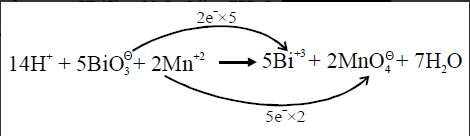
$5 \mathrm{BiO}_{3}^{-}+14 \mathrm{H}^{+}+2 \mathrm{Mn}^{2+} \rightarrow 5 \mathrm{Bi}^{3+}+7 \mathrm{H}_{2} \mathrm{O}+2 \mathrm{MnO}_{4}^{-}$
In this equation, the number of atoms of each element on the left side are equal to the number of atoms on the right side.
The charges are also balanced on the two sides of equation.
Hence, option B is the correct answer.
View full question & answer→MCQ 761 Mark
$KI$ is oxidised into $I_2$ by using the reagent
AnswerCorrect option: C. $CuSO_4$ solution
c
$2 CuSO_4 + 4KI \rightarrow K_2SO_4 + Cu_2I_2 + I_2$
View full question & answer→MCQ 771 Mark
The number of moles of acidified $KMnO_4$ required to convert one mole of sulphite ion into sulphate ion is
Answera
The balanced chemical reaction is:
$2 \mathrm{MnO}_{4}^{-}+5 \mathrm{CO}_{4}^{2-}+16 \mathrm{H}^{+} \rightarrow 2 \mathrm{Mn}^{2+}+5 \mathrm{SO}_{4}^{2-}+3 \mathrm{H}_{2} \mathrm{O}$
From the balanced chemical equation we can say that:
$\because 5$ moles $\mathrm{SO}_{4}^{2-}$ reacts with 2 moles of $\mathrm{KMnO}_{4}$.
$\therefore 1$ mole $\mathrm{SO}_{4}^{2-}$ reacts with $2 / 5$ mole of $\mathrm{KMnO}_{4}$
Hence, the correct option is $\mathrm{A}$
View full question & answer→MCQ 781 Mark
Number of moles of ${K_2}C{r_2}{O_7}$ reduced by one mole of $S{n^{2 + }}$ ions is
Answera
Ionic form of reaction is:
$Cr _2 O _7^{2-}+ Sn ^{+2}+ H ^{+} \rightarrow Sn ^{-4}+ Cr ^{+3}+ H _2 O$
Step $1:$ Assign the oxidation state using oxidation number of $O =-2$.
we get:
$Cr _2 O _7^{2-}+ Sn ^{+2+}+ H ^{+} \rightarrow Sn ^{+4}+ Cr ^{+3}+ H _2 O$
Reduction half-reaction:
$Cr _2 O _7^{2-} \rightarrow 2 Cr ^{-3}:$ Gain of 6 electrons
Oxidation half reaction:
$Sn ^{+2} \rightarrow Sn ^{+4}:$ Loss of $2$ electrons
Step $2:$ Equalise the number of electrons as:
Oxidation half reaction:
$3 Sn ^{-2} \rightarrow 3 Sn ^{+4}$
Step $3:$ balance $O$ atoms by adding $H _2 O$ and then $H$ by $H ^{+}$
$Cr _2^{+6} O _7^{2-}+14 H ^{+} \rightarrow 2 Cr ^{-3+}+7 H _2 O$
Step $4:$ overall reaction:
$Cr _2^{+6} O _7^{2-}+14 H ^{+}+3 Sn ^{+2} \rightarrow 2 Cr ^{3+}+3 Sn ^{+4}+7 H _2 O$
Thus $3$ mole of $Sn ^{2+}$ will reduce 1 moles of $K _2 Cr _2 O _7$.
Therefore,$1$ mole of $Sn ^{2+}$ will reduce $\frac{1}{3}$ moles of $K _2 Cr _2 O _7$.
View full question & answer→MCQ 791 Mark
In a balanced equation ${H_2}S{O_4} + x\,HI \to {H_2}S + y\,{I_2} + z\,{H_2}O$, the values of $ x, y, z$ are
- A
$x = 3, y = 5, z = 2$
- B
$x = 4, y = 8, z = 5$
- ✓
$x = 8, y = 4, z = 4$
- D
$x = 5, y = 3, z = 4$
AnswerCorrect option: C. $x = 8, y = 4, z = 4$
(c) The values of $x,\,y,\,z$ are $8, 4, 4 $ respectively hence the reaction is${H_2}S{O_4} + 8HI \to {H_2}S + 4{I_2} + 4{H_2}O$
View full question & answer→MCQ 801 Mark
In the reaction ${B_2}{H_6} + 2KOH + 2X \to 2Y + 6{H_2},$ $X $ and $Y$ are respectively
- A
${H_2}$, ${H_3}B{O_3}$
- B
$HCl$, $KB{O_3}$
- C
${H_2}O,\,\,KB{O_3}$
- ✓
${H_2}O$, $KB{O_2}$
AnswerCorrect option: D. ${H_2}O$, $KB{O_2}$
(d) ${B_2}{H_6} + 2KOH + 2{H_2}O \to 2KB{O_2} + 6{H_2}$.
View full question & answer→MCQ 811 Mark
Which one of the following reactions is not an example of redox reaction
- A
$C{l_2} + 2{H_2}O + S{O_2} \to 4{H^ + } + S{O^{4 - }} + 2C{l^ - }$
- B
$C{u^{ + + }} + Zn \to Z{n^{ + + }} + Cu$
- C
$2{H_2} + {O_2} \to 2{H_2}O$
- ✓
$HCl + {H_2}O \to {H_3}{O^ + } + C{l^ - }$
AnswerCorrect option: D. $HCl + {H_2}O \to {H_3}{O^ + } + C{l^ - }$
(d) In reaction $HCl + {H_2}O \to {H_3}{O^ + } + C{l^ - }$, only reduction has taken place not oxidation.
View full question & answer→MCQ 821 Mark
Which of the following reactions involves oxidation-reduction
- A
$NaBr + HCl\, \to \,NaCl + HBr$
- B
$HBr + AgN{O_3}\, \to \,AgBr + HN{O_3}$
- ✓
${H_2} + B{r_2}\, \to \,2HBr$
- D
$2NaOH + {H_2}S{O_4}\, \to \,N{a_2}S{O_4} + 2{H_2}O$
AnswerCorrect option: C. ${H_2} + B{r_2}\, \to \,2HBr$
(c)
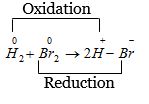
View full question & answer→MCQ 831 Mark
Which of the following reaction is a redox reaction
- A
${P_2}{O_5} + 2{H_2}O \to {H_4}{P_2}{O_7}$
- B
$2AgN{O_3} + BaC{l_2} \to 2AgCl + Ba{(N{O_3})_2}$
- C
$BaC{l_2} + {H_2}S{O_4} \to BaS{O_4} + 2HCl$
- ✓
$Cu + 2AgN{O_3} \to 2Ag + Cu{(N{O_3})_2}$
AnswerCorrect option: D. $Cu + 2AgN{O_3} \to 2Ag + Cu{(N{O_3})_2}$
(d) This is a redox reaction.
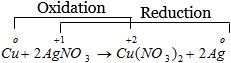
View full question & answer→MCQ 841 Mark
What is $ ‘A’$ in the following reaction $2F{e^{3 + }}_{(aq)} + S{n^{2 + }}_{(aq)} \to 2F{e^{2 + }}_{(aq)} + A$
- A
$S{n^{3 + }}_{(aq)}$
- ✓
$S{n^{4 + }}_{(aq)}$
- C
$S{n^{2 + }}_{(aq)}$
- D
$Sn$
AnswerCorrect option: B. $S{n^{4 + }}_{(aq)}$
b
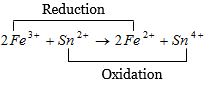
View full question & answer→MCQ 851 Mark
$2MnO_4^ - + 5{H_2}{O_2} + 6{H^ + } \to 2\,\,Z + 5{O_2} + 8{H_2}O$. In this reaction $Z $ is
- ✓
$M{n^{ + 2}}$
- B
$M{n^{ + 4}}$
- C
$Mn{O_2}^{}$
- D
$Mn$
AnswerCorrect option: A. $M{n^{ + 2}}$
(a) $2MnO_4^\Theta + 5{H_2}{O_2} + 6{H^ + } \to 2M{n^{2 + }} + 5{O_2} + 8{H_2}O$.
View full question & answer→MCQ 861 Mark
The number of electrons involved in the reduction of $C{r_2}O_7^{2 - }$ in acidic solution to $C{r^{3 + }}$ is
Answerc
In this reaction three electrons are required for the reduction of $C{r_2}O_7^{2 - }$ into $2C{r^{3 + }}$.
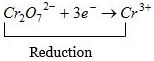
View full question & answer→MCQ 871 Mark
${C_2}{H_6}_{(g)} + n{O_2}\, \to \,C{O_2}\,_{(g)} + {H_2}O\,_{(l)}$ In this equation, the ratio of the coefficients of $C{O_2}$ and ${H_2}O$ is
Answer(b) The balanced equation is $2{C_2}{H_6} + 7{O_2} \to 4C{O_2} + 6{H_2}O$. Ratio of the coefficients of $C{O_2}$ and ${H_2}O$ is $4 : 6$ or $2 : 3$.
View full question & answer→MCQ 881 Mark
Oxidation of thiosulphate ${S_2}O_3^{2 - }$ ion by iodine gives
- A
$SO_3^{2 - }$
- B
$SO_4^{2 - }$
- ✓
${S_4}O_6^{2 - }$
- D
${S_2}O_6^{2 - }$
AnswerCorrect option: C. ${S_4}O_6^{2 - }$
(c) $2{S_2}O_3^{2 - } + {I_2} \to {S_4}O_6^{2 - } + 2{I^ - }$.
View full question & answer→MCQ 891 Mark
The ultimate products of oxidation of most of hydrogen and carbon in food stuffs are
- A
${H_2}O$ alone
- B
$C{O_2}$ alone
- ✓
${H_2}O$ and $C{O_2}$
- D
AnswerCorrect option: C. ${H_2}O$ and $C{O_2}$
c
Food stuffs $+ O _2 \rightarrow CO _2+ H _2 O$
$( C$ and $H )$
View full question & answer→MCQ 901 Mark
Which of the following is a disproportionation reaction?
- ✓
$C{u_2}O\, + \,2{H^ + }\, \to \,Cu\, + \,\,C{u^{2 + }}\, + \,{H_2}O$
- B
$2CrO_4^{ - 2} + \,2{H^ + }\, \to \,C{r_2}O_7^{2 - }\, + \,{H_2}O$
- C
$CaC{O_3} + \,2{H^ + }\, \to \,C{a^{2 + }}\, + \,{H_2}O\, + \,C{O_2}$
- D
$C{r_2}O_7^{ - 2} + \,2O{H^ - }\, \to \,2CrO_4^{2 - }\, + \,{H_2}O$
AnswerCorrect option: A. $C{u_2}O\, + \,2{H^ + }\, \to \,Cu\, + \,\,C{u^{2 + }}\, + \,{H_2}O$
View full question & answer→MCQ 911 Mark
Which of the following ionic/molecular species does not disproportionate in water at room temperature?
- A
$NO_2$
- B
$Cu^+$
- C
$MnO_4^{2-}$
- ✓
$Ca(OCl)Cl$
AnswerCorrect option: D. $Ca(OCl)Cl$
d
$2N{O_2} + {H_2}O \to HN{O_3} + HN{O_2}\xrightarrow[{dispn.Rn.}]{{R.T.}}HN{O_3} + NO$
$2C{u^ + }(aq.)\xrightarrow{{R.T.}}Cu + C{u^{2 + }}(aq.)$
$3\mathop {Mn}\limits^{ + 6} O_4^{2 - }(aq.)\xrightarrow[{dispn.Rn.}]{{R.T.}}2\mathop {Mn}\limits^{ + 7} O_4^ - (aq.) + \mathop {Mn}\limits^{ + 4} {O_2} + 4O{H^ - }$
$Ca(OCl)Cl\xrightarrow{{Water}}C{a^{2 + }}(aq.) + C{l^ - }(aq.) + OC{l^ - }(aq.)$
View full question & answer→MCQ 921 Mark
Assign $A, B, C, D$ from given type of reaction.
${K_2}Mn{O_4} + {H^ + } \longrightarrow KMn{O_4} + Mn{O_2} \downarrow $
- ✓
for disproportionation reaction.
- B
for comproportionation reaction.
- C
for either intermolecular redox reaction or displacement reaction.
- D
for either thermal combination redox reaction or thermal decomposition redox reaction.
AnswerCorrect option: A. for disproportionation reaction.
View full question & answer→MCQ 931 Mark
Assign $A, B, C, D$ from given type of reaction. $XeF_4 +H_2O \longrightarrow Xe + XeO_3 + HF + O_2$
- ✓
for disproportionation reaction.
- B
for comproportionation reaction.
- C
for either intermolecular redox reaction or displacement reaction.
- D
for either thermal combination redox reaction or thermal decomposition redox reaction.
AnswerCorrect option: A. for disproportionation reaction.
View full question & answer→MCQ 941 Mark
Assign $A, B, C, D$ from given type of reaction.
$Ca{\left( {OH} \right)_2} + C{l_2} \longrightarrow CaOC{l_2}$ or $Ca(OCl)Cl$
- ✓
for disproportionation reaction.
- B
for comproportionation reaction.
- C
for either intermolecular redox reaction or displacement reaction.
- D
for either thermal combination redox reaction or thermal decomposition redox reaction.
AnswerCorrect option: A. for disproportionation reaction.
View full question & answer→MCQ 951 Mark
Assign $A, B, C, D$ from given type of reaction.
$P{b_3}{O_4} + HCl\,\left( {dil} \right)\xrightarrow{{Warm}}PbC{l_2} \downarrow + C{l_2} + {H_2}O$
- A
for disproportionation reaction.
- B
for comproportionation reaction.
- ✓
for either intermolecular redox reaction or displacement reaction.
- D
for either thermal combination redox reaction or thermal decomposition redox reaction.
AnswerCorrect option: C. for either intermolecular redox reaction or displacement reaction.
View full question & answer→MCQ 961 Mark
Assign $A, B, C, D$ from given type of reaction.
${I_2} + NaOH \longrightarrow NaI + NaOI$
- ✓
for disproportionation reaction.
- B
for comproportionation reaction.
- C
for either intermolecular redox reaction or displacement reaction.
- D
for either thermal combination redox reaction or thermal decomposition redox reaction.
AnswerCorrect option: A. for disproportionation reaction.
View full question & answer→MCQ 971 Mark
Assign $A, B, C, D$ from given type of reaction.
$C{l_2} + NaOH \longrightarrow NaCl + NaOCl$
- ✓
for disproportionation reaction.
- B
for comproportionation reaction.
- C
for either intermolecular redox reaction or displacement reaction.
- D
for either thermal combination redox reaction or thermal decomposition redox reaction.
AnswerCorrect option: A. for disproportionation reaction.
View full question & answer→MCQ 981 Mark
Assign $A, B, C, D$ from given type of reaction.
${S_8} + NaOH \longrightarrow N{a_2}S + N{a_2}{S_2}{O_3}$
- ✓
for disproportionation reaction.
- B
for comproportionation reaction.
- C
for either intermolecular redox reaction or displacement reaction.
- D
for either thermal combination redox reaction or thermal decomposition redox reaction.
AnswerCorrect option: A. for disproportionation reaction.
View full question & answer→MCQ 991 Mark
Assign $A, B, C, D$ from given type of reaction.
A for precipitate formation reaction.
B for precipitate dissolution reaction.
C for precipitate exchange reaction.
D for no reaction.
${P_4} + NaOH \longrightarrow P{H_3} \uparrow + Na{H_2}P{O_2}$
- ✓
for disproportionation reaction.
- B
for comproportionation reaction.
- C
for either intermolecular redox reaction or displacement reaction.
- D
for either thermal combination redox reaction or thermal decomposition redox reaction.
AnswerCorrect option: A. for disproportionation reaction.
View full question & answer→MCQ 1001 Mark
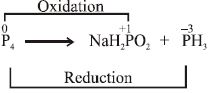
${P_4}\, + \,3NaOH\, + \,3{H_2}O\, \to \,3Na{H_2}P{O_2}\, + \,P{H_3}$ is an example of
- A
Inter molecular Redox reaction
- B
Intra molecular Redox reaction
- ✓
Disproportionation Redox reaction
- D
AnswerCorrect option: C. Disproportionation Redox reaction
c
View full question & answer→MCQ 1011 Mark
Which of the following is not a redox reaction
- A
$2Rb + 2{H_2}O \to 2RbOH + {H_2}$
- B
$2Cu{I_2} \to 2CuI + {I_2}$
- C
$2{H_2}{O_2} \to 2{H_2}O + {O_2}$
- ✓
$4KCN + Fe{(CN)_2} \to {K_4}Fe{(CN)_6}$
AnswerCorrect option: D. $4KCN + Fe{(CN)_2} \to {K_4}Fe{(CN)_6}$
(d) In the reaction $4KCN + Fe{(CN)_2} \to {K_4}Fe{(CN)_6}$, change in oxidation state is not taking place.
View full question & answer→MCQ 1021 Mark
The stability order of oxide, peroxide and superoxide of alkaline metals is
- ✓
Normal oxide $>$ Peroxide $>$ Superoxide
- B
Peroxide $>$ Normal oxide $>$ Superoxide
- C
Superoxide $>$ Normal oxide $>$ Peroxide
- D
AnswerCorrect option: A. Normal oxide $>$ Peroxide $>$ Superoxide
View full question & answer→MCQ 1031 Mark
$2\, mole$ of $N_2H_4$ loses $16\, mole$ of electron is being converted to a new compound $X$. Assuming that all of the $N$ appears in the new compound. What is the oxidation state of $'N'$ in $X$ ?
Answerc
$1\, mole$ $N_2H_4$ loses $8\, mole$ $e^-$; $1\, mole$ $N$ loses $4\, mole$ of $e^-$
$\therefore \,$ New oxidation state of $N$ is $-2+4 \Rightarrow 2$
View full question & answer→MCQ 1041 Mark
What is the equivalent weight of hydrochloric acid in given redox reaction
$MnO_2+ 4HCl \to MnCl_2 + 2H_2O + Cl_2$
If molar mass of hydrochloric acid is $M$.
Answerd
$n$ factor for $4\, mol HCl$ is $2$
$n$ factor for $1\, mol HCl =\frac{2}{4}=\frac{1}{2}$
Eq. wt. of $HCl =\frac{ M }{ n \cdot \text { factor }}=\frac{ M }{1 / 2}=2\, M$
View full question & answer→MCQ 1051 Mark
In which of the following reaction element sulphur get reduced
- A
$SO_3^{2 - } + C{r_2}O_7^{2 - } \longrightarrow SO_4^{2 - } + C{r^{ + 3}}$
- B
${H_2}S + MnO_4^ - \longrightarrow M{n^{ + 2}} + S$
- ✓
${H_2}S{O_4} + {I^ - } \longrightarrow {I_2} + S{O_2}$
- D
$H_2SO_4 + 2NaOH \longrightarrow Na_2SO_4 + 2H_2O$
AnswerCorrect option: C. ${H_2}S{O_4} + {I^ - } \longrightarrow {I_2} + S{O_2}$
c
$\mathop {{H_2}S{O_4}}\limits^{ + 6} \longrightarrow \mathop {S{O_2}}\limits^{ + 4\,\,\,\,\,\,\,\,} $
View full question & answer→MCQ 1061 Mark
In which of the following reactions is there a change in the oxidation number of nitrogen atom ?
- A
$2NO_2 \longrightarrow N_2O_4$
- B
$NH_3 + H_2O \longrightarrow NH_4^+ + OH^-$
- C
$N_2O_5 + H_2O \longrightarrow 2HNO_3$
- ✓
$N_2 + 3H_2 \longrightarrow 2NH_3$
AnswerCorrect option: D. $N_2 + 3H_2 \longrightarrow 2NH_3$
d
$\mathop {{N_2}}\limits^0 \to \mathop {N{H_3}}\limits^{ - 3\,\,\,\,\,\,\,\,} $
View full question & answer→MCQ 1071 Mark
Which one of the following does not have an underlined atom with fractional oxidation state
- A
$\underline{Fe}_3O_4$
- B
$\underline{N}_3H$
- C
$K\underline{O}_2$
- ✓
$Na_2\underline{S}_2O_3$
AnswerCorrect option: D. $Na_2\underline{S}_2O_3$
View full question & answer→MCQ 1081 Mark
Which of the following can act both as an oxidising as well as reducing agent ?
- ✓
$HNO_2$
- B
$KMnO_4$
- C
$H_2S$
- D
$H_2SO_4$
AnswerCorrect option: A. $HNO_2$
a
Central atom nitrogen $(O.N. = +3)$ present in intermediate oxidation state so it can act as oxidant as well as reductant.
View full question & answer→MCQ 1091 Mark
Which of the following is not a peroxide
- A
$Na_2O_2$
- B
$CaO_2$
- ✓
$PbO_2$
- D
$H_2O_2$
AnswerCorrect option: C. $PbO_2$
c
$PbO _2$ are not true peroxide because they do not liberate $H _2 O _2$ on treatment with dilute acids.
Lead $(IV)$ oxide and the lead atom shares its $4$ electrons $2$ each with oxygen atoms. In Peroxide there a bond sharing of two oxygen atoms as in:
Hydrogen Peroxide $H - O - O - H$
Water is an oxide $H - O - H$
Likewise $PbO _2$ is an oxide $P$ b has a valency $4$
$O = Pb = O$
View full question & answer→MCQ 1101 Mark
Oxidation state of $"S"$ in Peroxodisulphuric acid and Sodium tetrathionate are
- A
$+\,6,\,\, + \,5,\,\, 0$
- B
$+\, 6, \,\,+ \,6,\,\, +\, 6$
- ✓
$10\,mole$ of ferric oxalate is oxidised by $x$ mole of $MnO_4^-$ in acidic medium. The value of $'x'$ is
- D
$+ \,6, \,\,+\, 2,\, \,0$
AnswerCorrect option: C. $10\,mole$ of ferric oxalate is oxidised by $x$ mole of $MnO_4^-$ in acidic medium. The value of $'x'$ is
View full question & answer→MCQ 1111 Mark
The oxidation number of $Cr$ in $K_3CrO_8$ is $+5$ how many peroxy linkages are present in this molecule
Answera
The number of peroxy linkages in a compound can be calculated by using the formula = (Theoretical Oxidation number) - (Maximum Oxidation number)
View full question & answer→MCQ 1121 Mark
Oxidation number of $N$ in ammonium nitrate is
- A
$+3$
- B
$-3$
- ✓
$-3$ and $+5$
- D
$+5$
AnswerCorrect option: C. $-3$ and $+5$
c
Ammonium nitrate $\longrightarrow \mathrm{NH}_{4} \mathrm{NO}_{3}$
which can be written as $\mathrm{NH}_{4}^{+} \mathrm{NO}_{3}^{-}$ For $\mathrm{NH}_{4}^{+}$
Let oxidation state of $\mathrm{N}=\mathrm{x}$
we know that oxidation state of $\mathrm{H}=+1$
Sum of total oxidation state of all atoms $=$ Overall charge on the compound. $x+4 \times(1)=1$
$\mathrm{x}=-3$
Let oxidation state of $\mathrm{N}$ in $\mathrm{N} \mathrm{O}_{3}^{-}=\mathrm{y}$, we know that oxidation state of $\mathrm{O}=-2$
Applying above formula $y+3 \times(-2)=1$
$y=+5$
Oxidation state of $\mathrm{N}$ in $\mathrm{NH}_{4} \mathrm{N} \mathrm{O}_{3}=-3,+5$
View full question & answer→MCQ 1131 Mark
Which one has maximum oxidation number of phosphorous
- A
$PH_3$
- B
$H_4P_2O_6$
- ✓
$H_3PO_4$
- D
$H_3PO_3$
AnswerCorrect option: C. $H_3PO_4$
View full question & answer→MCQ 1141 Mark
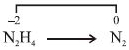
$N_2H_4 + IO_3^-+ 2H^+ + Cl^-\to ICl + N_2 + 3H_2O$ What is the equivalent weight of reductant in the above reaction
Answerb
$n$ factor $=2 \times 2=4$
$\mathrm{EW}=\frac{32}{4}=8$
View full question & answer→MCQ 1151 Mark
$KMnO_4$ oxidises oxallic acid to $CO_2$ in acidic medium then equivalent weight of $KMnO_4$ is $(Mn = 55)$
- A
$158$
- ✓
$31.6$
- C
$39.6$
- D
$52.67$
AnswerCorrect option: B. $31.6$
b
$\mathrm{M} \mathrm{n} \mathrm{O}_{4}^{-} \quad \rightarrow \quad$ (Oxidation number of $\left.\mathrm{Mn}=+2\right)$
Equivalent mass of $\mathrm{KMnO}_{4}=\frac{\text { Molecular mass }}{\text { Change in oxidation number }}$ $=\frac{158}{5}=31.6$
View full question & answer→MCQ 1161 Mark
Maximum oxidation state is present in
- A
$MnO_2$
- B
$MnO$
- ✓
$MnO_4^\Theta $
- D
$[Fe(CN)_6]^{-4}$
AnswerCorrect option: C. $MnO_4^\Theta $
c
COMPOUND OXIDATION STATE
$\begin{array}{ll}\mathrm{CrO}_{2} \mathrm{Cl}_{2} & +6 \\ \mathrm{MnO}_{4}^{-} & +7 \quad \text { (Maximum) } \\ \mathrm{MnO}_{2} & +4 \\ {\left[\mathrm{Fe}(\mathrm{CN})_{6}\right]^{3-}} & +3 \\ {\left[\mathrm{Co}(\mathrm{CN})_{6}\right]^{3-}} & +3 \\ \mathrm{MnO} & +2\end{array}$
View full question & answer→MCQ 1171 Mark
Which one is incorrect statement
- A
Fluorine always shows $-1$ oxidation state in combined state
- ✓
Hydrogen always shows $+1$ oxidation state in combined state.
- C
Sodium always shows $+1$ oxidation state in combined state.
- D
Calcium always shows $+2$ oxidation state in combined state.
AnswerCorrect option: B. Hydrogen always shows $+1$ oxidation state in combined state.
View full question & answer→MCQ 1181 Mark
Oxidation state of $H, N, C$ in $HNC$ are respectively
- A
$-3, +1, +2$
- B
$-2, +1, -2$
- ✓
$+1, -3, +2$
- D
$-2, -1, +3$
AnswerCorrect option: C. $+1, -3, +2$
c
$\mathop H\limits^{ + 1} \, - \mathop N\limits_{ - 2}^{ - 1} \,\vec = \,{C^{ + 2}}$
View full question & answer→MCQ 1191 Mark
In which of the following compounds nitrogen exhibits highest oxidation state ?
- ✓
$N_3H$
- B
$NH_2OH$
- C
$N_2H_4$
- D
$NH_3$
AnswerCorrect option: A. $N_3H$
a
$\mathrm{N}_{2} \mathrm{H}_{4} \Rightarrow 2 x+4(+1)=0 \Rightarrow 2 x+4=0$
$\Rightarrow \quad x=-2$
$\mathrm{NH}_{3} \Rightarrow x+3(+1)=0 \Rightarrow x=-3$
$\mathrm{N}_{3} \mathrm{H} \Rightarrow 3 x+1(+1)=0$
$\Rightarrow 3 x+1=0 \Rightarrow x=-1 / 3$
$\mathrm{NH}_{2} \mathrm{OH} \Rightarrow x+2+1(-2)+1=0$
$\Rightarrow x+1=0$
$\Rightarrow x=-1$
View full question & answer→MCQ 1201 Mark
In the reaction
$8 Al + 3Fe_3O_4 \to 4Al_2O_3 + 9 Fe$
the number of moles of electrons transfered by $1\,mol$ of reductant
Answerc
$R.A.$
Change in oxidation no. of
reductant $=$ moles of electrons transferred by
$1$ mol reductant $=3$

View full question & answer→MCQ 1211 Mark
Which of the following is not correctly matched
- A
$CrO_5$ ; oxidation number of $Cr = +10$
- B
$Fe_3O_4$ ; oxidation state of $Fe =-\frac {8}{3}$
- C
$Na-Hg$ ; oxidation number of $Na$ is $= +1$
- ✓
Answerd
$Cr = +6\, ,Fe = +2,\, +3\,, Na = 0$
View full question & answer→MCQ 1221 Mark
Equivalent mass of oxidizing agent in the reaction is $SO_2 + 2H_2S \to 3S + 2H_2O$ is
Answerb
$E = \frac{{{M_W}}}{{n\,factor}}\,;\,E = \frac{{({M_W})S{O_2}}}{4} = \frac{{64}}{4} = 16$
View full question & answer→MCQ 1231 Mark
The correct set of oxidation number of $N$ in $NH_4NO_2$ is
- A
$-3,\, +5$
- B
$+5,\, -3$
- C
$-3,\,-3$
- ✓
$-3,\, +3$
AnswerCorrect option: D. $-3,\, +3$
d
$N{H_4}N{O_2} \to \mathop {\mathop {NH_4^ + }\limits_ \downarrow }\limits_{ - 3} + \mathop {\mathop {NO_2^ - }\limits_ \downarrow }\limits_{ + 3} $
View full question & answer→MCQ 1241 Mark
Which of following reaction does not involve either oxidation or reduction
AnswerCorrect option: C. $CrO_4^{-2} \to Cr_2O_7^{-2}$
c
$\mathop {CrO_4^{ - 2}}\limits^{ + 6} \to \mathop {C{r_2}O_7^{ - 2}}\limits^{ + 6} $
View full question & answer→MCQ 1251 Mark
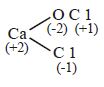
Oxidation state of both the chlorine atoms in bleaching powder are ?
- A
$+1, +1$
- B
$-1, -1$
- C
$0, -1$
- ✓
$+1, -1$
AnswerCorrect option: D. $+1, -1$
d
View full question & answer→MCQ 1261 Mark
What is the oxidation number of $Fe$ and $Cr$ in $FeCr_2O_4$
- ✓
$+2$ and $+3$
- B
$0$ and $+2$
- C
$+2$ and $+6$
- D
$+3$ and $+6$
AnswerCorrect option: A. $+2$ and $+3$
a
$\mathrm{FeCr}_{2} \mathrm{O}_{4}$
$\mathrm{Fe}: \mathrm{x}+6+(4 \times-2)=0$
$\Rightarrow \mathrm{x}=8-6$
$\Rightarrow \mathrm{x}=+2$
$\mathrm{Cr}: 2+2 \mathrm{x}+(4 \times-2)=0$
$\Rightarrow 2 \mathrm{x}=8-2$
$\Rightarrow \mathrm{x}=6 / 2$
$\Rightarrow \mathrm{x}=+3$
View full question & answer→MCQ 1271 Mark
In which of the following molecule or ion sulphur has minimum oxidation number
- A
$SO_3^{-2}$
- B
$H_2S_2O_8$
- ✓
$S_2O_3^{-2}$
- D
$SO_2$
AnswerCorrect option: C. $S_2O_3^{-2}$
View full question & answer→MCQ 1281 Mark
Choose the pair of species in which oxidation number of nitrogen is same
- ✓
$NO_2^ -\,,\,N_2O_3$
- B
$NO_3^-\,,\, NO_2$
- C
$NO\,,\, N_2O_5$
- D
AnswerCorrect option: A. $NO_2^ -\,,\,N_2O_3$
a
$+3$
View full question & answer→MCQ 1291 Mark
Which of the following shows a metal being oxidised ?
AnswerCorrect option: D. Both $(A)$ and $(B)$
View full question & answer→MCQ 1301 Mark
The oxidation number of $H$ in $KH, MgH_2$ and $NaOH$ are respectively
- ✓
$-1, -1, +1$
- B
$+1, +1, +1$
- C
$+2, +11, -2$
- D
$-2, -3, -1$
AnswerCorrect option: A. $-1, -1, +1$
a
Metal hydride : $KH, MgH_2$
Oxidation state of $H = -1$
$NaOH$ (Hydroxide)
Oxidation state of $H = +1$
View full question & answer→MCQ 1311 Mark
In which pair of species the oxidation number of chlorine is same
- A
$ClO^{-1}, HClO_3$
- ✓
$ICl, NaCl$
- C
$NaCl, NaClO_3$
- D
$ICl, ClF_3$
AnswerCorrect option: B. $ICl, NaCl$
b
$IC{l^{ - 1}},\,NaC{l^{ - 1}}$
$\mathop {Cl{O^ - }}\limits^{ + 1} ,\, + \mathop {HCl{O_3}}\limits^{ + 5} ,\,\mathop {NaCl{O_3}}\limits^{ + 5} $
View full question & answer→MCQ 1321 Mark
Oxidation number of $C$ in $HNC$ is
Answera
$H-\stackrel{..}{N}\stackrel{\rightarrow}{=}C$
$+1 \; \stackrel{-1}{-2}\,+2$
direction of co-ordinate bond is from more $EN$ atom to less $EN$ atom. So there is no development of charge due to this co-ordinate bond.
So in $\mathrm{HNC} \Rightarrow$
$\mathrm{O} \cdot \mathrm{N} \text { of } \mathrm{H}=+1$
$\mathrm{O} \cdot \mathrm{N}$ of $\mathrm{N}=-3$
$\mathrm{O} \cdot \mathrm{N}$ of $\mathrm{C}=+2$
View full question & answer→MCQ 1331 Mark
Oxidation numbers of $P$ in $PO_4^{3-} , S$ in $SO_4^{2-}$ and that of $Cr$ in $Cr_2O_7^{2-}$ are respectively
- A
$-3, +6$ and $+6$
- ✓
$+5, +6$ and $+6$
- C
$+3, +6$ and $+5$
- D
$+5, +3$ and $+6$
AnswerCorrect option: B. $+5, +6$ and $+6$
b
Let oxidation number of $\mathrm{P}$ in $\mathrm{PO}_{4}{ }^{3-}$ be $\mathrm{x}$.
$\therefore x+4(-2)=-3=>x=+5$
Let oxidation number of $\sin \mathrm{SO}_{4}^{2-}$ be y.
$\therefore y+4(-2)=-2=>y=+6$
Let oxidation number of Crin $\mathrm{Cr}_{2} \mathrm{O}_{7}^{2-}$ be z.
$\therefore 2 z+7(-2)=-2=>z=+6$
View full question & answer→MCQ 1341 Mark
In acidic medium, $H_2O_2$ changes $Cr_2O_7^{-2}$ to $CrO_5$ which has two $(-O-O)$ bonds. Oxidation state of $Cr$ in $CrO_5$ is
Answerc
$\mathrm{CrO}_{5}$ has $2$ peroxy linkage.

View full question & answer→MCQ 1351 Mark
The oxidation number of sulphur in $S_8, S_2F_2$ and $H_2S$ respectively are
- ✓
$0, +1, -2$
- B
$+2, +1, -2$
- C
$0, +1, +2$
- D
$-2, +1, -2$
AnswerCorrect option: A. $0, +1, -2$
a
$\mathrm{S}_{8} \Rightarrow$ (Homo atomic molecule)
$\Rightarrow \Delta \mathrm{EN}=0$
$O. {N}$ of $\mathrm{S}=0$
$\mathrm{S}_{2} \mathrm{F}_{2} \Rightarrow(\mathrm{O} . \mathrm{N} \text { of } \mathrm{F} \text { is always }-1)$
$2 x+(-1) \times 2=0$
${2 x=2} $
${x=+1}$
So $O.{N}$ of $\mathrm{S}$ in $\mathrm{S}_{2} \mathrm{F}_{2}=+1$
$\mathrm{H}_{2} \mathrm{S}$
$ 1 \times 2+x =0 $
$ x=-2$
So $O. {N}$ of $\mathrm{S}$ in $\mathrm{H}_{2} \mathrm{S}=-2$
View full question & answer→MCQ 1361 Mark
In Which of the following process nitrogen undergoes in oxidation process
- A
${N_{2\,}}\, \to \,H{N_3}$
- B
${N_{2\,}}{O_4}\, \to \,2N{O_2}$
- C
$NO_3^ - \, \to \,{N_2}{O_5}$
- ✓
${N_2}O\, \to \,NO$
AnswerCorrect option: D. ${N_2}O\, \to \,NO$
View full question & answer→MCQ 1371 Mark
In acidic medium, equivalent weight of ${K_2}C{r_2}{O_7}$ $(mol.\,\,wt.\, = M)$ is
Answer(c) $C{r_2}O_7^{2 - } + 14{H^ + } + 6{e^-} \to 2C{r^{3 + }} + 7{H_2}O$
${\text{Equivalent}}\,\,{\text{weight}}\,\,{\text{of }}{K_2}C{r_2}{O_7}$
$ = \frac{{{\text{Molecular}}\,\,{\text{Mass}}}}{6}$$ = \frac{{294.2}}{6} = \frac{M}{6}$.
View full question & answer→MCQ 1381 Mark
In alkaline condition $KMn{O_4}$ reacts as $2KMn{O_4} + 2KOH \to 2{K_2}Mn{O_4} + {H_2}O + O$. The equivalent weight of $KMn{O_4}$ would be (Atomic mass of $K$ $= 39$, $Mn = 55$, $O = 16$)
- ✓
$158$
- B
$79$
- C
$52.7$
- D
$31.6$
Answer(a) ${e^ - } + M{n^{7 + }} \to M{n^{6 + }}$ $\therefore E = \frac{M}{1}$.
View full question & answer→MCQ 1391 Mark
Oxidation number of $S$ in $N{a_2}S{O_4}$ is
Answer(d) $\mathop {N{a_2}S{O_4}}\limits^{\,\,\, * } $
$2 + x - 2 \times 4 = 0$
$x = + 6$.
View full question & answer→MCQ 1401 Mark
Consider the following statements :
In the chemical reaction
$Mn{O_2} + 4HCl \to MnC{l_2} + 2{H_2}O + C{l_2}$
$(1)$ Manganese ion is oxidised
$(2)$ Manganese ion is reduced
$(3)$ Chloride ion is oxidised
$(4)$Chloride ion is reduced.
Which of these statements are correct
- A
$1$ and $3$
- B
$1$ and $4$
- ✓
$2$ and $3$
- D
$2$ and $4$
AnswerCorrect option: C. $2$ and $3$
(c) Because the oxidation state of chlorine is $-4$ to $0$ while Manganese ion is reduced because its oxidation state $+ 4$ to $+ 2.$
View full question & answer→MCQ 1411 Mark
Oxidation number of oxygen in potassium super oxide $(K{O_2})$ is
AnswerCorrect option: C. $-1/2$
(c) $\mathop {K{O_2}\,}\limits^ * $, $ + 1 + 2x = 0,\,\,x = - \frac{1}{2}$.
View full question & answer→MCQ 1421 Mark
${M^{ + 3}}$ ion loses $3{e^ - }$. Its oxidation number will be
Answer(c) $2$ $×$ No. of ${e^ - }$ losses = Oxi. no.
$2 \times 3{e^ - } = + 6$.
View full question & answer→MCQ 1431 Mark
Match List $I$ with List $II$ and select the correct answer using the codes given below the lists
$\begin{array}{|l|l|} \hline \,\,List\,\,\,\,I\,\,(Compound) & \,\,List\,\,II\,\,(Oxidation\,\,state\,\,of\,\,N) \\ \hline (A)\,\,N{{O}_{2}} & (1)\,\,\,\,+\,\,5 \\ \hline (B)\,\,HNO & (2)\,\,-\,\,3 \\ \hline (C)\,\,N{{H}_{3}} & (3)\,\,+\,\,4 \\ \hline (D)\,\,{{N}_{2}}{{O}_{5}} & (4)\,\,+\,\,1 \\ \hline \end{array}$
code : $A \,\, B \,\,C \,\,D$
- A
$2 \, \,\,3\, \,\,4\,\, \,1$
- B
$3 \, \,\,1\, \,\,2\,\, \,4$
- ✓
$3 \, \,\,4\, \,\,2\,\, \,1$
- D
$2 \, \,\,3\, \,\,1\,\, \,4$
AnswerCorrect option: C. $3 \, \,\,4\, \,\,2\,\, \,1$
(c) (a) $\mathop N\limits^ * {O_2}$;$x - 4 = 0$;$x = + \,4$
(b) $H\mathop N\limits^ * O$;$1 + x - 2 = 0$;$x = + 1$
(c) $\mathop {N{H_3}}\limits^{ * \,\,\,\,\,\,} $; $x + 3 = 0$; $x = - 3$
(d) ${\mathop {N_2}\limits^ *}{O_5}$; $2x - 10 = 0$;$2x = 10$; $x = \frac{{10}}{2}$; $x = 5.$
View full question & answer→MCQ 1441 Mark
${H_2}S$ acts only as a reducing agent while $S{O_2}$ can act both as a reducing and oxidizing agent because
- A
$S$ in ${H_2}S$ has $-2$ oxidation state
- B
$S$ in $S{O_2}$ has oxidation state $+ 4$
- C
Hydrogen in ${H_2}S$ more $+ve$ than oxygen
- ✓
Both $(a)$ and $(b)$
AnswerCorrect option: D. Both $(a)$ and $(b)$
(d) In ${H_2}S$ sulphur shows $-2$ oxidation state and in $S{O_2}$ shows $+4$ oxidation state. Hence $S{O_2}$ shows both oxidising and reducing properties.
View full question & answer→MCQ 1451 Mark
The equivalent weight of $KI{O_3}$ in the reaction $2Cr{(OH)_3} + 4OH + KI{O_3} \to 2\,CrO_4^{2 - } + 5{H_2}O + KI$ is
- A
$Mole\, wt.$
- B
$\frac{{{\rm{Mol}}{\rm{. wt}}{\rm{.}}}}{{\rm{6}}}$
- C
$\frac{{{\rm{Mol}}{\rm{. wt}}{\rm{.}}}}{{\rm{2}}}$
- ✓
$\frac{{{\rm{Mol}}{\rm{. wt}}{\rm{.}}}}{{\rm{3}}}$
AnswerCorrect option: D. $\frac{{{\rm{Mol}}{\rm{. wt}}{\rm{.}}}}{{\rm{3}}}$
(d) $\frac{{{\rm{Molecular\, weight}}}}{3}$ Because in $KI{O_3}$ effective oxidation number is $3$.
View full question & answer→MCQ 1461 Mark
In the reaction ${I_2} + 2{S_2}O_3^{ - - } \to 2{I^ - } + {S_4}O_6^{ - - }$ equivalent weight of iodine will be equal to
AnswerCorrect option: A. $1/2$ of molecular weight
(a) $\frac{{{\rm{Molecular\, weight}}}}{2}$= Equivalent weight of Iodine.
View full question & answer→MCQ 1471 Mark
What is the equivalent mass of $IO_4^ - $ when it is converted into ${I_2}$ in acid medium
Answer(b) Equivalent mass $ = \frac{{{\rm{Molecular\, weight}}}}{{{\rm{Change\, in \,oxidation\,number\, per\, mole}}}}$
Suppose molecular weight is $M$ Oxidation number of ${I_2}$ in $IO_4^ - $ in Acidic medium i.e., $I \times ( - 8) + 1{e^ - } = + 7$
So eq. wt. $ = M/7$.
View full question & answer→MCQ 1481 Mark
In which of the following reactions there is no change in valency
- A
$4KCl{O_3}\, \to \,3KCl{O_4} + KCl$
- B
$C{l_2}$
- ✓
$Ba{O_2} + {H_2}S{O_4}\, \to \,\,BaS{O_4} + {H_2}{O_2}$
- D
$2BaO + {O_2}\, \to \,2Ba{O_2}$
AnswerCorrect option: C. $Ba{O_2} + {H_2}S{O_4}\, \to \,\,BaS{O_4} + {H_2}{O_2}$
C
$BaO _2+ H _2 SO _4 \longrightarrow BaSO_4 + H _2 O _2$
as we know oxygen in peroxide is hare $-1$ oxidation no.
So, $BaO _2$ and $H _2 O_2$ are peroxide have $-1$ oxidation in oxygon.
View full question & answer→MCQ 1491 Mark
If $1.2\, g$ of metal displace $1.12\, litre$ hydrogen at normal temperature and pressure ,equivalent weight of metal would be
- ✓
$12$
- B
$24$
- C
$1.2 $ $\div$ $11.2$
- D
$1.2 × 11.2$
Answer(a) $1.12\,ltr\,{H_2} = 1.2\,g;\,\,\therefore \,11.2\,ltr\,{H_2} = 12\,g$.
View full question & answer→MCQ 1501 Mark
In the equation ${H_2}S + 2HN{O_3} \to 2{H_2}O + 2N{O_2} + S$. The equivalent weight of hydrogen sulphide is
Answer(d) ${H_2}S \to \mathop S\limits^0 + 2e$
Equivalent wt. = $\frac{{{\rm{Mol}}{\rm{. wt}}{\rm{.}}}}{{\rm{2}}}$=$\frac{{34}}{2}$ $=17.$
View full question & answer→MCQ 1511 Mark
The oxidation state of $I$ in $IP{O_4}$ is
Answer(b) Let the oxidation number of $I$ in $IP{O_4} = x$ Oxidation number of $P{O_4} = - 3$
$x + ( - 3) = 0 \Rightarrow x = + 3$
View full question & answer→MCQ 1521 Mark
The oxidation number of sulphur in ${H_2}S$ is
Answer(a) ${H_2}S$ [ $O.N.$ of $H = + 1$ ]
$( + 1) \times 2 + x = 0$
$2 + x = 0$; $x = - 2$
View full question & answer→MCQ 1531 Mark
The oxidation state shown by silicon when it combines with strongly electropositive metals is
Answer(b) Silicon forms silicides with strongly electropositive metals (like $Na,\,Mg,\,K$ etc.) In these compounds. It has oxidation number $ = - 4$.
View full question & answer→MCQ 1541 Mark
Which of the following elements never show positive oxidation number
Answer(d) Fluorine is the most electronegative element in the periodic table so it never shows positive oxidation state.
View full question & answer→MCQ 1551 Mark
What is the net charge on ferrous ion
Answer(a) $_{26}Fe\xrightarrow{{}}[Ar]\,3{{d}^{6}}4{{s}^{2}}$
$F{{e}^{++}}\xrightarrow{{}}\,[Ar]\,3{{d}^{6}}\,4{{s}^{0}}$
$F{{e}^{+++}}\xrightarrow{{}}\,[Ar]\,3{{d}^{5}}4{{s}^{0}}$
In $ +2 $ state $Fe$ is called Ferrous & in $+3$ state as ferric.
View full question & answer→MCQ 1561 Mark
Oxidation number of $N$ in $N{H_3}$ is
Answer(a) $\mathop {N{H_3}}\limits^{ * \,\,\,\,\,\,\,\,} $
$x + 3( + 1) = 0$, $x = - 3$.
View full question & answer→MCQ 1571 Mark
Oxidation number of $Mn$ in ${K_2}Mn{O_4}$ and $MnS{O_4}$ are respectively
- A
$+ 7, + 2$
- ✓
$+ 6, + 2$
- C
$+ 5, + 2$
- D
$+ 2, + 6$
AnswerCorrect option: B. $+ 6, + 2$
(b) ${K_2}\mathop M\limits^ * n{O_4}$ $\mathop M\limits^ * nS{O_4}$
$2 + x - 8 = 0$ $x + 6 - 8 = 0$
$x = + 6$ $x = + \,2$
View full question & answer→MCQ 1581 Mark
Nitrogen show different oxidation states in the range
- A
$0$ to $+5$
- ✓
$-3$ to $+ 5$
- C
$-5$ to $+ 3$
- D
$-3$ to $+ 3$
AnswerCorrect option: B. $-3$ to $+ 5$
b
Since nitrogen atom have $5$ electrons in its outermost shell, so higher electronegative elements can extend its oxidation state up to $+5$, while in case of taking electrons it cannot go beyond $8$ electrons. So at most it can accept $3$ electrons.
View full question & answer→MCQ 1591 Mark
In which reaction there is a change in oxidation state
- A
$2N{O_2}\, \to \,\,{N_2}{O_4}$
- ✓
$2N{O_2} + {H_2}O\, \to \,HN{O_2} + HN{O_3}$
- C
$N{H_4}OH\, \to \,NH_4^ + + O{H^ - }$
- D
$CaC{O_3}\, \to \,CaO + C{O_2}$
AnswerCorrect option: B. $2N{O_2} + {H_2}O\, \to \,HN{O_2} + HN{O_3}$
(b) $\mathop {2N{O_2}}\limits^{ + 4} + {H_2}O \to HN{O_2} + \mathop {HN{O_3}}\limits^{ + 5} $. In this reaction oxidation state changes.
View full question & answer→MCQ 1601 Mark
Oxidation state of oxygen atom in potassium superoxide is
AnswerCorrect option: C. $-0.5$
(c) In potassium superoxide $(K{O_2})$ oxygen shows, $ - \frac{1}{2}$ oxidation state.
View full question & answer→MCQ 1611 Mark
Carbon has zero oxidation number in
- A
$CO$
- B
$C{H_4}$
- ✓
$C{H_2}C{l_2}$
- D
$C{H_3}Cl$
AnswerCorrect option: C. $C{H_2}C{l_2}$
(c) $x + 2 \times ( + 1) + 2( - 1) = 0$
$x + 2 - 2 = 0$; $x = 0\,\,in\,\,C{H_2}C{l_2}$.
View full question & answer→MCQ 1621 Mark
Oxygen has oxidation states of $ +2 $ in the
- A
${H_2}{O_2}$
- B
$C{O_2}$
- C
${H_2}O$
- ✓
$O{F_2}$
AnswerCorrect option: D. $O{F_2}$
(d) Oxygen have $+ 2 $ oxidation state in $O{F_2}$.
View full question & answer→MCQ 1631 Mark
The oxidation number of $Mn$ in $KMn{O_4}$ is
Answer(a) $\mathop {KMn{O_4}}\limits^{ * \,\,\,} $
$1 + x - 2 \times 4 = 0$; $x = 8 - 1 = + 7$.
View full question & answer→MCQ 1641 Mark
The oxidation number and the electronic configuration of sulphur in ${H_2}S{O_4}$ is
- A
$+ 4$ ;$1{s^2}2{s^2}2{p^6}3{s^2}$
- B
$+ 2$ ; $1{s^2}2{s^2}2{p^6}3{s^2}3{p^2}$
- C
$+ 3$ ; $1{s^2}2{s^2}2{p^6}3{s^2}3{p^1}$
- ✓
$+ 6$ ; $1{s^2}2{s^2}2{p^6}$
AnswerCorrect option: D. $+ 6$ ; $1{s^2}2{s^2}2{p^6}$
(d) ${H_2}\mathop {S{O_4}}\limits^{ * \,\,\,\,\,\,} $
$2 \times ( + 1) + x + 4 \times ( - 2) = 0$
$ + 2 + x - 8 = 0$; $x = 8 - 2 = + 6$
Electronic configuration of sulphur in ${H_2}S{O_4}$ is
$1{s^2},\,\,2{s^2},\,\,2{p^6}$.
View full question & answer→MCQ 1651 Mark
A compound is in its low oxidation state. Then its will be
- A
- B
- ✓
Highest oxidising property
- D
AnswerCorrect option: C. Highest oxidising property
c
Since the element is in lowest oxidation state, it can further oxidize into higher oxidation state hence it can act as a reducing agent., thus shall exhibit Highest Reducing Property
View full question & answer→MCQ 1661 Mark
In ferrous ammonium sulphate oxidation number of $Fe$ is
Answer(b) In ferrous ammonium sulphate $Fe$ shows $ +2 $ oxidation state.
View full question & answer→MCQ 1671 Mark
The oxidation number and covalency of sulphur in the sulphur molecule $({S_8})$ are respectively
- ✓
$0$ and $2$
- B
$6$ and $8$
- C
$0$ and $8$
- D
$6$ and $2$
AnswerCorrect option: A. $0$ and $2$
(a) The oxidation number of sulphur in the sulphur molecule $({S_8})$ is $0$ and $ 2.$
View full question & answer→MCQ 1681 Mark
Sulphur has lowest oxidation number in
- A
${H_2}S{O_3}$
- B
$S{O_2}$
- C
${H_2}S{O_4}$
- ✓
${H_2}S$
AnswerCorrect option: D. ${H_2}S$
(d) $\mathop {{H_2}S{O_3}}\limits^{\,\, * } = + 4$; $\mathop {S{O_2}}\limits^{ * \,\,\,\,\,\,} = + 4$
$\mathop {{H_2}S{O_4}}\limits^{\,\, * } = + 6$; $\mathop {{H_2}S}\limits^{\,\,\,\,\,\,\,\,\, * } = - 2$.
View full question & answer→MCQ 1691 Mark
The oxidation state of nitrogen is highest in
- ✓
${N_3}H$
- B
$N{H_2}OH$
- C
${N_2}{H_4}$
- D
$N{H_3}$
AnswerCorrect option: A. ${N_3}H$
(a) $3 \times x + 1\,(1) = 0$
$3x + 1 = 0$
$3x = - 1,\, \Rightarrow x = - \frac{1}{3}\,\,{\rm{in}}\,\,{N_3}H$
$x + 2\,( + 1) + 1\,( - 2) + 1(1) = 0$
$x = - 1\,\,{\rm{in}}\,\,N{H_2}OH$
$x \times 2 + 4\,(1) = 0$$x = - \frac{4}{2} = - 2\,{\rm{in}}\,\,{N_2}{H_4}$
$x + 3\,(1) = 0$$x = - 3\,\,in\,\,N{H_3}$
Hence, highest in ${N_3}H$.
View full question & answer→MCQ 1701 Mark
Oxidation state of oxygen in ${F_2}O$ is
Answer(b) Oxygen shows $+ 2$ oxidation state in ${F_2}O$. As $F$ most electronegative element, it always has an $O$. No.$ =\,-1$
View full question & answer→MCQ 1711 Mark
The atomic number of an element which shows the oxidation state of $+ 3$ is
Answer(a) $Al$ shows $+ 3$ oxidation state.
View full question & answer→MCQ 1721 Mark
The highest oxidation state of $Mn$ is shown by
- A
${K_2}Mn{O_4}$
- ✓
$KMn{O_4}$
- C
$Mn{O_2}$
- D
$M{n_2}{O_2}$
AnswerCorrect option: B. $KMn{O_4}$
(b)$Mn$ shows highest oxidation state in $\mathop {KMn{O_4}}\limits^{ + 7\,\,\,} $.
View full question & answer→MCQ 1731 Mark
The oxidation number of hydrogen in $M{H_2}$is
Answer(b)In all alkali and alkaline earth metal hydride hydrogen always shows $-1$ oxidation state.
View full question & answer→MCQ 1741 Mark
In which one of the following changes there are transfer of five electrons
- ✓
$MnO_4^ - \to \,M{n^{2 + }}$
- B
$CrO_4^2 \to \,C{r^{3 + }}$
- C
$MnO_4^{2 - } \to \,Mn{O_2}$
- D
$C{r_2}O_7^{2 - }\, \to \,2C{r^{3 + }}$
AnswerCorrect option: A. $MnO_4^ - \to \,M{n^{2 + }}$
(a) $MnO_4^ - \to M{n^{2 + }} + 5{e^ - }$.
View full question & answer→MCQ 1751 Mark
If $HN{O_3}$ changes into ${N_2}O$, the oxidation number is changed by
Answer(d) $HN{O_3}$ $ \rightleftharpoons $ $\mathop {{N_2}O}\limits^{ * \,\,\,\,\,\,} $
$1 + x - 6 = 0$ $2x - 2 = 0$
$x = + 5$ $2x = 2$
$x = \frac{2}{2} = + 1$
View full question & answer→MCQ 1761 Mark
In which of the following compounds the oxidation number of carbon is maximum
AnswerCorrect option: B. $CHC{l_3}$
(b)Oxidation number of $C$ in
$HCHO = 0$
$CHC{l_3} = + 2$
$C{H_3}OH = - 2$
${C_{12}}{H_{22}}{O_{11}} = 0$
View full question & answer→MCQ 1771 Mark
The oxidation number of $N$ in ${N_2}H_5^ + $
Answer(b) $\mathop {{N_2}H_5^ + }\limits^{ * \,\,\,\,\,\,\,\,\,} $
$2x + 5 = + 1$; $2x = 1 - 5$
$2x = - 4$; $x = - 2$.
View full question & answer→MCQ 1781 Mark
Which one of the following has the highest oxidation number of iodine
- A
$K{I_3}$
- B
$KI$
- C
$I{F_5}$
- ✓
$KI{O_4}$
AnswerCorrect option: D. $KI{O_4}$
(d) $\mathop {KI{O_4}}\limits^ * $
$1 + x - 2 \times 4 = 0$; $x = 8 - 1 = + 7$.
View full question & answer→MCQ 1791 Mark
The oxidation number of $Fe$ and $S$ in iron pyrites are
- ✓
$4, -2$
- B
$2, -1$
- C
$3, -1.5$
- D
$3, -1$
AnswerCorrect option: A. $4, -2$
(a)$\mathop {Fe}\limits^ * {S_2}$ $Fe\mathop {{S_2}}\limits^{ * \,\,} $
$x - 4 = 0$ $4 + 2x = 0$
$x = + 4$ $2x = - 4$
$x = \frac{{ - 4}}{2} = - 2$
View full question & answer→MCQ 1801 Mark
Sulphur has highest oxidation state in
- A
$S{O_2}$
- ✓
${H_2}S{O_4}$
- C
$N{a_2}{S_2}{O_3}$
- D
$N{a_2}{S_4}{O_6}$
AnswerCorrect option: B. ${H_2}S{O_4}$
(b) $\mathop {S{O_2}}\limits^{ * \,\,\,\,\,\,\,} = + 4$
$\mathop {{H_2}S{O_4}}\limits^ * = + 6$
$\mathop {N{a_2}{S_2}{O_3}}\limits^{\,\, * } = + 2$
$\mathop {N{a_2}{S_4}{O_6}}\limits^{\,\, * } = + \frac{5}{2}$.
View full question & answer→MCQ 1811 Mark
The oxidation state of nitrogen in ${N_3}H$ is
- A
$ + \frac{1}{3}$
- B
$+3$
- C
$ - 1$
- ✓
$ - \frac{1}{3}$
AnswerCorrect option: D. $ - \frac{1}{3}$
(d)In hydrazoic acid $({N_3}H)$ nitrogen shows $ - \frac{1}{3}$ oxidation state.
$\mathop {{N_3}H}\limits^{ * \,\,\,\,\,\,\,\,} $
$3x + 1 = 0$, $3x = - 1$, $x = - \frac{1}{3}$.
View full question & answer→MCQ 1821 Mark
The oxidation number of $S$ in ${H_2}{S_2}{O_8}$ is
Answer(c)The chemical structure of ${H_2}{S_2}{O_8}$ is as follows
$H - O - \mathop {\mathop S\limits_{||}^{||} }\limits_O^O - O - O - \mathop {\mathop S\limits_{||}^{||} }\limits_O^O - O - H$
:-So the oxidation number of S should be :$\mathop {2 \times ( + 1)}\limits_{({\rm{for}}\,\,H)} + \mathop {2 \times X}\limits_{({\rm{for}}\,\,S)} + \mathop {6 \times ( - 2)}\limits_{({\rm{for}}\,\,O)} + \mathop {2 \times ( - 1)}\limits_{({\rm{for}}\,\,O - O)} = 0$ or $X = + 6$.
View full question & answer→MCQ 1831 Mark
The oxidation states of phosphorus vary from
- ✓
$-3$ to $+5$
- B
$-1$ to $+1$
- C
$-3$ to $+3$
- D
$-5$ to $+1$
AnswerCorrect option: A. $-3$ to $+5$
(a) Phosphorus shows $-3$ to $+ 5 $ oxidation state.
View full question & answer→MCQ 1841 Mark
Carbon is in the lowest oxidation state in
- ✓
$C{H_4}$
- B
$CC{l_4}$
- C
$C{F_4}$
- D
$C{O_2}$
AnswerCorrect option: A. $C{H_4}$
(a) In $ (b, c, d)$ carbon show $+ 4 $ oxidation state while in $(a)$ carbon show $-4$ oxidation state.
View full question & answer→MCQ 1851 Mark
Oxidation number of oxygen in ${O_2}$ molecule is
Answer(b) Each molecule always show zero oxidation state.
View full question & answer→MCQ 1861 Mark
Oxidation state of chlorine in perchloric acid is
Answer(d) $\mathop {HCl{O_4}}\limits^ * $
$1 + x - 2 \times 4 = 0;\,\,1 + x - 8 = 0$
$x = 8 - 1 = + 7$ oxidation state.
View full question & answer→MCQ 1871 Mark
In which compound, oxidation state of nitrogen is $1$
- A
$NO$
- ✓
${N_2}O$
- C
$N{H_2}OH$
- D
${N_2}{H_4}$
AnswerCorrect option: B. ${N_2}O$
(b) In ${N_2}O$ nitrogen have $+1$ oxidation state.
View full question & answer→MCQ 1881 Mark
Oxidation number of $N$ in ${(N{H_4})_2}S{O_4}$ is
View full question & answer→MCQ 1891 Mark
When ${K_2}C{r_2}{O_7}$ is converted to ${K_2}Cr{O_4},$ the change in the oxidation state of chromium is
Answer(a) $\mathop {{K_2}C{r_2}{O_7}}\limits^{ + 6} \to \mathop {{K_2}Cr{O_4}}\limits^{ + 6} $.In this reaction no change in oxidation state of chromium.
View full question & answer→MCQ 1901 Mark
Chlorine is in $+1$ oxidation state in
- A
$HCl$
- B
$HCl{O_4}$
- C
$ICl$
- ✓
$C{l_2}O$
AnswerCorrect option: D. $C{l_2}O$
(d) In case of $C{l_2}O$ chlorine shows $+ 1 $ oxidation state.
View full question & answer→MCQ 1911 Mark
The oxidation number of $Ba $ in barium peroxide is
Answer(b) $+2 $ it is a second group element.
View full question & answer→MCQ 1921 Mark
The oxidation number of $As$ is
- A
$+ 2 $ and $+ 3$
- ✓
$+ 3 $ and $+ 5$
- C
$+ 3$ and $+ 4$
- D
AnswerCorrect option: B. $+ 3 $ and $+ 5$
b
Arsenic [$As$] belongs to group $15$ of the periodic table, hence can exhibit both $+3$ and $+5$ oxidation states.
View full question & answer→MCQ 1931 Mark
The conversion of sugar ${C_{12}}{H_{22}}{O_{11}}\, \to \,\,C{O_2}$ is
- ✓
- B
- C
Neither oxidation nor reduction
- D
Both oxidation and reduction
Answer(a) In this reaction oxidation occur.
View full question & answer→MCQ 1941 Mark
In the following reaction, $4P + 3KOH + 3{H_2}O \to 3K{H_2}P{O_2} + P{H_3}$
AnswerCorrect option: A. $P$ is oxidized as well as reduced
(a) $P$ is oxidized as well as reduced (as in option $(a)$).
View full question & answer→MCQ 1951 Mark
Which one of the following reactions does not involve either oxidation or reduction
- A
$VO_2^ + \, \to \,{V_2}{O_3}$
- B
$Na\, \to \,N{a^ + }$
- ✓
$CrO_4^{2 - }\, \to \,C{r_2}O_7^{2 - }$
- D
$Z{n^{2 + }}\, \to \,Zn$
AnswerCorrect option: C. $CrO_4^{2 - }\, \to \,C{r_2}O_7^{2 - }$
(c) $\mathop {CrO_4^{2 - }}\limits^{ * \,\,\,\,\,\,\,\,\,\,\,\,} \mathop {C{r_2}O_7^{2 - }}\limits^{ * \,\,\,\,\,\,\,\,\,\,\,\,\,} $
$x + [( - 2) \times 4] = - 2$$2x + ( - 2) \times 7 = - 2$$x = 8 - 2 = + 6$$2x = 14 - 2 = 12$,$x = \frac{{12}}{2} = + 6$
In this reaction oxidation and reduction are not involved because there is no change in oxidation number.
View full question & answer→MCQ 1961 Mark
When $S{n^{2 + }}$changes to $S{n^{4 + }}$in a reaction
Answer(a) $S{n^{2 + }} \to S{n^{4 + }} + 2{e^ - }$. In this reaction $S{n^{2 + }}$ change in $S{n^{4 + }}$ it is called an oxidation reaction.
View full question & answer→MCQ 1971 Mark
Max. number of moles of electrons taken up by one mole of $NO_3^ - $ when it is reduced to
- ✓
$N{H_3}$
- B
$N{H_2}OH$
- C
$NO$
- D
$N{O_2}$
AnswerCorrect option: A. $N{H_3}$
a
Oxidation state of $N$ in the following compounds:
$NO _3{ }^{-} \rightarrow+5$
$NH _3 \rightarrow-3$ [ Number of moles of electrons taken $=5-(-3)=8$ ]
$NH _2 OH \rightarrow-1$ [ Number of moles of electrons taken $=5-(-1)=6$ ]
$NO \rightarrow+2$ [ Number of moles of electrons taken $=5-(+2)=3]$
$NO _2 \rightarrow+4$ [ Number of moles of electrons taken $\left.=5-(4)=1\right]$
View full question & answer→MCQ 1981 Mark
Which one of the following compound is not used as reducing agent
- A
$CaH_2$
- B
$PbCl_2$
- ✓
$HIO_4$
- D
$H_2S$
AnswerCorrect option: C. $HIO_4$
View full question & answer→MCQ 1991 Mark
In which of the following reaction $H_2O_2$ is working as reducing agent ?
- A
$2KI + H_2O_2 \to 2KOH + I_2$
- ✓
$2FeSO_4 + H_2SO_4 + H_2O_2 \to Fe_2(SO_4)_3 + 2H_2O$
- C
$H_2SO_3 + H_2O_2 \to H_2SO_4 + H_2O$
- D
$Ag_2O + H_2O_2 \to 2Ag + H_2O + O_2$
AnswerCorrect option: B. $2FeSO_4 + H_2SO_4 + H_2O_2 \to Fe_2(SO_4)_3 + 2H_2O$
View full question & answer→MCQ 2001 Mark
Which of the following reagent does not oxidize $HCl$ ?
- A
$PbO_2$
- ✓
conc. $H_2SO_4$
- C
$MnO_2$
- D
$K_2Cr_2O_7/H^-$
AnswerCorrect option: B. conc. $H_2SO_4$
(b) $\mathrm{Cl}^{-}$ being weak reducing nature it can only be oxidize by strong oxidizing agent.
$(a)$ $2{\text{HCl}} + {\text{Pb}}{{\text{O}}_2} \to {\text{PbO}} + {\text{C}}{{\text{l}}_2} \uparrow + {{\text{H}}_2}{\text{O}}$
$(b)$ $HCl + conc.{H_2}S{O_4} \to No\,reaction$
$(c)$ $4{\text{HCl}} + {\text{Mn}}{{\text{O}}_2} \to {\text{MnC}}{{\text{l}}_2} + 2C{l_2} \uparrow + 2{{\text{H}}_2}{\text{O}}$
$(d)$ $2{\text{HCl + }}{{\text{K}}_2}{\text{C}}{{\text{r}}_2}{{\text{O}}_7} + 12{{\text{H}}^ + } \to 2{\text{C}}{{\text{r}}^{3 + }}(aq.) + 2{{\text{K}}^ + }(aq.) + {\text{C}}{{\text{l}}_2} \uparrow + 7{{\text{H}}_2}{\text{O}}$
View full question & answer→MCQ 2011 Mark
$C{u^{2 + }}(aq.) + {X^ - }(aq.)\xrightarrow{{R.T.}}CuX \downarrow + {X_2}$
$'X'$ cannot be
- ✓
$Cl^- (aq.)$
- B
$I^- (aq.)$
- C
$CN^- (aq.)$
- D
$SCN^- (aq.)$
AnswerCorrect option: A. $Cl^- (aq.)$
a
$Cu^{2+}(aq.)$ has oxidizing property it oxidizes $I^-(aq.)$ $CN^-(aq.)$ $SCN^-(aq.)$ into $I_2,\,(CN)_2,\,(SCN)_2$ respectively but does not oxidize $Cl^-(aq.)$ as it is weaker reductant.
View full question & answer→MCQ 2021 Mark
Colourless gas that has oxidising as well as reducing properties
- A
$CO_2$
- ✓
$SO_2$
- C
$NO_2$
- D
$SO_3$
AnswerCorrect option: B. $SO_2$
b
$S \downarrow \,\overset {\operatorname{Re} ducing\,\,\,agent\,} \longleftrightarrow S{O_2} \uparrow \xrightarrow{{Oxidi\sin g\,\,agent\,}}SO_4^{2 - }(aq.)$
$SO_2$ is colourless gas.
View full question & answer→MCQ 2031 Mark
Which can act as oxidizing as well as reducing agent?
- ✓
$SO_2$
- B
$Mn_2O_7$
- C
$Al_2O_3$
- D
$CrO_3$
AnswerCorrect option: A. $SO_2$
a
$SO _2$ acts both oxidizing agent and reducing agent. In $SO _2$ sulphur loses $4$ electrons to oxygen and forms $+4$ oxidation state and as it has $6$ valence electrons it has the ability to gain $2$ electrons and forms $-2$ oxidation state. So it has the ability to donate and gain the electrons so it acts like both oxidizing and reducing agent.
View full question & answer→MCQ 2041 Mark
Identify the substance acting as oxidant in the following reaction.
$BaCl_2 + Na_2SO_4 \to BaSO_4 + 2NaCl$
- A
$BaCl_2$
- B
$Na_2SO_4$
- C
$NaCl$
- ✓
Answerd
$\mathop {Ba}\limits^{ + 2} \mathop {C{l_2}}\limits^{ - 1} + \mathop {N{a_2}}\limits^{ + 1} \mathop {S{O_4}}\limits^{ + 6{\kern 1pt} {\kern 1pt} - 2} \to \mathop {Ba}\limits^{ + 2} \mathop {S{O_4}}\limits^{ + 6{\kern 1pt} {\kern 1pt} - 2} + 2\mathop {Na}\limits^{ + 1} \mathop {Cl}\limits^{ - 1} $
No change in oxidation number
View full question & answer→MCQ 2051 Mark
In which of the following reaction $H_2O_2$ is working as reducing agent ?
- A
$2KI + H_2O_2 \to 2KOH + I_2$
- B
$2FeSO_4 + H_2SO_4 + H_2O_2 \longrightarrow Fe_2(SO_4)_3 + 2H_2O$
- C
$H_2SO_3 + H_2O_2 \longrightarrow H_2SO_4 + H_2O$
- ✓
$Ag_2O + H_2O_2 \longrightarrow 2Ag + H_2O + O_2$
AnswerCorrect option: D. $Ag_2O + H_2O_2 \longrightarrow 2Ag + H_2O + O_2$
View full question & answer→MCQ 2061 Mark
Which of the following cannot act as a reducing agent
- A
$SO_2$
- B
$Cl_2O_3$
- C
$NO_2$
- ✓
$CO_2$
AnswerCorrect option: D. $CO_2$
d
$CO_2$ cannot be oxidised
View full question & answer→MCQ 2071 Mark
Hydrogen behaves as oxidising agent when it reacts with
- A
$N_2$ to give $NH_3$
- B
$Br_2$ to give $HBr$
- ✓
$Ca$ to give $CaH_2$
- D
$S$ to give $H_2S$
AnswerCorrect option: C. $Ca$ to give $CaH_2$
View full question & answer→MCQ 2081 Mark
Which of the following can act both as oxidizing and reducing agent ?
Answerd
If central element have oxidation state between highest and lowest value than compound will act as both $O.A$ and $R.A.$
View full question & answer→MCQ 2091 Mark
The compound that can not work as reductant
- A
$KI$
- ✓
$HNO_3$
- C
$HNO_2$
- D
$H_2S$
AnswerCorrect option: B. $HNO_3$
b
In $HNO_3$ oxidation state of $N$ is $+5$ which is its maximum $O.S.$ hence it acts as oxidant only
View full question & answer→MCQ 2101 Mark
In the reaction :$I_2 + 2S_2O_3^{2-} \to 2I^- + S_4O_6^{2-}$
- A
$I_2$ is reducing agent.
- ✓
$I_2$ is oxidising agent and $S_2O_3^{2-}$ is reducing agent.
- C
$S_2O_3^{2-}$ is oxidising agent.
- D
$I_2$ is reducing agent and $S_2O_3^{2-}$ is oxidising agent.
AnswerCorrect option: B. $I_2$ is oxidising agent and $S_2O_3^{2-}$ is reducing agent.
b
$\stackrel{0}{I}_2 \rightarrow \stackrel{0^{-}}{2I}$
$I _2$ undergoes reduction hence acts as oxidising agents.
$S _2^{+2} O _6^{2-} \rightarrow S _4^{+2.5} O _6^{2-}$
It undergoes oxidation hence acts as a reducing agent.
View full question & answer→MCQ 2111 Mark
Which of the following can act as reducing as well as oxidising agent
- A
$H_2O_2$
- B
$SO_2$
- C
$H_2S$
- ✓
Both $(A)$ and $(B)$
AnswerCorrect option: D. Both $(A)$ and $(B)$
d
Substance can acts as both oxidizing as well as reducing agent when a metal atom is present in its intermediate step.
$\mathrm{SO}_{2}:$ Sulphur is present in +4 oxidation state so it can act as both oxidizing as well as reducing agent.
$\mathrm{H}_{2} \mathrm{O}_{2}:$ Oxygen is present in -1 oxidation state so it can act as both oxidizing as well as reducing agent.
View full question & answer→MCQ 2121 Mark
Of all the three common mineral acids, only sulphuric acid is found to be suitable for making the solution acidic because
AnswerCorrect option: D. All of the above are correct
(d) All the given statements are true.
View full question & answer→MCQ 2131 Mark
In the reaction $P + NaOH \to P{H_3} + Na{H_2}P{O_2}$
AnswerCorrect option: C. $P$ is oxidized as well as reduced
(c)
View full question & answer→MCQ 2141 Mark
Which of the following substances acts as an oxidising as well as a reducing agent
- A
$N{a_2}O$
- B
$SnC{l_2}$
- C
$N{a_2}{O_2}$
- ✓
$NaN{O_2}$
AnswerCorrect option: D. $NaN{O_2}$
(d) $NaN{O_2}$ (Sodium nitrite) act both as oxidising as well as reducing agent because in it $N$ atom is in $+3$ oxidation state (intermediate oxidation state) Oxidising property
$2NaN{O_2} + 2KI + 2{H_2}S{O_4}\xrightarrow{{}}\,N{a_2}S{O_4} + {K_2}S{O_4}$
$ + 2NO + 2{H_2}O + {I_2}$
Reducing property.
${H_2}{O_2} + NaN{O_2}\xrightarrow{{}}NaN{O_3} + {H_2}O$
View full question & answer→MCQ 2151 Mark
In the reaction $HAs{O_2} + S{n^{2 + }} \to As + S{n^{4 + }} + {H_2}O$ oxidising agent is
- A
$S{n^{2 + }}$
- B
$S{n^{4 + }}$
- C
$As$
- ✓
$HAs{O_2}$
AnswerCorrect option: D. $HAs{O_2}$
(d)Oxidizing agent itself, undergoes reduction during a redox reaction
$\mathop {HAs{O_2}}\limits^{ + 3} + \mathop {Sn}\limits^{ + 2} \xrightarrow{{}}\,\mathop {As}\limits^0 + \mathop {Sn}\limits^{2 + } + {H_2}O$
Hence, here $HAs{O_2}$ is acting as oxidizing agent.
View full question & answer→MCQ 2161 Mark
Strongest reducing agent is
Answer(a) Potassium has higher negative value of reduction potential hence it shows more reducing properties.
View full question & answer→MCQ 2171 Mark
In which of the following reactions ${H_2}{O_2}$ is a reducing agent
- A
$2FeC{l_2} + 2HCl + {H_2}{O_2}\, \to \,2FeC{l_3} + 2{H_2}O$
- ✓
$C{l_2} + {H_2}{O_2}\,\, \to \,\,2HCl + {O_2}$
- C
$2HI + {H_2}{O_2}\, \to \,\,2{H_2}O + {I_2}$
- D
${H_2}S{O_3} + {H_2}{O_2}\, \to \,\,{H_2}S{O_4} + {H_2}O$
AnswerCorrect option: B. $C{l_2} + {H_2}{O_2}\,\, \to \,\,2HCl + {O_2}$
(b) $C\mathop {{l_2}}\limits^o + {H_2}{O_2} \to \mathop {2HCl}\limits^{\,\,\,\,\,\,\,\,\, - 1} + {O_2}$. In this reaction chlorine reduced from zero to $-1$ oxidation state.
View full question & answer→MCQ 2181 Mark
Which one is an oxidising agent
- A
$FeS{O_4}$
- B
$HN{O_3}$
- C
${H_2}S{O_4}$
- ✓
$(b)$ and $(c)$ both
AnswerCorrect option: D. $(b)$ and $(c)$ both
View full question & answer→MCQ 2191 Mark
The strongest reducing agent is
- A
$HN{O_2}$
- ✓
${H_2}S$
- C
${H_2}S{O_3}$
- D
$SnC{l_2}$
AnswerCorrect option: B. ${H_2}S$
(b) Hydrogen sulphide $({H_2}S)$ acts as strong reducing agent as it decomposes by evolving hydrogen.
View full question & answer→MCQ 2201 Mark
Which of these substances is a good reducing agent
- A
$NaOCl$
- ✓
$HI$
- C
$FeC{l_3}$
- D
$KBr$
Answer(b) $HI$ (Hydrogen Iodide) is a good reducing agent than other compound.
View full question & answer→MCQ 2211 Mark
A solution of sulphur dioxide in water reacts with ${H_2}S$ precipitating sulphur. Here sulphur dioxide acts as
Answer(a)When sulphur dioxide is react with ${H_2}S$ here $S{O_2}$ act as an oxidising agent and ${H_2}S$ act as reducing agent.
View full question & answer→MCQ 2221 Mark
Strongest reducing agent is
- A
${F^ - }$
- B
$C{l^ - }$
- C
$B{r^ - }$
- ✓
${I^ - }$
AnswerCorrect option: D. ${I^ - }$
(d) ${I^ - }$ act as a more reducing agent than other ions.
View full question & answer→MCQ 2231 Mark
In $C + {H_2}O\, \to \,\,CO + {H_2},\,\,{H_2}O$ acts as
Answer(a) In this reaction ${H_2}O$ acts as oxidising agent.
View full question & answer→MCQ 2241 Mark
${H_2}{O_2}$ is used as
- A
- B
- C
- ✓
An oxidant, a reductant and an acid
AnswerCorrect option: D. An oxidant, a reductant and an acid
View full question & answer→MCQ 2251 Mark
Which of the following cannot work as oxidising agent
- A
${O_2}$
- B
$KMn{O_4}$
- ✓
${I_2}$
- D
AnswerCorrect option: C. ${I_2}$
(c) Because ${I_2}$ is a reducing agent.
View full question & answer→MCQ 2261 Mark
Which of the following is not a reducing agent
- A
$NaN{O_2}$
- ✓
$NaN{O_3}$
- C
$HI$
- D
$SnC{l_2}$
AnswerCorrect option: B. $NaN{O_3}$
(b) $NaN{O_2}$, $SnC{l_2}$ and $HI$ have reducing and oxidizing properties but $NaN{O_3}$ have only oxidizing property.
View full question & answer→MCQ 2271 Mark
The reaction ${H_2}S + {H_2}{O_2} \to 2{H_2}O + S$ shows
- ✓
Oxidizing action of ${H_2}{O_2}$
- B
Reducing action of ${H_2}{O_2}$
- C
Alkaline nature of ${H_2}{O_2}$
- D
Acidic nature of ${H_2}{O_2}$
AnswerCorrect option: A. Oxidizing action of ${H_2}{O_2}$
(a) In this reaction ${H_2}{O_2}$ acts as a oxidizing agent.
View full question & answer→MCQ 2281 Mark
Which of the following behaves as both oxidising and reducing agents
- A
${H_2}S{O_4}$
- ✓
$S{O_2}$
- C
${H_2}S$
- D
$HN{O_3}$
AnswerCorrect option: B. $S{O_2}$
b
In $SO _2$, sulphur has a $+4$ oxidation state. In $H _2 SO _4$, Sulphur exhibits its highest oxidation state of $+6$.
On the other hand in $H _2 S$, sulphur exists in its lowest $- 2$ oxidation state. Thus, we can surmise that $SO _2$ could act as both an oxidising agent as well as a reducing agent. Nitrogen exhibits its highest oxidation state of $+5$ in $HNO _3$
View full question & answer→MCQ 2291 Mark
Of the four oxyacids of chlorine the strongest oxidising agent in dilute aqueous solution is
- A
$HCl{O_4}$
- B
$HCl{O_3}$
- C
$HCl{O_2}$
- ✓
$HOCl$
AnswerCorrect option: D. $HOCl$
(d)$HClO$ is the strongest oxidising agent. The correct order of oxidising power is $H\mathop C\limits^{ + 1} lO > H\mathop C\limits^{ + 3} l{O_2} > H\mathop C\limits^{ + 5} l{O_3} > H\mathop C\limits^{ + 7} l{O_4}$.
View full question & answer→MCQ 2301 Mark
Which of the following is the most powerful oxidizing agent
- ✓
${F_2}$
- B
$C{l_2}$
- C
$B{r_2}$
- D
${I_2}$
AnswerCorrect option: A. ${F_2}$
(a) Fluorine is a most powerful oxidizing agent because it consist of ${E^o} = + 2.5\,\,volt$.
View full question & answer→MCQ 2311 Mark
In the reaction ${C_2}O_4^{2 - } + MnO_4^ - + {H^ + }\, \to \,M{n^{2 + }} + C{O_2} + {H_2}O$ the reductant is
- ✓
${C_2}O_4^{2 - }$
- B
$MnO_4^ - $
- C
$M{n^{2 + }}$
- D
${H^ + }$
AnswerCorrect option: A. ${C_2}O_4^{2 - }$
(a) ${C_2}O_4^{2 - } + MnO_4^ - + {H^ + } \to M{n^{2 + }} + C{O_2} + {H_2}O$. In this reaction ${C_2}O_4^{2 - }$ act as a reducing agent.
View full question & answer→MCQ 2321 Mark
Equation ${H_2}S + {H_2}{O_2} \to S + 2{H_2}O$ represents
- A
Acidic nature of${H_2}{O_2}$
- B
Basic nature of ${H_2}{O_2}$
- ✓
Oxidising nature of ${H_2}{O_2}$
- D
Reducing nature of ${H_2}{O_2}$
AnswerCorrect option: C. Oxidising nature of ${H_2}{O_2}$
(c)The oxidation of $S$ shows oxidising nature of ${H_2}{O_2}$.
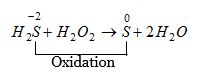
View full question & answer→MCQ 2331 Mark
In acid solution, the reaction $MnO_4^ - \, \to \,M{n^{2 + }}$ involves
- A
Oxidation by $3$ electrons
- B
Reduction by $ 3 $ electrons
- C
Oxidation by $5 $ electrons
- ✓
Reduction by $5$ electrons
AnswerCorrect option: D. Reduction by $5$ electrons
(d)$MnO_4^ - \to M{n^{2 + }}$. In this reaction $5{e^ - }$are needed for the reduction of $M{n^{2 + }}$ as:$MnO_4^ - + 5{e^ - } \to M{n^{2 + }}$.
View full question & answer→MCQ 2341 Mark
Thiosulphate reacts differently with iodine and bromine in the reaction given below :
$ 2 \mathrm{~S}_2 \mathrm{O}_3^{2-}+\mathrm{I}_2 \rightarrow \mathrm{S}_4 \mathrm{O}_6^{2-}+2 \mathrm{I}^{-}$
$\mathrm{S}_2 \mathrm{O}_3^{2-}+5 \mathrm{Br}_2+5 \mathrm{H}_2 \mathrm{O} \rightarrow 2 \mathrm{SO}_4^{2-}+4 \mathrm{Br}^{-}+10 \mathrm{H}^{+}$
Which of the following statement justifies the above dual behaviour of thiosulphate?
- A
Bromine undergoes oxidation and iodine undergoes reduction by iodine in these reactions
- B
Thiosulphate undergoes oxidation by bromine and reduction by iodine in these reaction
- ✓
Bromine is a stronger oxidant than iodine
- D
Bromine is a weaker oxidant than iodine
AnswerCorrect option: C. Bromine is a stronger oxidant than iodine
c
In the reaction of $\mathrm{S}_2 \mathrm{O}_3{ }^{2-}$ with $\mathrm{I}_2$, oxidation state of sulphur changes to +$2$ to +$2.5$
In the reaction of $\mathrm{S}_2 \mathrm{O}_3{ }^{2-}$ with $\mathrm{Br}_2$, oxidation state of sulphur changes from +$2$ to +$6$ .
$\therefore$ Both $\mathrm{I}_2$ and $\mathrm{Br}_2$ are oxidant (oxidising agent) and $\mathrm{Br}_2$ is stronger oxidant than $\mathrm{I}_2$.
View full question & answer→MCQ 2351 Mark
Only $2 \mathrm{~mL}$ of $\mathrm{KMnO}_4$ solution of unknown molarity is required to reach the end point of a titration of $20 \mathrm{~mL}$ of oxalic acid ($2$ M) in acidic medium. The molarity of $\mathrm{KMnO}_4$ solution should be . . . . . . . . . $M$.
Answera
$\text { eq. }\left(\mathrm{KMnO}_4\right)=\text { eq. }\left(\mathrm{H}_2 \mathrm{C}_2 \mathrm{O}_4\right)$
$\mathrm{M} \times 2 \times 5=2 \times 20 \times 2$
$\mathrm{M}=8 \mathrm{M}$
View full question & answer→MCQ 2361 Mark
Match List-$I$ with the List-$II$
|
List-$I$
Reaction
|
List-$II$
Type of redox reaction
|
| $(A)$ $\mathrm{N}_{2(\mathrm{~g})}+\mathrm{O}_{2(\mathrm{~g})} \rightarrow 2 \mathrm{NO}_{(\mathrm{g})}$ |
$(I)$ Decomposition |
| $(B)$ $\begin{aligned} & 2 \mathrm{~Pb}\left(\mathrm{NO}_3\right)_{2(\mathrm{~s})} \rightarrow 2 \mathrm{PbO}_{(\mathrm{s})}+4 \mathrm{NO}_{2(\mathrm{~g})}+\mathrm{O}_{2(\mathrm{~g})}\end{aligned}$ |
$(II)$ Displacement |
| $(C)$ $\begin{aligned} 2 \mathrm{Na}_{(\mathrm{s})}+2 \mathrm{H}_2 \mathrm{O}_{(\mathrm{l})} \rightarrow 2 \mathrm{NaOH}_{(\mathrm{aq} .)}+\mathrm{H}_{2(\mathrm{~g})}\end{aligned}$ |
$(III)$ Disproportionation |
| $(D)$ $\begin{aligned} 2 \mathrm{NO}_{2(\mathrm{~g})}+2-\mathrm{OH}_{(\mathrm{aq})} \rightarrow \mathrm{NO}_{2(\mathrm{aq} .)}^{-}+\mathrm{NO}_{3(\mathrm{qq} .)}^{-}+\mathrm{H}_2 \mathrm{O}_{(\mathrm{l})}\end{aligned}$ |
$(IV)$ Combination |
Choose the correct answer from the options given below:
- A
$(A)-(I), (B)-(II), (C)-(III), (D)-(IV)$
- B
$(A)-(III), (B)-(II), (C)-(I), (D)-(IV)$
- C
$(A)-(II), (B)-(III), (C)-(IV), (D)-(I)$
- ✓
$(A)-(IV), (B)-(I), (C)-(II), (D)-(III)$
AnswerCorrect option: D. $(A)-(IV), (B)-(I), (C)-(II), (D)-(III)$
d
$\mathrm{A} \rightarrow \text { (IV) }$
$\mathrm{B} \rightarrow(\mathrm{I})$
$\mathrm{C} \rightarrow \text { (II) }$
$\mathrm{D} \rightarrow \text { (III) }$
View full question & answer→MCQ 2371 Mark
In acidic medium, $\mathrm{K}_2 \mathrm{Cr}_2 \mathrm{O}$, shows oxidising action as represented in the half reaction
$\mathrm{Cr}_2 \mathrm{O}_7^{2-}+\mathrm{XH}^{+}+\mathrm{Ye}^{-} \rightarrow 2 \mathrm{~A}+\mathrm{ZH}_2 \mathrm{O}$
$\mathrm{X}, \mathrm{Y}, \mathrm{Z}$ and $\mathrm{A}$ are respectively are:
- A
$8, 6, 4$ and $\mathrm{Cr}_2 \mathrm{O}_3$
- B
$14,7,6$ and $\mathrm{Cr}^{3+}$
- C
$8,4,6$ and $\mathrm{Cr}_2 \mathrm{O}_3$
- ✓
$14,6,7$ and $\mathrm{Cr}^{3+}$
AnswerCorrect option: D. $14,6,7$ and $\mathrm{Cr}^{3+}$
d
The balanced reaction is,
$\mathrm{Cr}_2 \mathrm{O}_7^{2-}+14 \mathrm{H}^{+}+6 \mathrm{e}^{-} \rightarrow 2 \mathrm{Cr}^{3+}+7 \mathrm{H}_2 \mathrm{O}$
$\mathrm{X}=14$ $\mathrm{Y}=6$ $\mathrm{~A}=7$
View full question & answer→MCQ 2381 Mark
Number of moles of $\mathrm{H}^{+}$ions required by $1 \mathrm{~mole}$ of $\mathrm{MnO}_4^{-}$to oxidise oxalate ion to $\mathrm{CO}_2$ is . . .. . .
Answera
$2 \mathrm{MnO}_4^{-}+5 \mathrm{C}_2 \mathrm{O}_4^{2-}+16 \mathrm{H}^{+} \longrightarrow 2 \mathrm{Mn}^{2+}+10 \mathrm{CO}_2+8 \mathrm{H}_2 \mathrm{O}$
$\therefore$ Number of moles of $\mathrm{H}^{+}$ions required by 1 mole of
$\mathrm{MnO}_4^{-}$to oxidise oxalate ion to $\mathrm{CO}_2$ is 8
View full question & answer→MCQ 2391 Mark
$2 \mathrm{MnO}_4^{-}+\mathrm{bI}^{-}+\mathrm{cH}_2 \mathrm{O} \rightarrow \mathrm{xI}_2+\mathrm{yMnO}_2+\mathrm{zOH}^{-}$
If the above equation is balanced with integer coefficients, the value of $z$ is____
Answera
Reduction Half Oxidation Half
$2 \mathrm{MnO}_4^{-} \rightarrow 2 \mathrm{MnO}_2$ $2 \mathrm{I}^{-} \rightarrow \mathrm{I}_2+2 \mathrm{e}^{-}$
$2 \mathrm{MnO}_4^{-}+4 \mathrm{H}_2 \mathrm{O}+6 \mathrm{e}^{-} \rightarrow 2 \mathrm{MnO}_2+8 \mathrm{OH}^{-}$ $6 \mathrm{I}^{-} \rightarrow 3 \mathrm{I}_2+6 \mathrm{e}^{-}$
Adding oxidation half and reduction half, net reaction is
$2 \mathrm{MnO}_4^{-}+6 \mathrm{I}^{-}+4 \mathrm{H}_2 \mathrm{O} \rightarrow 3 \mathrm{I}_2+2 \mathrm{MnO}_2+8 \mathrm{OH}^{-}$
${z}=8$
${ Ans. }8$
View full question & answer→MCQ 2401 Mark
Chlorine undergoes disproportionation in alkaline medium as shown below :
$ \text { a } \mathrm{Cl}_2(\mathrm{~g})+\mathrm{b} \mathrm{OH}^{-}(\mathrm{aq}) \rightarrow \mathrm{c} \mathrm{ClO}^{-}(\mathrm{aq})+\mathrm{d} \mathrm{Cl}^{-}(\mathrm{aq}) +\mathrm{e} \mathrm{H}_2 \mathrm{O}(l)$
The values of $a, \ b,\ c$ and $d$ in a balanced redox reaction are respectively :
- ✓
$1$, $2$, $1$ and $1$
- B
$2$, $2$, $1$ and $3$
- C
$3$,$4$,$4$ and $2$
- D
$2$, $4$, $1$ and $3$
AnswerCorrect option: A. $1$, $2$, $1$ and $1$
a
$\Rightarrow \mathrm{Cl}_2+2 \overline{\mathrm{O}} \mathrm{H} \longrightarrow \mathrm{Cl}^{-}+\mathrm{ClO}^{-}+\mathrm{H}_2 \mathrm{O}$
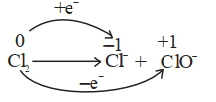
View full question & answer→MCQ 2411 Mark
$1$ mole of $\mathrm{PbS}$ is oxidised by " $\mathrm{X}$ " moles of $\mathrm{O}_3$ to get $"Y"$ moles of $\mathrm{O}_2 \cdot \mathrm{X}+\mathrm{Y}=$__________.
Answerc
$ \mathrm{PbS}+4 \mathrm{O}_3 \rightarrow \mathrm{PbSO}_4+4 \mathrm{O}_2 $
$ \mathrm{x}=4, \mathrm{y}=4$
View full question & answer→MCQ 2421 Mark
Which of the following reactions are disproportionation reactions?
(A) $\mathrm{Cu}^{+} \rightarrow \mathrm{Cu}^{2+}+\mathrm{Cu}$
(B) $3 \mathrm{MnO}_4^{2-}+4 \mathrm{H}^{+} \rightarrow 2 \mathrm{MnO}_4^{-}+\mathrm{MnO}_2+2 \mathrm{H}_2 \mathrm{O}$
(C) $2 \mathrm{KMnO}_4 \rightarrow \mathrm{K}_2 \mathrm{MnO}_4+\mathrm{MnO}_2+\mathrm{O}_2$
(D) $2 \mathrm{MnO}_4^{-}+3 \mathrm{Mn}^{2+}+2 \mathrm{H}_2 \mathrm{O} \rightarrow 5 \mathrm{MnO}_2+4 \mathrm{H}^{+}$
Choose the correct answer from the options given below:
- ✓
$(A), (B)$
- B
$(B), (C), (D)$
- C
$(A), (B), (C)$
- D
$(A),(D)$
AnswerCorrect option: A. $(A), (B)$
a
When a particular oxidation state becomes less stable relative to other oxidation state, one lower, one higher, it is said to undergo disproportionation.
$\mathrm{Cu}^{+} \rightarrow \mathrm{Cu}^{2+}+\mathrm{Cu}$
$3 \mathrm{MnO}_4^{2-}+4 \mathrm{H}^{+} \rightarrow 2 \mathrm{MnO}_4^{-}+\mathrm{MnO}_2+2 \mathrm{H}_2 \mathrm{O}$
View full question & answer→MCQ 2431 Mark
Given below are two statements :
Statement $I$: $\mathrm{S}_8$ solid undergoes disproportionation reaction under alkaline conditions to form $\mathrm{S}^{2-}$ and $\mathrm{S}_2 \mathrm{O}_3{ }^{2-}$
Statement $II$: $\mathrm{ClO}_4^{-}$can undergodisproportionation reaction under acidic condition. In the light of the above statements, choose the most appropriate answer from the options given below :
- ✓
Statement $I$ is correct but statement $II$ is incorrect.
- B
Statement $I$ is incorrect but statement $II$ is correct
- C
Both statement $I$ and statement $II$ are incorrect
- D
Both statement $I$ and statement $II$ are correct
AnswerCorrect option: A. Statement $I$ is correct but statement $II$ is incorrect.
a
$\mathrm{S}_1: \mathrm{S}_{\mathrm{8}}+12 \mathrm{OH}^{\ominus} \rightarrow 4 \mathrm{~S}^{2-}+2 \mathrm{~S}_2 \mathrm{O}_3^{2-}+6 \mathrm{H}_2 \mathrm{O}$
$\mathrm{S}_2: \mathrm{ClO}_4^{\ominus}$ cannot undergo disproportionation reaction as chlorine is present in it's highest oxidation state.
View full question & answer→MCQ 2441 Mark
Total number of species from the following which can undergo disproportionation reaction________.
$\mathrm{H}_2 \mathrm{O}_2, \mathrm{ClO}_3^{-}, \mathrm{P}_4, \mathrm{Cl}_2, \mathrm{Ag}, \mathrm{Cu}^{+1}, \mathrm{~F}_2, \mathrm{NO}_2, \mathrm{~K}^{+}$
Answerc
Intermediate oxidation state of element can undergo disproportionation.
$\mathrm{H}_2 \mathrm{O}_2, \mathrm{ClO}_3^{-}, \mathrm{P}_4, \mathrm{Cl}_2, \mathrm{Cu}^{+1}, \mathrm{NO}_2$
View full question & answer→MCQ 2451 Mark
From the given list, the number of compounds with $+4$ oxidation state of Sulphur__________.
$\mathrm{SO}_3, \mathrm{H}_2 \mathrm{SO}_3, \mathrm{SOCl}_2, \mathrm{SF}_4, \mathrm{BaSO}_4, \mathrm{H}_2 \mathrm{~S}_2 \mathrm{O}_7$
Answerb
| Compounds |
$\mathrm{SO}_3$ |
$\mathrm{H}_2 \mathrm{SO}_3$ |
$\mathrm{SOCl}_2$ |
$\mathrm{SF}_4$ |
$ \mathrm{BaSO}_4$ |
$\mathrm{H}_2 \mathrm{~S}_2 \mathrm{O}_7$
|
| $O.S.$ of sulphur |
$+6$ |
$+4$ |
$+4$ |
$+4$ |
$+6$ |
$+6$ |
View full question & answer→MCQ 2461 Mark
Element not showing variable oxidation state is :
Answerd
Fluorine does not show variable oxidation state.
View full question & answer→MCQ 2471 Mark
Which of the following cannot function as an oxidising agent?
- ✓
$\mathrm{N}^{3-}$
- B
$\mathrm{SO}_4^{2-}$
- C
$\mathrm{BrO}_3^{-}$
- D
$\mathrm{MnO}_4^{-}$
AnswerCorrect option: A. $\mathrm{N}^{3-}$
a
In $\mathrm{N}^{3-}$ ion ' $\mathrm{N}$ ' is present in its lowest possible oxidation state, hence it cannot be reduced further because of which it cannot act as an oxidizing agent.
View full question & answer→MCQ 2481 Mark
See the following chemical reaction:
$Cr _2 O _7^{2-}+ XH ^{+}+6 Fe ^{2+} \rightarrow YCr ^{3+}+6 Fe ^{3+}+ ZH _2 O$
The sum of $X . Y$ and $Z$ is $.......$.
Answerd
$Cr _2 O _7^{2-}+14 H ^{+}+6 Fe ^{2+} \rightarrow 6 Fe ^{3+}+2 Cr ^{3+}+7 H _2 O$
$x =14$
$y =2$
$z =7$
Hence $(x+y+z)=14+2+7=23$
View full question & answer→MCQ 2491 Mark
Given below are two statements :-
Statement $I:$- In redox titration, the indicators used are sensitive to change in $pH$ of the solution.
Statement $II:$- In acid-base titration, the indicators used are sensitive to change in oxidation potential.
In the light of the above statements, choose the most appropriate answer from the options given below
- A
Both statement $I$ and statement $II$ are correct.
- B
Statement $I$ is incorrect but Statement $II$ is correct.
- C
Statement $I$ is correct but Statement $II$ is incorrect.
- ✓
Both statement $I$ and statement $II$ are incorrect.
AnswerCorrect option: D. Both statement $I$ and statement $II$ are incorrect.
d
In redox titration, indicators are sensitive to oxidation potential and in acid base titration, indicators are sensitive to change in $pH$ of solution Both statement are false.
View full question & answer→MCQ 2501 Mark
Which of the following options are correct for the reaction
$2\left[ Au ( CN )_2\right]_{( aq )}^{-}+ Zn ( s ) \rightarrow 2 Au ( s )+\left[ Zn ( CN )_4\right]_{( aq )}^{2-}$
$A.$ Redox reaction
$B.$ Displacement reaction
$C.$ Decomposition reaction
$D.$ Combination reaction
Choose the correct answer from the options given below:
- ✓
$A$ and $B$ only
- B
$A$ only
- C
$C$ and $D$ only
- D
$A$ and $D$ only
AnswerCorrect option: A. $A$ and $B$ only
a
$2\left[\stackrel{+1}{ Au ( CN )_2}\right]^{-}+\stackrel{0}{ Z } n ( s ) \longrightarrow 2 \stackrel{0}{ Au }+\left[\stackrel{+2}{ Zn }( CN )_4\right]^{-2}$
$Zn$ displaced $Au ^{+}$
Reduction and Oxidation both are taking place.
View full question & answer→MCQ 2511 Mark
Potassium dichromate acts as a strong oxidizing agent in acidic solution. During this process, the oxidation state changes from
- A
$+3$ to $+1$
- ✓
$+6$ to $+3$
- C
$+2$ to $+1$
- D
$+6$ to $+2$
AnswerCorrect option: B. $+6$ to $+3$
b
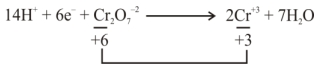
View full question & answer→MCQ 2521 Mark
In Chromyl chloride, the oxidation state of chromium is $(+)..........$
Answera
$CrO _2 Cl _2 x -4-2=0$
Oxidation State $=+6$
View full question & answer→MCQ 2531 Mark
The sum of oxidation state of the metals in $Fe ( CO )_5, VO ^{2+}$ and $WO _3$ is $.........$.
Answera
So, Sum of oxidation state $=0+4+6=10$
View full question & answer→MCQ 2541 Mark
In which of the following reactions the hydrogen peroxide acts as a reducing agent?
- A
$PbS +4 H _2 O _2 \rightarrow PbSO _4+4 H _2 O$
- B
$2 Fe ^{2+}+ H _2 O _2 \rightarrow 2 Fe ^{3+}+2 OH ^{-}$
- ✓
$HOCl + H _2 O _2 \rightarrow H _3 O ^{+}+ Cl ^{-}+ O _2$
- D
$Mn ^{2+}+ H _2 O _2 \rightarrow Mn ^{4+}+2 OH ^{-}$
AnswerCorrect option: C. $HOCl + H _2 O _2 \rightarrow H _3 O ^{+}+ Cl ^{-}+ O _2$
c
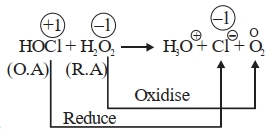
View full question & answer→MCQ 2551 Mark
$2 IO _3^{-}+ xI ^{-}+12 H ^{+} \rightarrow 6 I _2+6 H _2 O$ What is the value of $x$ ?
Answerd
Number of atoms of iodine on reactant side $=$ number of atoms of Iodine on product side
$2+ x =6 \times 2$
$X =10$
$2 IO _3^{-}+10 I ^{-}+12 H ^{+} \rightarrow 6 I _2+6 H _2 O$
View full question & answer→MCQ 2561 Mark
In the titration of $KMnO _{4}$ and oxalic acid in acidic medium, the change in oxidation number of carbon at the end point is
Answera
Oxidation state of carbon changes from $+3$ to $+4$.
$2 KMnO _{4}+5 H _{2} C _{2} O _{4}+3 H _{2} SO _{4}(\text { dil. }) \rightarrow K _{2} SO _{4}+2 MnSO _{4}+10 CO _{2}+8 H _{2} O$
View full question & answer→MCQ 2571 Mark
$20\,mL$ of $0.02\,M\,K _{2} Cr _{2} O _{7}$ solution is used for the titration of $10 \,mL$ of $Fe ^{2+}$ solution in the acidic medium.The molarity of $Fe ^{2+}$ solution is ........... $\times 10^{-2}\,M$ (Nearest Integer)
Answerc
Eq. of $K _{2} Cr _{2} O _{7}=$ Eq. of $Fe ^{2+}$
$(Molarity$ $\times$ $volume$ $\times$ $n.f)$ of $K _{2} Cr _{2} O _{7}=$ (molarity $\times$ volume $\times$ n.f ) of $Fe ^{2+}$
$0.02 \times 20 \times 6= M \times 10 \times 1$
$M =0.24$
Molarity $=24 \times 10^{-2}$
View full question & answer→MCQ 2581 Mark
$20\,mL$ of $0.02\,M$ hypo solution is used for the titration of $10\,mL$ of copper sulphate solution, in the presence of excess of $KI$ using starch as an indicator. The molarity of $Cu ^{2+}$ is found to be $\times 10^{-2}\,M$[nearest integer]Given : $2 Cu ^{2+}+4 I ^{-} \rightarrow Cu _{2} I _{2}+ I _{2}$ $I _{2}+2 S _{2} O _{3}{ }^{2-} \rightarrow 2 I ^{-}+ S _{4} O _{6}{ }^{2-}$
Answerb
$n _{\text {eq. }}$ of $I _{2}= n _{ eq }$ of $Na _{2} S _{2} O _{3}=20 \times 0.002 \times 1$
$2 \times n _{ mol }$ of $I _{2}=0.4$
$n _{ mol }$ of $I _{2}=0.2 m mol$
$n _{ mol }$ of $Cu ^{+2}=0.2 \times 2 \times 10^{-3}$
$\left[ Cu ^{+2}\right]=\frac{0.4 \times 10^{-3}}{10 \times 10^{-3}}=0.04=4 \times 10^{-2}$
View full question & answer→MCQ 2591 Mark
Which of the given reactions is not an example of disproportionation reaction?
- A
$2 H _{2} O _{2} \rightarrow 2 H _{2} O + O _{2}$
- B
$2 NO _{2}+ H _{2} O \rightarrow HNO _{3}+ HNO _{2}$
- ✓
$MnO _{4}^{-}+4 H ^{+}+3 e ^{-} \rightarrow MnO _{2}+2 H _{2} O$
- D
$3 MnO _{4}{ }^{2-}+4 H ^{+} \rightarrow 2 MnO _{4}{ }^{-}+ MnO _{2}+2 H _{2} O$
AnswerCorrect option: C. $MnO _{4}^{-}+4 H ^{+}+3 e ^{-} \rightarrow MnO _{2}+2 H _{2} O$
c
$2 NO _{2}+ H _{2} O \rightarrow HNO _{3}+ HNO _{2} : Disproportionation$
$MnO _{4}^{-}+4 H ^{+}+3 e ^{-} \rightarrow MnO _{2}+2 H _{2} O : reduction$
$3 MnO _{4}^{+-}+4 H ^{+} \rightarrow 2 MnO _{4}^{-}+ MnO _{2}^{+4}+2 H _{2} O :Disproportionation$
View full question & answer→MCQ 2601 Mark
Which one of the following is an example of disproportionation reaction?
- ✓
$3 MnO _{4}^{2-}+4 H ^{+} \rightarrow 2 MnO _{4}^{-}+ MnO _{2}+2 H _{2} O$
- B
$MnO _{4}^{2-}+4 H ^{+}+4 e ^{-} \rightarrow MnO _{2}+2 H _{2} O$
- C
$10 I ^{-}+2 MnO _{4}^{-}+16 H ^{+} \rightarrow 2 Mn ^{2+}+8 H _{2} O +5 I _{2}$
- D
$8 MnO _{4}^{-}+3 S _{2} O _{3}^{2-}+ H _{2} O \rightarrow 8 MnO _{2}+6 SO _{4}^{2-}+2 OH ^{-}$
AnswerCorrect option: A. $3 MnO _{4}^{2-}+4 H ^{+} \rightarrow 2 MnO _{4}^{-}+ MnO _{2}+2 H _{2} O$
a
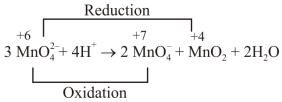
View full question & answer→MCQ 2611 Mark
The difference in oxidation state of chromium in chromate and dichromate salts is .... .
Answerb
$Cr=+6$
$Cr O_{4}^{2-}, Cr _{2} O _{7}^{2-}$ difference is zero.
View full question & answer→MCQ 2621 Mark
A $2.0 \,g$ sample containing $MnO _{2}$ is treated with $HCl$ liberating $Cl _{2}$. The $Cl _{2}$ gas is passed into a solution of $KI$ and $60.0\, mL$ of $0.1\, M\, Na _{2} S _{2} O_{3}$ is required to titrate the liberated iodine. The percentage of $MnO _{2}$ in the sample is $.....$ (Nearest integer)
[Atomic masses (in $u$) $Mn =55 ; Cl =35.5 ; O =16, I =127, Na =23, K =39, S =32]$
Answera
$MnO _{2}+ HCl \longrightarrow Cl _{2}+ Mn ^{+2}$
$6\, meq\quad\quad\quad\quad\quad\quad\quad 6\, meq$
$=3 m mol$
$Cl _{2}+ KI \longrightarrow Cl ^{-}+ I _{2}$
$6\, meq\quad\quad\quad\quad\quad\quad\quad6\, meq$
$I _{2}+ Na _{2} S _{2} O _{3} \longrightarrow I ^{-}+ Na _{2} S _{4} O _{6}$
$6\, meq\quad\quad\quad\quad\quad\quad\quad 6\, m\,mol$
$\quad=6 meq$
$\% \,MnO _{2}=\frac{3 \times 10^{-3} \times 87}{2} \times 100$
$=13.05\, \%$
View full question & answer→MCQ 2631 Mark
The reaction of sulphur in alkaline medium is the below
$S _{8( s )}+ a OH ^{-}_{( aq )} \rightarrow b S ^{2-}_{( aq )}+ c S _{2} O _{3}{ }^{2-}{ }_{( aq )}+ d H _{2} O _{(\ell)}$
The values of $'a'$ is ............ (Integer answer)
Answerc
$16 e ^{\ominus}+ S _{8} \longrightarrow 8 S ^{2-}$
$\frac{12 H _{2} O + S _{8} \longrightarrow 4 S _{2} O _{3}^{2-}+24 H ^{+}+16 e ^{\circ}}{2 S _{8}+12 H _{2} O \longrightarrow 8 S ^{2-}+4 S _{2} O _{3}^{2-}+24 H }$
for balancing in basic medium add equal number of $OH ^{\ominus}$ that of $H ^{+}$
$2 S _{8}+12 H _{2} O +24 OH ^{\ominus} \longrightarrow 8 S ^{2-}+4 S _{2} O _{8}^{2-}$
$+24 H _{2} O$
$2 S _{8}+24 OH ^{\ominus} \rightarrow 8 S ^{2-}+4 S _{2} O _{8}^{2-}+12 H _{2} O$
$S _{8}+12 OH ^{\ominus} \rightarrow 4 S ^{2-}+2 S _{2} O _{8}^{2-}+6 H _{2} O$
$a =12$
View full question & answer→MCQ 2641 Mark
$2\, Mn O _{4}^{-}+ b\, C _{2} O _{4}^{2-}+ c\, H ^{+} \rightarrow x\, Mn ^{2+}+ y\, CO _{2}$ $+ z\, H _{2} O$
If the above equation is balanced with integer coefficients, the value of $c$ is ...........
(Round off to the Nearest Integer).
Answerd
Writting the half reaction oxidation half reaction
$MnO _{4}^{-} \rightarrow Mn ^{2+}$
balancing oxygen
$MnO _{4}^{-} \rightarrow Mn ^{2+}+4 H _{2} O$
balancing Hydrogen
$8 H ^{+}+ MnO _{4}^{-} \rightarrow Mn ^{2+}+4 H _{2} O$
balancing charge
$5 e ^{-}+8 H ^{+}+ MnO _{4}^{-} \rightarrow Mn ^{2+}+4 H _{2} O$
Reduction half
$C _{2} O _{4}^{2-} \rightarrow CO _{2}$
Balancing carbon
$C _{2} O _{4}^{2-} \rightarrow 2 CO _{2}$
Balancing charge
$C _{2} O _{4}^{2-} \rightarrow 2 CO _{2}+2 e ^{-}$
Net equation
$16 H ^{+}+2 MnO _{4}^{-}+5 C _{2} O _{4}^{2-} \rightarrow 10 CO _{2}+2 Mn ^{2+}+8 H _{2} O$
So $\quad c=16$
View full question & answer→MCQ 2651 Mark
$(A)$ $HOCl + H _{2} O _{2} \rightarrow H _{3} O ^{+}+ Cl ^{-}+ O _{2}$
$(B)$ $I _{2}+ H _{2} O _{2}+2 OH ^{-} \rightarrow 2 I ^{-}+2 H _{2} O + O _{2}$
Choose the correct option.
- A
$H _{2} O _{2}$ acts as reducing and oxidising agent respectively in equation $(A)$ and $(B)$
- B
$H _{2} O _{2}$ acts as oxidising agent in equation $(A)$ and $(B)$
- ✓
$H _{2} O _{2}$ acts as reducing agent in equation $(A)$ and $( B )$
- D
$H _{2} O _{2}$ act as oxidizing and reducing agent respectively in equation $(A)$ and $(B)$
AnswerCorrect option: C. $H _{2} O _{2}$ acts as reducing agent in equation $(A)$ and $( B )$
c
$(A)$ $HOCl + H _{2} O _{2} \rightarrow H _{3} O ^{+}+ Cl ^{-}+ O _{2}$
In this equation, $H _{2} O _{2}$ is reducing chlorine from $+1$ to $-1$
$(B)$ $I _{2}+ H _{2} O _{2}+2 OH^- \rightarrow 2 I ^{-}+2 H _{2} O + O _{2}$
In this equation, $H _{2} O _{2}$ is reducing iodine from $0$ to $-1$
View full question & answer→MCQ 2661 Mark
Identify the process in which change in the oxidation state is five :
- A
$\mathrm{C}_{2} \mathrm{O}_{4}^{2-} \rightarrow 2 \mathrm{CO}_{2}$
- B
$\mathrm{CrO}_{4}^{2-} \rightarrow \mathrm{Cr}^{3+}$
- C
$\mathrm{Cr}_{2} \mathrm{O}_{7}^{2-} \rightarrow 2 \mathrm{Cr}^{3+}$
- ✓
$\mathrm{MnO}_{4}^{-} \rightarrow \mathrm{Mn}^{2+}$
AnswerCorrect option: D. $\mathrm{MnO}_{4}^{-} \rightarrow \mathrm{Mn}^{2+}$
d
$\underset{(+7)}{\mathrm{MnO}_{4}^{-}} \rightarrow \underset{(+2)}{\mathrm{Mn}^{2+}} 5 \mathrm{e}^{-}$change
View full question & answer→MCQ 2671 Mark
In polythionic acid, $\mathrm{H}_{2} \mathrm{~S}_{\mathrm{x}} \mathrm{O}_{6}(\mathrm{x}=3$ to $5$ ) the oxidation state(s) of sulphur is/are :
- A
$+5$ only
- B
$+6$ only
- C
$+3$ and $+5$ only
- ✓
$0$ and $+5$ only
AnswerCorrect option: D. $0$ and $+5$ only
d
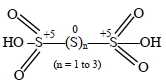
View full question & answer→MCQ 2681 Mark
The species given below that does NOT show disproportionation reaction is :
- A
$\mathrm{BrO}_{2}^{-}$
- ✓
$\mathrm{BrO}_{4}^{-}$
- C
$\mathrm{BrO}^{-}$
- D
$\mathrm{BrO}_{3}^{-}$
AnswerCorrect option: B. $\mathrm{BrO}_{4}^{-}$
b
In $\mathrm{BrO}_{4}^{\ominus}, \mathrm{Br}$ is in highest oxidation state $(+7),$ Soit cannot oxidise further it only reduced hence it cannot show disproportionation reaction
View full question & answer→MCQ 2691 Mark
The volume, in $mL ,$ of $0.02\, M K _{2} Cr _{2} O _{7}$ solution required to react with $0.288\, g$ of ferrous oxalate in acidic medium is........
(Molar mass of $Fe =56\, g\, mol ^{-1}$ )
Answerd
$K _{2} Cr _{2} O _{7}+ FeC _{2} O _{4} \longrightarrow Cr ^{+3}+ Fe ^{+3}+ CO _{2}$
$n=6 \quad \quad n=3$
$\frac{0.02 \times 6 \times V ( mL )}{1000}=\frac{0.288}{144} \times 3$
$\Rightarrow \quad V =50 mL$
View full question & answer→MCQ 2701 Mark
Consider the following equations:
$2 Fe ^{2+}+ H _{2} O _{2} \rightarrow x A + y B$
(in basic medium)
$2 MnO _{4}^{-}+6 H ^{+}+5 H _{2} O _{2} \rightarrow x ^{\prime} C + y ^{\prime} D + z ^{\prime} E$
(in acidic medium)
The sum of the stoichiometric coefficients $x , y , x ^{\prime}, y ^{\prime}$ and $z ^{\prime}$ for products $A , B , C , D$ and $E ,$ respectively, is............
Answerd
$\left[ Fe ^{2+} \rightarrow Fe ^{3+}+ e ^{-}\right] \times 2$
$\frac{ H _{2} O _{2}+2 e ^{-} \rightarrow 2 HO ^{\ominus}}{2 Fe ^{2+}+ H _{2} O _{2} \rightarrow 2 Fe ^{3+}+2 HO _{(q\omega)}^{\ominus}}$
$x =2 \quad y =2$
$\left[8 H ^{+}+ MnO _{4}^{-}+5 e ^{-} \rightarrow Mn ^{2+}+4 H _{2} O \right] \times 2$
$\left[ H _{2} O _{2} \rightarrow O _{2( g )}+2 H ^{+}+2 e ^{-}\right] \times 5$
$\Rightarrow 16 H ^{+}+2 MnO _{4}^{-}+5 H _{2} O _{2}$
$\rightarrow 2 Mn ^{2+}+8 H _{2} O +5 O _{2(g)}+10 H ^{+}$
$\Rightarrow 6 H ^{+}+2 MnO _{4}^{-}+5 H _{2} O _{2}$
$\rightarrow 2 Mn ^{2+}+8 H _{2} O +5 O _{2( g )}$
So $\quad x^{\prime}=2 \quad y^{\prime}=8 \quad z^{\prime}=5$
so $\quad x+y+x^{\prime}+y^{\prime}+z^{\prime}$
$\Rightarrow 2+2+2+8+5$
$\Rightarrow 19$
View full question & answer→MCQ 2711 Mark
Conside the following reactions:
$\mathrm{NaCl}+\mathrm{K}_{2} \mathrm{Cr}_{2} \mathrm{O}_{7}+\mathrm{H}_{2} \mathrm{SO}_{4}(\mathrm{Conc} .) \rightarrow(\mathrm{A})+$ Side products
$(\mathrm{A})+\mathrm{NaOH} \rightarrow(\mathrm{B})+$ side product
$(\mathrm{B})+\mathrm{H}_{2} \mathrm{SO}_{4}(\mathrm{dilute})+\mathrm{H}_{2} \mathrm{O}_{2} \rightarrow(\mathrm{C})+$ Side product
The sum of the total number of atoms in one molecule each of $(A), (B)$ and $(C)$ is
Answerc
$4 \mathrm{NaCl}+\mathrm{K}_{2} \mathrm{Cr}_{2} \mathrm{O}_{7}+6 \mathrm{H}_{2} \mathrm{SO}_{4}$
$\quad \quad \quad \quad \quad \downarrow$
$2 \mathrm{CrO}_{2} \mathrm{Cl}_{2}+4 \mathrm{NaHSO}_{4}+2 \mathrm{KHSO}_{4}+3 \mathrm{H}_{2} \mathrm{O}$
$(\mathrm{A})$
$\mathrm{CrO}_{2} \mathrm{Cl}_{2}+4 \mathrm{NaOH} \longrightarrow \mathrm{Na}_{2} \mathrm{CrO}_{4}+2 \mathrm{NaCl}+2 \mathrm{H}_{2} \mathrm{O}$
$\quad \quad \quad \quad \quad \quad \quad \quad \quad \quad \quad (B)$
$\mathrm{Na}_{2} \mathrm{CrO}_{4}+2 \mathrm{H}_{2} \mathrm{SO}_{4}+2 \mathrm{H}_{2} \mathrm{O}_{2}$
$\mathrm{CrO}_{5}+2 \mathrm{NaHSO}_{4}+3 \mathrm{H}_{2} \mathrm{O}$
$(\mathrm{C})$
$A=C r O_{2} C l_{2}$
${B}=\mathrm{Na}_{2} \mathrm{CrO}_{4}$
${C}={C r O}_{5}$
Total number of atom in $\mathrm{A}+\mathrm{B}+\mathrm{C}=18$
View full question & answer→MCQ 2721 Mark
The oxidation states of transition metal atoms in $K _{2} Cr _{2} O _{7}, KMnO _{4}$ and $K _{2} FeO _{4},$ respectively, are $x , y$ and $z$. The sum of $x , y$ and $z$ is
Answerc
$K _{2} Cr _{2} O _{7}$
$2(+1)+2 x+7(-2)=0$
$x=+6$
In $K _{2} Cr _{2} O _{7},$ Transition metal $( Cr )$ present in +6
oxidation state.
$KMnO _{4}$
$(+1)+y+4(-2)=0$
$x=+7$
In $KMnO _{4}$, transition metal (Mn) present in $+7$ oxidation state
$K _{2} FeO _{4}$
$2(+1)+z+4(-2)=0$
$x=+6$
In $K _{2} FeO _{4},$ transition metal (Fe) present in $+6$ oxidation state
So $x=+6$
$y=+7$
$z=+6$
____________
$x+y+z=19$
View full question & answer→MCQ 2731 Mark
The sum of the total number of bonds between chromium and oxygen atoms in chromate and dichromate ions is
Answera
Total number of bonds between chromium and oxygen in both structures are $18$
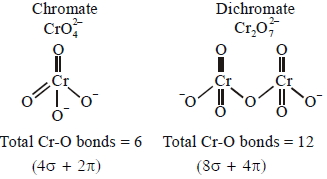
View full question & answer→MCQ 2741 Mark
The strength of an aqueous $NaOH$ solution is most accurately determined by titrating
(Note : consider that an appropriate indicator is used)
- A
Aq. $\mathrm{NaOH}$ in a volumetric flask and concentrated $\mathrm{H}_{2} \mathrm{SO}_{4}$ in a conical flask
- B
Aq. $\mathrm{NaOH}$ in a pipette and aqueous oxalic acid in a burette
- C
Aq. $\mathrm{NaOH}$ in a burette and concentrated $\mathrm{H}_{2} \mathrm{SO}_{4}$ in a conical flask
- ✓
Aq. NaOH in a burette and aqueous oxalic acid in a conical flask
AnswerCorrect option: D. Aq. NaOH in a burette and aqueous oxalic acid in a conical flask
d
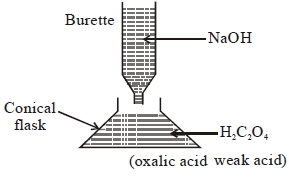
View full question & answer→MCQ 2751 Mark
The redox reaction among the following is
- ✓
Combination of dinitrogen with dioxygen at $2000 \;K$
- B
Formation of ozone from atmosphereic oxygen in the presence of sunlight
- C
Reaction of $\mathrm{H}_{2} \mathrm{SO}_{4}$ with $\mathrm{NaOH}$
- D
Reaction of $\left[\mathrm{Co}\left(\mathrm{H}_{2} \mathrm{O}\right)_{6}\right] \mathrm{Cl}_{3}$ with $\mathrm{AgNO}_{3}$
AnswerCorrect option: A. Combination of dinitrogen with dioxygen at $2000 \;K$
a
$\mathrm{N}_{2}+\mathrm{O}_{2} \stackrel{2000 \mathrm{K}}{\longrightarrow} 2 \mathrm{NO} \quad$ (Redox reaction)
during the reaction, oxidation of nitrogen take place from $0$ to $2$ and reduction of oxygen take place from $0$ to $-2 .$ It means this reaction is redox reaction.
$3 \mathrm{O}_{2} \stackrel{\mathrm{hv}}{\longrightarrow} 2 \mathrm{O}_{3} \quad$ (Non - redox reaction)
$\mathrm{H}_{2} \mathrm{SO}_{4}+2 \mathrm{NaOH} \rightarrow \mathrm{Na}_{2} \mathrm{SO}_{4}+2 \mathrm{H}_{2} \mathrm{O}$ (neutralization reaction)
$\left[\mathrm{Co}\left(\mathrm{H}_{2} \mathrm{O}\right)_{6}\right] \mathrm{Cl}_{3}+3 \mathrm{AgNO}_{3}$
$\rightarrow 3 \mathrm{AgCl} \downarrow+\left[\mathrm{Co}\left(\mathrm{H}_{2} \mathrm{O}\right)_{6}\right]\left(\mathrm{NO}_{3}\right)_{3}$
(White ppt.)
View full question & answer→MCQ 2761 Mark
In the reaction of oxalate with permanganate in acidic medium, the number of electrons involved in producing one molecule of $CO_2$ is
Answerb
$5CrO_4^{2 - } + 2KMn{O_4} + {H^ + } \to 10C{O_2} + M{n^{2 + }} + {H_2}O$ After balancing $10$ gain or loss of electron
View full question & answer→MCQ 2771 Mark
An example of a disproportionation reaction is
- A
$2KMnO_4 \longrightarrow K_2MnO_4 + MnO_2 + O_2$
- B
$2NaBr + Cl_2 \longrightarrow 2NaCl + Br_2$
- ✓
$2CuBr \longrightarrow CuBr_2 + Cu$
- D
$2MnO_4^ - + 10{I^ - } + 16{H^ + } \longrightarrow 2M{n^{2 + }} + 5{I_2} + 8{H_2}O$
AnswerCorrect option: C. $2CuBr \longrightarrow CuBr_2 + Cu$
c
$2C{u^ \oplus }$ $\longrightarrow$ $C{u^{2 + }} + Cu$
View full question & answer→MCQ 2781 Mark
The correct order of the oxidation states of nitrogen in $NO, N_2O, NO_2$ and $N_2O_3$ is
- A
$N_2O < N_2O_3 < NO < NO_2$
- B
$NO_2 < NO < N_2O_3 < N_2O$
- C
$NO_2 < N_2O_3 < NO < N_2O$
- ✓
$N_2O < NO < N_2O_3 < NO_2$
AnswerCorrect option: D. $N_2O < NO < N_2O_3 < NO_2$
d
$\mathop {NO}\limits^{ + 2} ,{\mkern 1mu} \mathop {{N_2}}\limits^{ + 1} O{\mkern 1mu} ,{\mkern 1mu} \mathop {{\text{ }}N}\limits^{ + 4} {O_2},\mathop {{N_2}}\limits^{ + 3} {O_3}$
View full question & answer→MCQ 2791 Mark
In order to oxidize a mixture of one mole of each of $Fe{C_2}{O_4},F{e_2}\,{\left( {{C_2}{O_4}} \right)_3},FeS{O_4}$ and $F{e_2}{\left( {S{O_4}} \right)_3}$ in acidic medium, the number of moles of $KMnO_4$ required is
Answera
$n-$ factors of $KMnO_4=5,\,n-$ factor of $FeSO_4=1$
$n-$ factors of $FeC_2O_4=3,\,Fe_2(SO_4)_3$ does not react
$n-$ factors of $Fe_2(C_2O_4)_3=6$,
$n_{eq}\,KMnO_4=n_{eq}[FeC_2O_4+Fe_2(C_2O_4)_3+FeSO_4]$
or, $x \times 5=1 \times 3+1\times 6+1\times1 $
$x=2$
View full question & answer→MCQ 2801 Mark
In $KO_2$, the nature of oxygen species and the oxidation state of oxygen atom are, respectively
- A
Superoxide and $-1$
- ✓
Superoxide and $-1/2$
- C
Peroxide and $-1/2$
- D
Oxide and $-2$
AnswerCorrect option: B. Superoxide and $-1/2$
b
In $KO_2$, the nature of oxygen species and the oxidation state of oxygen atom are superoxide (superoxide ion is $O_2^-$) and $-1/2$ respectively.
Let $x$ be oxidation state of oxygen. The oxidation state of $K$ is $+1.$ Hence
$+1+2(x)=0$
$2x=-1$
$x=-\frac {1}{2}$
View full question & answer→MCQ 2811 Mark
Which of the following reactions is an example of a redox reaction ?
- ✓
$XeF_4 + O_2F_2 \rightarrow XeF_6 + O_2$
- B
$XeF_2 + PF_5 \rightarrow [XeF]^+ PF_6^-$
- C
$XeF_6 + H_2O \rightarrow XeOF_4 + 2HF$
- D
$XeF_6 + 2H_2O \rightarrow XeO_2F_2 + 4HF$
AnswerCorrect option: A. $XeF_4 + O_2F_2 \rightarrow XeF_6 + O_2$
a
The following reaction is an example of redox reaction as xenon undergoes oxidation from state $+4$ to $+6$ and oxygen undergoes reduction from state $+1$ to $0 .$
$\stackrel{+4}{\mathrm{X}} \mathrm{eF}_{4}+\stackrel{+1}{\mathrm{O}_{2}} \mathrm{F}_{2} \rightarrow \stackrel{+6}{\mathrm{Xe}} \mathrm{F}_{6}+\stackrel{0}{\mathrm{O}_{2}}$
View full question & answer→MCQ 2821 Mark
The pair of compounds having metals in their highest oxidation state is
- ✓
$MnO_4 ^-$ and $CrO_2Cl_2$
- B
$[NiCl_4]^{2-}$ and $[CoCl_4]^{2-}$
- C
$[Fe(CN)_6]^{3-}$ and $[Cu(CN)_2]^{2-}$
- D
$[FeCl_4]^-$ and $Co_2O_3$
AnswerCorrect option: A. $MnO_4 ^-$ and $CrO_2Cl_2$
a
$(1)\,Cr\mathop {{O_2}}\limits^{2 - } \mathop {C{l_2}}\limits^{ - 1} \,\,Cr = + 6;\,Mn\mathop {{O_2}}\limits^{2 - } \,\,Mn = + 4$
(Highest oxidation state)
$(2)\,{[Ni\mathop {C{l_4}}\limits^{ - 1} ]^{2 - }}\,\,Ni = + 2;\,{[Co\mathop {C{l_4}}\limits^{ - 1} ]^{2 - }}\,\,Co = + 2$
$(3)\,{[Fe{(\mathop {CN}\limits^{ - 1} )_6}]^{3 - }}\,\,Fe = + 3;\,{[Cu{(\mathop {CN}\limits^{ - 1} )_4}]^{2 - }}\,\,Cu = + 2$
$(4)\,{[Fe\mathop {C{l_4}}\limits^{ - 1} ]^ - }\,\,Fe = + 3;\,C{o_2}\mathop {{O_3}}\limits^{ - 2} \,Co = + 3$
View full question & answer→MCQ 2831 Mark
Consider the reaction ${H_2}S{O_3}\left( {aq} \right) + S{n^{4 + }}\left( {aq} \right) + {H_2}O\left( l \right) \to S{n^{2 + }}\left( {aq} \right) + HSO_4^ - \left( {aq} \right) + 3{H^ + }\left( {aq} \right)$ Which of the following statements is correct?
- A
$Sn^{4+}$ is the oxidizing agent because it undergoes oxidation
- B
$Sn^{4+}$ is the reducing agent because it undergoes oxidatio
- ✓
$H_2SO_3$ is the reducing agent because it undergoes oxidation
- D
$H_2SO_3$ is the reducing agent because it undergoes reduction
AnswerCorrect option: C. $H_2SO_3$ is the reducing agent because it undergoes oxidation
c
$\mathop {{H_2}S{O_3}}\limits^{ + 4} (aq) + \mathop {Sn^{+4}} (aq) + {H_2}O(l) \to S{n^{2 + }}(aq) + \mathop {HS{O_4}^ - }\limits^{ + 6} (aq) + 3{H^ + }$ Hence $H_2SO_3$ is the reducing agent because it undergoes oxidation
View full question & answer→MCQ 2841 Mark
Which of the following statements about $Na_2O_2$ is not correct
AnswerCorrect option: D. It is the super oxide of sodium
d
$Na_2O_2$ is peroxide of sodium not super oxide. The formula of sodium superoxide is $NaO_2$
View full question & answer→MCQ 2851 Mark
Hydrogen peroxide acts both as an oxidising and as a reducing agent depending upon the nature of the reacting species . In which of the following cases $H_2O_2$ acts as a reducing agent in acid medium?
- ✓
$MnO_4^-$
- B
$Cr_2O_7^{2-}$
- C
$SO_3^{2-}$
- D
$KI$
AnswerCorrect option: A. $MnO_4^-$
a
$H_2O_2$ acts as a reducing agent only in presence of strong oxidising agents ($i.e.,MnO_4^-$ ) in acidic as well as alkaline medium. $2KMnO_4 + 3H_2SO_4 + 5H_2O_2 \to K_2SO_4 + 2MnSO_4 + 8H_2O + 5O_2$
View full question & answer→MCQ 2861 Mark
The equation which is balanced and represents the correct product(s) is :
- A
$Li_2O + 2KCl \rightarrow 2LiCl + K_2O$
- ✓
$[ CoCl( NH_3 )_5]^+ +5H^+ \rightarrow Co^{2+} +5NH_4^+ +Cl^-$
- C
$[ Mg(H_2O)_6]^{2+} +(EDTA)^{4-} \xrightarrow{{excess\,NaOH}} $ $[Mg(EDTA)]^{2+} +6H_2O$
- D
$CuSO_4 + 4KCN \rightarrow K_2[Cu(CN)_4]+K_2SO_4$
AnswerCorrect option: B. $[ CoCl( NH_3 )_5]^+ +5H^+ \rightarrow Co^{2+} +5NH_4^+ +Cl^-$
b
Equation $-1$ is not balanced with respect to charge.
Equation $-2$ gives $K _3\left[ Cu ( CN )_4\right]$ as product.
Equation $-3$ reaction is unfavourable in the forward direction $\left( K _2 O\right.$ is unstable, while $LiO _2$ is stable).
Equation $-4$ is correct and balanced.
View full question & answer→MCQ 2871 Mark
How many electrons are involved in the following redox reaction?
$C{r_2}O_7^{2 - } + F{e^{2 + }} + {C_2}O_4^{2 - } \to C{r^{3 + }} + F{e^{3 + }} + C{O_2}$ (Unbalanced)
Answera
The reaction given is
$C{r_2}{O_7}^{2 - } + F{e^{2 + }} + {C_2}{O_4}^{2 - } \to C{r^{3 + }} + F{e^{3 + }} + C{O_2}$
$C{r_2}{O_7}^{2 - } \to 2C{r^{3 + }}$
On balancing
$14{H^ + } + C{r_2}{O_7}^{2 - } + 6{e^ - } \to 2C{r^{3 + }} + 7{H_2}O.....(i)$
$F{e^{2 + }} \to F{e^{3 + }} + {e^ - }.....(ii)$
${C_2}{O_4}^{2 - } \to 2C{O_2} + 2{e^ - }.....(iii)$
On adding all the three equations.
$C{r_2}{O_7}^{2 - } + F{e^{2 + }} + {C_2}{O_4}^{2 - } + 14{H^ + } + 3{e^ - }$ $ \to 2C{r^{3 + }} + F{e^{3 + }} + 2C{O_2} + 7{H_2}O$
Hence the total no. of electrons involved in the reaction $=3$
View full question & answer→MCQ 2881 Mark
Given
$XNa_2HAsO_3 + YNaBrO_3 + ZHCl \longrightarrow$
$NaBr + H_3AsO_4 + NaCl$
The values of $X, Y$ and $Z$ in the above redox reaction are respectively
- A
$2,1,2$
- B
$2,1,3$
- ✓
$3, 1,6$
- D
$3, 1, 4$
AnswerCorrect option: C. $3, 1,6$
c
On balancing the given reaction, we find
$3Na_2HAsO_3 + NaBrO_3 + 6HCl \longrightarrow$
$6NaCl + 3H_3AsO_4 + NaBr$
View full question & answer→MCQ 2891 Mark
Which one of the following cannot function as an oxidising agent ?
Answera
If an electronegative element is in its lowest possible oxidation state in a compound or in free state. It can function as a powerful reducing agent.
e.g. $I^-$
View full question & answer→MCQ 2901 Mark
Consider the following reaction :
$xMnO_4^ - \, + \,y{C_2}O_4^{2 - }\, + \,z{H^ + }\, \rightarrow $$\,xM{n^{2 + }} + 2yC{O_2} + \frac{z}{2}{H_2}O$
The value's of $x, y$ and $z$ in the reaction are, respectively :
- A
$5, 2$ and $16$
- B
$2, 5$ and $8$
- ✓
$2, 5$ and $16$
- D
$5,2$ and $8$
AnswerCorrect option: C. $2, 5$ and $16$
c
The half-equations of the reaction are
$\mathrm{MnO}_{4}^{-} \rightarrow \mathrm{Mn}^{2+}$
$\mathrm{C}_{2} \mathrm{O}_{4}^{2-} \rightarrow \mathrm{CO}_{2}$
The balanced half equations are
$\begin{aligned} \left(\mathrm{MnO}_{4}^{-}+8 \mathrm{H}^{+}+5 e^{-} \longrightarrow\right.\left.\mathrm{Mn}^{2+}+4 \mathrm{H}_{2} \mathrm{O}\right) \times 2 \\ \left(\mathrm{C}_{2} \mathrm{O}_{4}^{2-} \longrightarrow\right.\left.2 \mathrm{CO}_{2}+2 \mathrm{e}^{-}\right) \times 5 \end{aligned}$
Equating number of electrons, we get $2 \mathrm{MnO}_{4}^{-}+16 \mathrm{H}^{+}+10 \mathrm{e}^{-} \longrightarrow 2 \mathrm{Mn}^{2+}+8 \mathrm{H}_{2} \mathrm{O}$
$5 \mathrm{C}_{2} \mathrm{O}_{4}^{2-} \longrightarrow 10 \mathrm{CO}_{2}+10 \mathrm{e}^{-}$
On adding both the equations, we get
$\begin{aligned} 2 \mathrm{MnO}_{4}^{-}+5 \mathrm{C}_{2} \mathrm{O}_{4}^{-}+16 \mathrm{H}^{+} \longrightarrow 2 \mathrm{Mn}^{2+} \\ +2 \times 5 \mathrm{CO}_{2}+\frac{16}{2} \mathrm{H}_{2} \mathrm{O} \end{aligned}$
Thus, $x, y$ and $z$ are $2,5$ and $16,$ respectively.
View full question & answer→MCQ 2911 Mark
In the chemical reaction between stoichiometric quantities of $KMnO _4$ and $KI$ in weakly basic solution, what is the number of moles of $I _2$ released for $4$ moles of $KMnO _4$ consumed ?
Answerb
$KMnO _4+ KI \longrightarrow MnO _2+ I _2$
$Eq _2 \text { of } KMnO _4= Eq ^2 \text { of } I _2$
$4 \times 3= n \times 2$
$n =6$
View full question & answer→MCQ 2921 Mark
Fusion of $MnO _2$ with $KOH$ in presence of $O _2$ produces a salt $W$. Alkaline solution of $W$ upon eletrolytic oxidation yields another salt $X$. The manganese containing ions present in $W$ and $X$, respectively, are $Y$ and $Z$. Correct statement($s$) is (are)
$(1)$ $Y$ is diamagnetic in nature while $Z$ is paramagnetic
$(2)$ Both $Y$ and $Z$ are coloured and have tetrahedral shape
$(3)$ In both $Y$ and $Z , \pi$-bonding occurs between $p$-orbitals of oxygen and $d$-orbitals of manganese.
$(4)$ In aqueous acidic solution, $Y$ undergoes disproportionation reaction to give $Z$ and $MnO _2$.
- A
$1,2,3$
- ✓
$2,3,4$
- C
$3,4$
- D
$2,4$
AnswerCorrect option: B. $2,3,4$
b
$MnO _2+2 KOH +\frac{1}{2} O _2 \xrightarrow{\Delta} K _2 MnO _4+ H _2 O$
$(W)$
${\left[( W )= K _2 MnO _{4( sq )} \rightleftharpoons \underset{( Y )}{\left.2 K _{( 2 )}^{\oplus}\right)}+\underset{+( Mn )}{2-}\right]}$
$K _2 MnO _4+ H _2 O \xrightarrow[\text { Redodic }]{\text { Electryic }} H _2+ KOH + KMnO _4$
$(X) $
[anion of $X = MnO _4^{-} \text {] }$
$(Z) $
$\left[\begin{array}{c} \because MnO _4^{2-} \xrightarrow[\text { Oxidation }]{\text { Electrolyic }} MnO _4^{-}+ e ^{-} \$ Y ) \end{array}\right]$
$\because$ In acidic solution; Y undergoes disproportionation reaction
${\left[3 MnO _{4( qq )}^{2-}+4 H ^{\oplus} \longrightarrow 2 MnO _4^{-}+ MnO _2+2 H _2 O \right]}$
View full question & answer→MCQ 2931 Mark
To measure the quantity of $MnCl _2$ dissolved in an aqueous solution, it was completely converted to $KMnO _4$ using the reaction,
$MnCl _2+ K _2 S _2 O _8+ H _2 O \longrightarrow KMnO _4+ H _2 SO _4+ HCl$ (equation not balanced).
Few drops of concentrated $HCl$ were added to this solution and gently warmed. Further, oxalic acid ( $225 mg$ ) was added in portions till the colour of the permanganate ion disappeared. The quantity of $MnCl _2$ (in $mg$ ) present in the initial solution is. . . . . . . . . (Atomic weights in $g mol ^{-1}: Mn =55, Cl =35.5$ )
Answerd
No. of equivalents of $MnCl _2= No$. of eq. of $KMnO _4=$ No. of eq. of $H _2 C _2 O _4$
$5 \times n _{ MnCl _2}=2 \times n _{ H _2 C _2 O _4}$
$5 \times \frac{ w }{126}=2 \times \frac{225}{90}$
$\Rightarrow w =\frac{2 \times 225 \times 126}{90 \times 5}=126 mg$
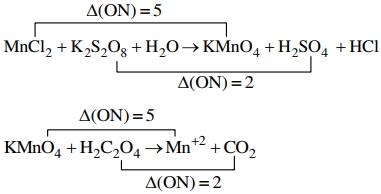
View full question & answer→MCQ 2941 Mark
In dilute aqueous $H _2 SO _4$, the complex diaquodioxalatoferrate($II$) is oxidized by $MnO _4^{-}$. For this reaction, the ratio of the rate of change of $\left[ H ^{+}\right]$to the rate of change of $\left[ MnO _4\right]$ is
Answerd
$\left[ Fe \left( C _2 O _4\right)\left( H _2 O \right)\right]^{2-}+ MnO _4^{2-}+8 H ^{+} \longrightarrow Mn ^{2+}+ Fe ^{3+}+4 CO _2+6 H _2 O$
So the ratio of rate of change of $\left[ H ^{+}\right]$to that of rate of change of $\left[ MnO _4\right]$ is $8$ .
View full question & answer→MCQ 2951 Mark
Consider the following list of reagents :
Acidified $K _2 Cr _2 O _7$, alkaline $KMnO _4, CuSO _4, H _2 O _2, Cl _2, O _3, FeCl _3, HNO _3$ and $Na _2 S _2 O _3$. The total number of reagents that can oxidise aqueous iodide to iodine is
Answerc
$I ^{-}$to $I _2$ oxidation can be done by acidfied $K _2 Cr _2 O _7, CuSO _4, H _2 O _2$
$I ^{-}$ $I _2$ $K _2 Cr _2 O _7, CuSO _4, H _2 O _2$
$K _2 Cr _2 O _7+ KI + H _2 SO _4 \longrightarrow K _2 SO _4+ Cr _2\left( SO _4\right)_3+ I _2+ H _2 O $
$2 CuSO _4+4 KI \longrightarrow 2 CuI \downarrow+ I _2+2 K _2 SO _4 $
$H _2 O _2+2 KI \longrightarrow 2 KOH + I _2 $
$2 KI + Cl _2 \longrightarrow 2 KCl + I _2 $
$H _2 O +2 KI + O _3 \longrightarrow 2 KOH + O _2+ I _2 $
$FeCl _3+2 KI \longrightarrow 2 KCl + FeCl _2+ I _2 $
$HNO _3+ KI \longrightarrow KNO _3+ I _2+ NO \uparrow$
$Na _2 S _2 O _3+ KI \longrightarrow$ no reaction.
$Note :$ In $H _2 O _2 \& O _3 I ^{-}$to $I _2$ oxidation will occur intially.
However as concentration of $KOH$ builds up, it will begin causing disproportionation of resulting $I _2$ to $IO _3$ $KOH$ $I _2$ से $IO _3^{-}$
View full question & answer→MCQ 2961 Mark
For the reaction:
$I ^{-}+ ClO _3^{-}+ H _2 SO _4 \longrightarrow Cl ^{-}+ HSO _4^{-}+ I _2$
The correct statement(s) in the balanced equation is/are:
$(A)$ Stoichiometric coefficient of $HSO _4^{-}$is 6 .
$(B)$ lodide is oxidized.
$(C)$ Sulphur is reduced.
$(D)$ $H _2 O$ is one of the products.
- A
$(A,B,C)$
- ✓
$(A,B,D)$
- C
$(A,C,D)$
- D
$(B,C,D)$
AnswerCorrect option: B. $(A,B,D)$
b
$6 I ^{-}+ ClO _3^{-}+6 H _2 SO _4 \rightarrow Cl ^{-}+6 HSO _4^{-}+3 I _2+3 H _2 O$
Hence, $I ^{-}$is oxidised to $I _2$
Coefficient of $HSO _4^{-}=6$
and $H _2 O$ is one of the product.
Hence $(A),(B),(D)$
View full question & answer→MCQ 2971 Mark
Bleaching powder and bleach solution are produced on a large scale and used in several house hold products.
The effectiveness of bleach solution is often measured by iodometry.
$1.$ $25 mL$ of household bleach solution was mixed with $30 \ mL$ of $0.50 \ M \ KI$ and $10 \ mL$ of $4 \ N$ acetic acid. In the titration of the liberated iodine, $48 \ mL$ of $0.25 \ N \ Na _2 S _2 O _3$ was used to reach the end point. The molarity of the household bleach solution is
$(A)$ $0.48 \ M$ $(B)$ $0.96 \ M$ $(C)$ $0.24 \ M$ $(D)$ $0.024 \ M$
$2.$ Bleaching powder contains a salt of an oxoacid as one of its components. The anhydride of that oxoacid is
$(A)$ $Cl _2 O$ $(B)$ $Cl _2 O _7$ $(C)$ $ClO _2$ $(D)$ $Cl _2 O _6$
Give the answer question $1$ and $2.$
- A
$(B,D)$
- B
$(B,C)$
- C
$(A,D)$
- ✓
$(C,A)$
AnswerCorrect option: D. $(C,A)$
d
$1.$ $\text { milli mole of Hypo } $$ =0.25 \times 48 $
$ =2 \times \text { milli mole of } Cl _2$
milli mole of $Cl _2=\frac{0.25 \times 48}{2}=6$ milli mole
= milli mole of $Cl _2=$ milli mole of $CaOCl _2$
So, molarity $=\frac{6}{25} M =0.24 M$
$2.$ $CaOCl _2= Ca ( OCl ) Cl$
$OCl ^{-}$- Hypochlorite ion which is anion of $HOCl$ Anhydride of $HOCl = Cl _2 O$
View full question & answer→MCQ 2981 Mark
Reduction of the metal centre in aqueous permanganate ion involves
$(A)$ $3$ electrons in neutral medium
$(B)$ $5$ electrons in neutral medium
$(C)$ $3$ electrons in alkaline medium
$(D)$ $5$ electrons in acidic medium
- ✓
$(A,C,D)$
- B
$(A,B,C)$
- C
$(B,C,D)$
- D
$(A,B,D)$
AnswerCorrect option: A. $(A,C,D)$
a
In neutral medium
$MnO _4^{-}+2 H _2 O +3 e^{-} \rightarrow MnO _2+4 OH ^{-}$
In alkaline medium
$MnO _4^{-}+e^{-} \rightarrow MnO _4^{2-}$
But $MnO _4^{2-}$ is further reduced to $MnO _2$ as shown below
$MnO _4^{2-}+2 H _2 O +2 e^{-} \rightarrow MnO _2+4 OH ^{-}$
Complete reaction is
$MnO _4^{2-}+2 H _2 O +3 e^{-} \rightarrow MnO _2+4 OH ^{-}$
which is the same as that for neutral medium.
In acidic medium
$MnO _4^{-}+8 H ^{+}+5 e^{-} \rightarrow Mn ^{2+}+4 H _2 O$
Hence, the number of electrons involved in the reduction of metal centre in aqueous $MnO _4^{-}$ion in neutral, alkaline and acidic media are $3,3$ and $5$ respectively.
View full question & answer→MCQ 2991 Mark
Oxidation states of the metal in the minerals haematite and magnetite, respectively, are
- A
$II$, $III$ in haematite and $III$ in magnetite
- B
$II$, $III$ in haematite and $II$ in magnetite
- C
$II$ in haematite and $II$, $III$ in magnetite
- ✓
$III$ in haematite and $II$, $III$ in magnetite
AnswerCorrect option: D. $III$ in haematite and $II$, $III$ in magnetite
d
$III$ in haematite and $II, III$ in magnetite
Haematite is $Fe _2 O _3$ and clearly iron is in its $+3$ oxidation state.
Magnetite is $Fe _3 O _4$ which is in fact $FeO$ . $Fe _2 O _3$.
$FeO$ is Iron $(II)$ oxide while $Fe _2 O _3$ is Iron $(III)$ oxide.
Hence, magnetite has iron in both $III$ and $II$
View full question & answer→MCQ 3001 Mark
The difference in the oxidation numbers of the two types of sulphur atoms in $\mathrm{Na}_2 \mathrm{~S}_4 \mathrm{O}_6$ is
Answera
The structure of $Na _2 S_4 O _6$ is.
$Image$
Oxidation number of sulphur atom involved in coordinate bond formation is $(+5)$ and that of middle sulphur atom is zero. Hence, the difference in oxidation number of two types of sulphur atoms will be $( +5 )$.
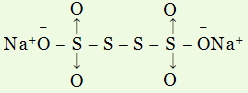
View full question & answer→MCQ 3011 Mark
When $Mn{O_2}$ is fused with $KOH,$ a coloured compound is formed, the product and its colour is
AnswerCorrect option: A. ${K_2}Mn{O_4}$, purple green
(a) $2Mn{{O}_{2}}+4KOH+{{O}_{2}}\xrightarrow{\Delta }\underset{\text{purple}\,\,\text{green}}{\mathop{2{{K}_{2}}Mn{{O}_{4}}}}\,+2{{H}_{2}}O$
View full question & answer→MCQ 3021 Mark
For ${H_3}P{O_3}$ and ${H_3}P{O_4}$ the correct choice is
- ✓
${H_3}P{O_3}$ is dibasic and reducing
- B
${H_3}P{O_3}$ is dibasic and non-reducing
- C
${H_3}P{O_4}$ is tribasic and reducing
- D
${H_3}P{O_3}$ is tribasic and non-reducing
AnswerCorrect option: A. ${H_3}P{O_3}$ is dibasic and reducing
(a) $H - O - \mathop {\mathop P\limits_ \downarrow ^| }\limits_O^H - OH$, hence it is dibasic. It acts as reducing agent also.
View full question & answer→MCQ 3031 Mark
In standardization of $N{a_2}{S_2}{O_3}$ using ${K_2}C{r_2}{O_7}$ by iodometry, the equivalent weight of ${K_2}C{r_2}{O_7}$ is
- A
$MW/2$
- B
$MW/3$
- ✓
$MW/6$
- D
$MW/1$
AnswerCorrect option: C. $MW/6$
(c)
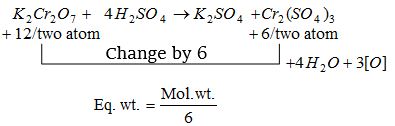
View full question & answer→MCQ 3041 Mark
Amongst the following identify the species with an atom in $+ 6$ oxidation state
- A
$MnO_4^ - $
- B
$Cr(CN)_6^{3 - }$
- C
$NiF_6^{2 - }$
- ✓
$Cr{O_2}C{l_2}$
AnswerCorrect option: D. $Cr{O_2}C{l_2}$
(d) $\mathop {Cr{O_2}C{l_2}}\limits^{ * \,\,\,\,\,\,\,\,\,\,\,\,\,} $, $x - 4 - 2 = 0,\,x = + 6$.
View full question & answer→MCQ 3051 Mark
The compound $YB{a_2}C{u_3}{O_7}$ which shows superconductivity has copper in oxidation state ........ Assume that the rare earth element Yttrium is in its usual $ + \,3$ oxidation state
Answer(b) $B{a_2}\mathop {C{u_3}}\limits^{ * \,\,} {O_7}$
$3 + 2 \times 2 + 3x - (2 \times 7) = 0$
$3 + 4 + 3x - 14 = $$3x = 7$
$x = \frac{7}{3}$.
View full question & answer→MCQ 3061 Mark
For the redox reaction $MnO_4^ - + {C_2}O_4^{ - 2} + {H^ + } \to \,M{n^{2 + }} + C{O_2} + {H_2}O$ the correct coefficients of the reactants for the balanced reaction are
$MnO_4^ - $ ${C_2}O_4^{2 - }$ ${H^ + }$
- ✓
$2$ $5$ $16$
- B
$16 $ $5$ $ 2$
- C
$5$ $16$ $2$
- D
$2$ $16$ $5$
AnswerCorrect option: A. $2$ $5$ $16$
(a) $MnO_4^ - + 8{H^ + } + 5{e^ - } \to M{n^{2 + }} + 4{H_2}O \times 2$
${C_2}O_4^{2 - } \to 2C{O_2} + 2{e^ - } \times 5$
$\overline{2MnO_4^ - + 5{C_2}O_4^{2 - } + 16{H^ + } \to 2M{n^{2 + }} + 10C{O_2} + 8{H_2}O} $
Thus the coefficient of $MnO_4^ - $, ${C_2}O_4^{2 - }$and${H^ + }$in the above balanced equation respectively are $2, 5, 16.$
View full question & answer→MCQ 3071 Mark
The compound which could not act both as oxidising as well as reducing agent is
- A
$S{O_2}$
- B
$Mn{O_2}$
- ✓
$A{l_2}{O_3}$
- D
$CrO$
AnswerCorrect option: C. $A{l_2}{O_3}$
(c) $A{l_2}{O_3}$ could not act as a oxidising and reducing agent.
View full question & answer→MCQ 3081 Mark
The number of electrons to balance the following equation $NO_3^ - + 4{H^ + } + {e^ - }\, \to \,2{H_2}O + NO$ is
Answer(c)$NO_3^ - + 4{H^ + } + 4{e^ - } \to 2{H_2}O + NO.$ In this equation all the atoms are balanced. For balancing added $3{e^ - }$ to $L.H.S.$ we have, $NO_3^ - + 4{H^ + } + 3{e^ - } \to 2{H_2}O + NO$.
View full question & answer→MCQ 3091 Mark
The oxidation states of the most electronegative element in the products of the reaction of $Ba{O_2}$ with dilute ${H_2}S{O_4}$ are
- A
$0$ and $-1$
- ✓
$-1$ and $-2$
- C
$-2$ and $0$
- D
$-2$ and $+ 1$
AnswerCorrect option: B. $-1$ and $-2$
(b) In ${H_2}{O_2}$ oxygen shows $= -1$ (peroxide) oxidation state and in $BaS{O_4}$ oxygen shows $= -2$ oxidation state.
View full question & answer→MCQ 3101 Mark
The oxidation number of carbon in $C{H_2}O$ is
Answer(c) $\mathop {C{H_2}O}\limits^{ * \,\,\,\,\,\,\,\,\,} $
$x + 2 - 2 = 0$
$x = 0$.
View full question & answer→MCQ 3111 Mark
One mole of ${N_2}{H_4}$ loses $10\, mol$ of electrons to form a new compound $Y$. Assuming that all nitrogen appear in the new compound, what is the oxidation state of ${N_2}$ in $Y$ ? (There is no change in the oxidation state of hydrogen)
Answer(a) $N_2^{ - 2}{H_4}$ $ \rightleftharpoons $ $\,2{N^{a + }} + 10{e^ - }$
$( - 2) \times 2 = 2a - 10$
$2a - [2 \times ( - 2)] = 10$
$a = + 3$.
View full question & answer→MCQ 3121 Mark
When $P$ reacts with caustic soda, the products are $P{H_3}$ and $Na{H_2}P{O_2}.$ This reaction is an example of
- A
- B
- ✓
Oxidation and reduction (Redox)
- D
AnswerCorrect option: C. Oxidation and reduction (Redox)
(c) It shows oxidation and reduction (Redox) properties.
$\overset{0}{\mathop{{{P}_{4}}}}\,+3NaOH+3{{H}_{2}}O\to \underset{\begin{smallmatrix}
\,\,\,\,\,\,\,\text{Sodium} \\
\text{hypophosphite}
\end{smallmatrix}}{\mathop{3Na{{H}_{2}}P{{O}_{2}}}}\,+\overset{-3\,\,\,\,\,\,\,\,\,}{\mathop{P{{H}_{3}}}}\,$
View full question & answer→MCQ 3131 Mark
Assign $A, B, C, D$ from given type of reaction.
$CuS{O_4} + Zn\left( s \right) \longrightarrow ZnS{O_4} + Cu$
- A
for disproportionation reaction.
- B
for comproportionation reaction.
- ✓
for either intermolecular redox reaction or displacement reaction.
- D
for either thermal combination redox reaction or thermal decomposition redox reaction.
AnswerCorrect option: C. for either intermolecular redox reaction or displacement reaction.
View full question & answer→MCQ 3141 Mark
Assign $A, B, C, D$ from given type of reaction.
$3PbS + 8HNO_3\, (Dil.) \longrightarrow 3Pb(NO_3)_2 + 3S \downarrow + 2NO + 4H_2O$
- A
for disproportionation reaction.
- B
for comproportionation reaction.
- ✓
for either intermolecular redox reaction or displacement reaction.
- D
for either thermal combination redox reaction or thermal decomposition redox reaction.
AnswerCorrect option: C. for either intermolecular redox reaction or displacement reaction.
View full question & answer→MCQ 3151 Mark
Assign $A, B, C, D$ from given type of reaction.
$NaN{O_3} + {H_2}S{O_4}\left( {conc.} \right)\xrightarrow{{Hot}}N{a_2}S{O_4} + N{O_2} \uparrow + {O_2} \uparrow $
- A
for disproportionation reaction.
- B
for comproportionation reaction.
- C
for either intermolecular redox reaction or displacement reaction.
- ✓
for either thermal combination redox reaction or thermal decomposition redox reaction.
AnswerCorrect option: D. for either thermal combination redox reaction or thermal decomposition redox reaction.
View full question & answer→MCQ 3161 Mark
Assign $A, B, C, D$ from given type of reaction.
$NaI + Mn{O_2} + {H_2}S{O_4}\left( {conc.} \right) \to MnS{O_4} + {I_2} \uparrow $
- A
for disproportionation reaction.
- B
for comproportionation reaction.
- ✓
for either intermolecular redox reaction or displacement reaction.
- D
for either thermal combination redox reaction or thermal decomposition redox reaction.
AnswerCorrect option: C. for either intermolecular redox reaction or displacement reaction.
View full question & answer→MCQ 3171 Mark
Assign $A, B, C, D$ from given type of reaction.
$NaI + H_2SO_4 \,(Conc.) \longrightarrow Na_2SO_4 +I_2 \uparrow + SO_2$
- A
for disproportionation reaction.
- B
for comproportionation reaction.
- ✓
for either intermolecular redox reaction or displacement reaction.
- D
for either thermal combination redox reaction or thermal decomposition redox reaction.
AnswerCorrect option: C. for either intermolecular redox reaction or displacement reaction.
View full question & answer→MCQ 3181 Mark
Assign $A, B, C, D$ from given type of reaction.
$NaBr +MnO_2 +H_2SO_4\, (Conc.) \longrightarrow MnSO_4 +Br_2 \uparrow $
- A
for disproportionation reaction.
- B
for comproportionation reaction.
- ✓
for either intermolecular redox reaction or displacement reaction.
- D
for either thermal combination redox reaction or thermal decomposition redox reaction.
AnswerCorrect option: C. for either intermolecular redox reaction or displacement reaction.
View full question & answer→MCQ 3191 Mark
Assign $A, B, C, D$ from given type of reaction.
$MnO_2 + NaCl + H_2SO_4\, (Conc.) \longrightarrow MnSO_4 +Cl_ 2 \uparrow $
- A
for disproportionation reaction.
- B
for comproportionation reaction.
- ✓
for either intermolecular redox reaction or displacement reaction.
- D
for either thermal combination redox reaction or thermal decomposition redox reaction.
AnswerCorrect option: C. for either intermolecular redox reaction or displacement reaction.
View full question & answer→MCQ 3201 Mark
Assign $A, B, C, D$ from given type of reaction.
$Na_2S + H_2SO_4\, (Conc.) \longrightarrow S \downarrow +SO_2 + Na_2SO_4$
- A
for disproportionation reaction.
- B
for comproportionation reaction.
- ✓
for either intermolecular redox reaction or displacement reaction.
- D
for either thermal combination redox reaction or thermal decomposition redox reaction.
AnswerCorrect option: C. for either intermolecular redox reaction or displacement reaction.
View full question & answer→MCQ 3211 Mark
Assign $A, B, C, D$ from given type of reaction.
$PC{l_5}\xrightarrow{\Delta }PC{l_3} + C{l_2}$
- A
for disproportionation reaction.
- B
for comproportionation reaction.
- C
for either intermolecular redox reaction or displacement reaction.
- ✓
for either thermal combination redox reaction or thermal decomposition redox reaction.
AnswerCorrect option: D. for either thermal combination redox reaction or thermal decomposition redox reaction.
View full question & answer→MCQ 3221 Mark
Assign $A, B, C, D$ from given type of reaction.
$Sn + PC{l_5}\xrightarrow{\Delta }SnC{l_4} + PC{l_3}$
- A
for disproportionation reaction.
- B
for comproportionation reaction.
- ✓
for either intermolecular redox reaction or displacement reaction.
- D
for either thermal combination redox reaction or thermal decomposition redox reaction.
AnswerCorrect option: C. for either intermolecular redox reaction or displacement reaction.
View full question & answer→MCQ 3231 Mark
Assign $A, B, C, D$ from given type of reaction.
$Ag + PC{l_5}\xrightarrow{\Delta }AgCl + PC{l_3}$
- A
for disproportionation reaction.
- B
for comproportionation reaction.
- ✓
for either intermolecular redox reaction or displacement reaction.
- D
for either thermal combination redox reaction or thermal decomposition redox reaction.
AnswerCorrect option: C. for either intermolecular redox reaction or displacement reaction.
View full question & answer→MCQ 3241 Mark
Assign $A, B, C, D$ from given type of reaction.
$Pb{\left( {N{O_3}} \right)_2}\xrightarrow{\Delta }PbO + N{O_2} + {O_2}$
- A
for disproportionation reaction.
- B
for comproportionation reaction.
- C
for either intermolecular redox reaction or displacement reaction.
- ✓
for either thermal combination redox reaction or thermal decomposition redox reaction.
AnswerCorrect option: D. for either thermal combination redox reaction or thermal decomposition redox reaction.
View full question & answer→MCQ 3251 Mark
Assign $A, B, C, D$ from given type of reaction.
${N_2} + 3{H_2} \longrightarrow NH_3$
- A
for disproportionation reaction.
- B
for comproportionation reaction.
- C
for either intermolecular redox reaction or displacement reaction.
- ✓
for either thermal combination redox reaction or thermal decomposition redox reaction.
AnswerCorrect option: D. for either thermal combination redox reaction or thermal decomposition redox reaction.
View full question & answer→MCQ 3261 Mark
Assign $A, B, C, D$ from given type of reaction.
$NaN{O_3}\xrightarrow{\Delta }NaN{O_2} + {O_2}$
- A
for disproportionation reaction.
- B
for comproportionation reaction.
- C
for either intermolecular redox reaction or displacement reaction.
- ✓
for either thermal combination redox reaction or thermal decomposition redox reaction.
AnswerCorrect option: D. for either thermal combination redox reaction or thermal decomposition redox reaction.
View full question & answer→MCQ 3271 Mark
$10\,mole$ of ferric oxalate is oxidised by $x$ mole of $MnO_4^-$ in acidic medium. The value of $'x'$ is
View full question & answer→MCQ 3281 Mark
Iodine is formed when $ KI $ reacts with a solution of
- ✓
$CuS{O_4}$
- B
${(N{H_4})_2}S{O_4}$
- C
$ZnS{O_4}$
- D
$FeS{O_4}$
AnswerCorrect option: A. $CuS{O_4}$
(a)Iodine being a strong reducing agent reduce $C{u^{2 + }}$ ions to $C{u^ + }$ ions and itself gets oxidised to iodine.
$\mathop {2CuS{O_4}}\limits_{{\rm{Reduced}}}^{ + 2} + \mathop {4KI}\limits_{{\rm{Oxidised}}}^{ - 1} \to \mathop {C{u_2}{I_2}}\limits^{ + 1} + \mathop {{I_2}}\limits^0 + 2{K_2}S{O_4}$
View full question & answer→MCQ 3291 Mark
Starch paper is used to test for the presence of
Answer(a) Starch paper are used for iodine test as:
${{I}^{-}}+\text{oxidant }\xrightarrow{{}}{{I}_{2}}$
${{I}_{2}}+\text{starch}\xrightarrow{{}}\text{blue colour}$
View full question & answer→MCQ 3301 Mark
The value of $x$ in the partial redox equation $MnO_4^ - + 8{H^ + } + xe$ $\rightleftharpoons$ $M{n^{2 + }} + 4{H_2}O$ is
Answera
$MnO_4^ - + 8{H^ + } + 5{e^ - }$ ⇌ $M{n^{ + + }} + 4{H_2}O$.
View full question & answer→MCQ 3311 Mark
In the reaction, $4Fe + 3{O_2} \to 4F{e^{3 + }} + 6{O^{2 - }}$ which of the following statement is incorrect
AnswerCorrect option: D. Metallic iron is reduced to $F{e^{3 + }}$
(d) $\mathop {4Fe}\limits^{\,\,\,0\,\,} + 3{O_2}\,\,\,\, \to \mathop {4Fe}\limits^{\,\,\,\,3 + } + 6{O^{2 - }}$, in this reaction metallic iron is oxidised to $F{e^{3 + }}$.
View full question & answer→MCQ 3321 Mark
When $Cu$ or $Zn$ added to $CuSO_4$ we get $Cu$ .It is due to
AnswerCorrect option: B. Reduction of $C{u^{ + 2}}$
(b)In this reaction $C{u^{2 + }}$ change in $C{u^o}$, hence it is called as reduction reaction.
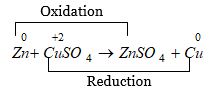
View full question & answer→MCQ 3331 Mark
In a reaction between zinc and iodine, in which zinc iodide is formed, what is being oxidised
Answer(c)In this reaction $Zn$ atom oxidised to $\mathop {Z{n^{2 + }}}\limits^{} $ ion and iodine reduced to ${I^ - }$.
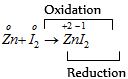
View full question & answer→MCQ 3341 Mark
$SnC{l_2}$ gives a precipitate with a solution of $HgC{l_2}.$ In this process $HgC{l_2}$ is
Answer(a) In this reaction $HgC{l_2}$ is reduced in $Hg$.
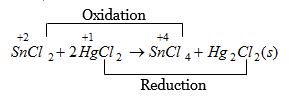
View full question & answer→MCQ 3351 Mark
$2CuI\, \to Cu + Cu{I_2}$, the reaction is
Answer(a) $\mathop {2CuI}\limits^{ + 1\,\,} \to \mathop {Cu}\limits^0 \,\, + \mathop {Cu{I_2}}\limits^{ + 2\,\,\,\,\,} $. Oxidation and Reduction both occur so the reaction is redox.
View full question & answer→MCQ 3361 Mark
Assign $A, B, C, D$ from given type of reaction.
$N{a_2}{C_2}{O_4} + {H_2}S{O_4}\left( {conc.} \right) \longrightarrow N{a_2}S{O_4} + CO + C{O_2}$
- ✓
for disproportionation reaction.
- B
for comproportionation reaction.
- C
for either intermolecular redox reaction or displacement reaction.
- D
for either thermal combination redox reaction or thermal decomposition redox reaction.
AnswerCorrect option: A. for disproportionation reaction.
View full question & answer→MCQ 3371 Mark
Assign $A, B, C, D$ from given type of reaction.
$Red\, P + Alkali \longrightarrow Na_4P_2O_6 + P_2H_4$
- ✓
for disproportionation reaction.
- B
for comproportionation reaction.
- C
for either intermolecular redox reaction or displacement reaction.
- D
for either thermal combination redox reaction or thermal decomposition redox reaction.
AnswerCorrect option: A. for disproportionation reaction.
View full question & answer→MCQ 3381 Mark
The decomposition of hydrogen peroxide is an example of
Answerd
(a.c,d)Decomposition of ${H_2}{O_2}$ is an example of exothermic reaction, negative catalysis and auto-oxidation.
View full question & answer→MCQ 3391 Mark
Which of the following halogen can be purified by sublimation
- A
${F_2}$
- B
$C{l_2}$
- C
$B{r_2}$
- ✓
${I_2}$
AnswerCorrect option: D. ${I_2}$
d
Iodine is purified by a sublimation process
Because iodine is solid at room temperature, fluorine and chlorine are gases and bromine are liquid at room temperature
View full question & answer→MCQ 3401 Mark
The oxidation state of $N$ in $HNO _{4}$ is
Answerb
$HNO _{2} O _{2}$ (one Peroxybond)
$+1+N+2(-2)+2(-1)=0$
$N=+5$
View full question & answer→MCQ 3411 Mark
Cairo's acid have how many $S-OH$ bond
Answera
Cairo's acid $\begin{array}{*{20}{c}}
{OH\,\,\,\,\,\,\,\,\,\,\,} \\
{|\,\,\,\,\,\,\,\,\,\,\,\,\,\,\,\,} \\
{O = S - O - OH} \\
{||\,\,\,\,\,\,\,\,\,\,\,\,\,\,\,\,} \\
{O\,\,\,\,\,\,\,\,\,\,\,\,\,\,\,\,}
\end{array}$
View full question & answer→MCQ 3421 Mark
Which one has maximum oxidation number of phosphorous
- A
$PH_3$
- B
$H_4P_2O_6$
- ✓
$H_3PO_4$
- D
$H_3PO_3$
AnswerCorrect option: C. $H_3PO_4$
c
$H_3PO_4$ oxidation state of $P = +5$
View full question & answer→MCQ 3431 Mark
In which of the following compound oxidation state of $Fe$ is zero
- A
$FeS$
- B
$Fe_2O_3$
- C
$FeSO_4$
- ✓
$Fe(CO)_5$
AnswerCorrect option: D. $Fe(CO)_5$
d
$CO$ neutral ligand
View full question & answer→MCQ 3441 Mark
The oxidation state of iodine in $H_4IO_6^-$ is
Answera
$H_4IO_6^-$
$+4 +x -12 = -1$
$x-8 = -1$
$x = +7$
View full question & answer→MCQ 3451 Mark
Oxidation number of $P$ in $Mg_2P_2O_7$ is
Answerc
$Mg_2 P_2O_7$
$2 \times 2 + 2x -14 = 0$
$2x = 10$
$x = 5$
View full question & answer→MCQ 3461 Mark
In $Na_2S_4O_6$, the oxidation number of $S$ is
AnswerCorrect option: D. $+2.5$
d
$+1(2)+4 \times x+6 \times(-2)=0$
$x=+2.5$
View full question & answer→MCQ 3471 Mark
Basicity of $H_3BO_3$ is :
Answera
Protic acid is an acid that can undergo ionization and produce hydrogen ions/protons. However, aprotic acids do not produce any hydrogen ions/protons.
Although Boric acid contains 3 OH groups yet it can act as monobasic acid rather than tribasic acid. This is because boric acid does not act as a proton donor rather it accepts a pair of
electrons from $\mathrm{OH}^{-}$ ions.
It does not donate $\mathrm{H}^{+}$ rather it accepts an electron pair from the solution or the donor i.e. $\mathrm{OH}^{-}$
Thus, Boric acid is an aprotic acid (like lewis acid) and monobasic acid.
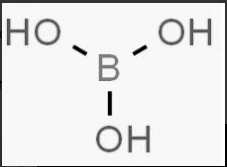
View full question & answer→MCQ 3481 Mark
The oxidation number of hydrogen in $LiH$ is
Answer(b) $\mathop {Li}\limits^{ + 1} \mathop H\limits^{ - 1} $.
View full question & answer→MCQ 3491 Mark
Oxidation number of oxygen in ozone $({O_3})$ is
Answer(d) Molecule and free atoms show zero oxidation state ${O_3}$ is a molecule shows zero oxidation state.
View full question & answer→MCQ 3501 Mark
A metal ion ${M^{3 + }}$ after loss of three electrons in a reaction will have an oxidation number equal to
Answer(d) ${M^{3 + }} \to {M^{6 + }} + 3{e^ - }$. Thus the oxidation number of metal $= + 6.$
View full question & answer→MCQ 3511 Mark
The oxidation state of sulphur in $SO_4^{2 - }$ is
Answer(c) $\mathop {SO_4^{2 - }}\limits^{ * \,\,\,\,\,\,\,\,\,\,} $
$x - 2 \times 4 = - 2$
$x = 8 - 2 = + 6$.
View full question & answer→MCQ 3521 Mark
The oxidation state of each oxygen atom in $N{a_2}{O_2}$ is
- A
$-2$ each
- B
$-2$ and zero
- ✓
$-1$ each
- D
AnswerCorrect option: C. $-1$ each
(c) In $N{a_2}{O_2}$ oxygen show $-1$ oxidation state.
View full question & answer→MCQ 3531 Mark
In which of the following compounds, is the oxidation number of iodine is fractional
- A
$I{F_3}$
- B
$I{F_2}$
- ✓
$I_3^ - $
- D
$I{F_7}$
AnswerCorrect option: C. $I_3^ - $
(c) $3x = - 1,\,\,x = - 1/3$.
View full question & answer→MCQ 3541 Mark
Oxidation number of $S$ in $SO_4^{2 - }$
Answer(a) $x = 8 - 2 = + 6$
View full question & answer→MCQ 3551 Mark
Oxidation number of nitrogen in $NaN{O_2}$ is
Answer(b) Let the oxidation number of $N$ in $NaN{O_2}$ be $x$
$ + 1 + x + ( - 2) \times 2 = 0$
$1 + x - 4 = 0$; $x = + 3$
View full question & answer→MCQ 3561 Mark
The oxidation number of fluorine in ${F_2}O$ is
Answer(a) Fluorine always shows $-1 $ oxidation state in oxides.
View full question & answer→MCQ 3571 Mark
The oxidation number of $N$ in $N{H_4}Cl$ is
Answer(d) $N{H_4}Cl$ $ \rightleftharpoons $ $N{H_4}^ + + C{l^ - }$
$\mathop {N{H_4}^ + }\limits^{ * \,\,\,\,\,\,\,\,\,} $
$x + 4 = + 1$; $x = 1 - 4 = - 3$.
View full question & answer→MCQ 3581 Mark
Oxidation number of $S$ in ${S_2}C{l_2}$ is
Answer(a) $\mathop {{S_2}C{l_2}}\limits^{ * \,\,\,\,\,\,\,\,\,} $
$2x + 2( - 1) = 0$; $2x - 2 = 0$
$x = + 1$.
View full question & answer→MCQ 3591 Mark
Oxidation number of sulphur in ${S_2}O_3^{2 - }$is
Answer(b) $\mathop {{S_2}O_3^{2 - }}\limits^{ * \,\,\,\,\,\,\,\,\,\,\,} $
$2x + 3( - 2) = - 2$; $x = + 2$.
View full question & answer→MCQ 3601 Mark
Select the compound in which chlorine is assigned the oxidation number $ +5$
- A
$HCl{O_4}$
- B
$HCl{O_2}$
- ✓
$HCl{O_3}$
- D
$HCl$
AnswerCorrect option: C. $HCl{O_3}$
(c) $\mathop {HCl{O_3}}\limits^ * $
$1 + x - 2 \times 3 = 0$; $x = 6 - 1 = + 5$.
View full question & answer→MCQ 3611 Mark
Oxidation state of $‘S’ $ in ${H_2}S{O_3}$
Answer(c)${H_2}\mathop {S{O_3}}\limits^{ * \,\,\,\,\,\,\,} $
$ + 2 + x - 2 \times 3 = 0$; $x = 6 - 2 = + 4$.
View full question & answer→MCQ 3621 Mark
The oxidation state of $Cr$ in $C{r_2}O_7^{2 - }$ is
Answer(c) $\mathop {C{r_2}O_7^{2 - }}\limits^{ * \,\,\,\,\,\,\,\,\,\,\,\,\,} $
$2x - 2 \times 7 = - 2$; $2x = 14 - 2 = 12$
$x = \frac{{12}}{2} = + 6$.
View full question & answer→MCQ 3631 Mark
Oxidation number of carbon in $C{H_3} - Cl$ is
Answer(b) $\mathop {C{H_3}}\limits^{ * \,\,\,\,\,\,\,\,} - Cl$
$x + 3( + 1) + ( - 1) \times 1 = 0$
$x + 3 - 1 = 0$; $x + 2 = 0$
$x = - 2$.
View full question & answer→MCQ 3641 Mark
In $Xe{O_3}$ and $Xe{F_6}$ the oxidation state of $Xe$ is
Answer(b) The oxidation state of $Xe$ in both $Xe{O_3}$ and $Xe{F_6}$ is $+ 6$
$\mathop {Xe{O_3}}\limits^{ * \,\,\,\,\,\,\,\,\,\,} $ $\mathop {Xe{F_6}}\limits^{ * \,\,\,\,\,\,\,\,\,} $
$x - 2 \times 3 = 0$ $x - 6 = 0$
$x = + 6$ $x = + 6$
View full question & answer→MCQ 3651 Mark
Oxidation number of $As$ atoms in ${H_3}As{O_4}$ is
Answer(d) ${H_3}As{O_4}$
$ + \,3 + x - 2 \times 4 = 0$; $x = 8 - 3 = + \,5$.
View full question & answer→MCQ 3661 Mark
The oxidation number of phosphorus in $Ba{({H_2}P{O_2})_2}$ is
Answer(b) $Ba{({H_2}\mathop P\limits^ * {O_2})_2}$; $Ba{H_4}\mathop {{P_2}}\limits^ * {O_4}$
$2 + 4 + 2x - 8 = 0$;
$2x = 2$$x = \frac{2}{2} = + 1$.
View full question & answer→MCQ 3671 Mark
The oxidation number of nitrogen in $N{H_2}OH$ is
Answer(b) ${\mathop {NH_2}\limits^{ * \,\,\,}}OH$
$x + 2\,( + 1) - 2 + 1 = 0$
$x + 2 - 2 + 1 = 0$; $x = - 1$.
View full question & answer→MCQ 3681 Mark
The most common oxidation state of an element is $-2.$ The number of electrons present in its outermost shell is
Answer(c)Oxygen has $6$ electrons in the outer most shell and shows common oxidation state $-2.$
View full question & answer→MCQ 3691 Mark
Oxidation number of $P$ in $K{H_2}P{O_2}$ is
Answer(a) In $\mathop {K{H_2}P{O_2}}\limits^{\,\,\,\,\, * } $
$1 + 2 + x + ( - 2 \times 2) = 0$
$3 + x - 4 = 0$; $x = + 1$.
View full question & answer→MCQ 3701 Mark
Oxidation number of $P$ in $M{g_2}{P_2}{O_7}$ is
Answer(c) $\mathop {M{g_2}{P_2}{O_7}}\limits^{\,\,\, * } $
$4 + 2x - 2 \times 7 = 0$;$2x = 14 - 4 = 10$
$2x = 10$; $x = \frac{{10}}{2} = + \,5$.
View full question & answer→MCQ 3711 Mark
The oxidation number of $Cr$ in ${K_2}C{r_2}{O_7}$ is
Answer(a) $\mathop {{K_2}C{r_2}{O_7}}\limits^{ * \,\,} $
$2 + 2x - 2 \times 7 = 0$; $2x - 14 + 2 = 0$
$2x = 12$; $x = \frac{{12}}{2} = + 6$.
View full question & answer→MCQ 3721 Mark
Oxidation state of oxygen in hydrogen peroxide is
Answer(a)In all peroxide oxygen shows $-1 $ oxidation state.
View full question & answer→MCQ 3731 Mark
Oxidation number of iodine varies from
- A
$-1$ to $+1$
- ✓
$-1$ to $+7$
- C
$+3$ to $+5$
- D
$-1$ to $+5$
AnswerCorrect option: B. $-1$ to $+7$
(b) Iodine shows $-1$ to $+ 7$ oxidation state.
View full question & answer→MCQ 3741 Mark
Oxidation number of $C$ in ${C_6}{H_{12}}{O_6}$ is
Answer(c) $C$ has oxidation number $= 0.$
View full question & answer→MCQ 3751 Mark
The characteristic oxidation number of atoms in free metals is
Answer(d) All free metals always shows zero oxidation state.
View full question & answer→MCQ 3761 Mark
The oxidation state of chlorine in $KCl{O_4}$ is
Answer(c)$\mathop {KCl{O_4}}\limits^ * $
$1 + x - 2 \times 4 = 0$
$x - 8 + 1 = 0$.
$x = +7$.
View full question & answer→MCQ 3771 Mark
Oxidation state of elemental carbon is
Answer(a) Every element always shows zero oxidation state.
View full question & answer→MCQ 3781 Mark
The oxidation number of nitrogen in $NO_3^ - $ is
Answer(d) $\mathop {NO_3^ - }\limits^{ * \,\,\,\,\,\,} $
$x - 2 \times 3 = - 1$; $x = 6 - 1 = + 5$.
View full question & answer→MCQ 3791 Mark
The oxidation number of carbon in $C{H_2}C{l_2}$ is
Answer(a) $\mathop {C{H_2}}\limits^{ * \,\,\,\,\,\,\,} C{l_2}$
$x + 2 - 2 = 0$; $x = 0$.
View full question & answer→MCQ 3801 Mark
Oxidation number of carbon in ${H_2}{C_2}{O_4}$ is
Answer(b) $\mathop {{H_2}{C_2}{O_4}}\limits^ * $
$2 + 2x - 2 \times 4 = 0$; $2x = 8 - 2 = 6$
$x = \frac{6}{2} = + 3$.
View full question & answer→MCQ 3811 Mark
Maximum oxidation state of $Cr$ is
Answer(c) Maximum oxi. state for $Cr$ is $ + 6.$
View full question & answer→MCQ 3821 Mark
The oxidation state of $Mn$ in ${K_2}Mn{O_4}$
Answer(d) $\mathop {{K_2}Mn{O_4}}\limits^ * $
$2 + x - 2 \times 4 = 0$
$x = 8 - 2 = + 6$.
View full question & answer→MCQ 3831 Mark
$S{n^{ +2 }}$ loses two electrons in a reaction. What will be the oxidation number of tin after the reaction
Answer(c) $S{n^{2 + }} \to S{n^{4 + }} + 2{e^ - }$
View full question & answer→MCQ 3841 Mark
The oxidation number of $Mn$ in $MnO_4^{ - 1}$ is
Answer(a) $Mn$ shows $+ 7$ oxidation state in
$\mathop {MnO_4^{ - 1}}\limits^{ * \,\,\,\,\,\,\,\,\,\,\,\,\,\,\,} $
$x + ( - 2 \times 4) = - 1$
$x - 8 = - 1$
$x = - 1 + 8 = + 7$.
View full question & answer→MCQ 3851 Mark
Oxidation number of $N$ in $HN{O_3}$ is
- A
$-3.5$
- B
$+3.5$
- C
$-3, +5$
- ✓
$+5$
Answer(d) $H\mathop N\limits^ * {O_3}$; $1 + x - 6 = 0$; $x = + 5$.
View full question & answer→MCQ 3861 Mark
The oxidation number of sulphur in ${H_2}S{O_4}$ is
Answer(d)$\mathop {{H_2}S{O_4}}\limits^ * $
$2 + x - 2 \times 4 = 0$, $x = 8 - 2 = + 6$.
View full question & answer→MCQ 3871 Mark
Oxidation number of $S$ in ${S^{2 - }}$ is
Answera) $S \to {S^{2 - }}$ $O.N.$ of $S$ $= -2.$
View full question & answer→MCQ 3881 Mark
The oxidation number of chlorine in $HOCl$
Answer(c) In hypochlorous acid chlorine atom has $ + 1$ oxidation number.
View full question & answer→MCQ 3891 Mark
In the chemical reaction $C{l_2} + {H_2}S \to 2HCl + S$, the oxidation number of sulphur changes from
- A
$0$ to $2$
- B
$2$ to $ 0$
- ✓
$-2 $ to $ 0$
- D
$-2$ to $ -1$
AnswerCorrect option: C. $-2 $ to $ 0$
(c) Oxidation state of sulphur in ${H_2}S$ is $-2,$ while it is zero in $‘S’$ i.e. in this reaction oxidation of sulphur and reduction of chlorine is takes place.
View full question & answer→MCQ 3901 Mark
In the conversion $B{r_2}\, \to \,BrO_3^ - ,$ the oxidation state of bromine changes from
- A
$-1 $ to $ -1$
- B
$0 $ to $-1$
- ✓
$0 $ to $+ 5$
- D
$0$ to $- 5$
AnswerCorrect option: C. $0 $ to $+ 5$
(c) $\mathop {B{r_2}}\limits^{0\,\,\,} \to \mathop {BrO_3^ - }\limits^{ + 5\,\,\,\,\,\,\,} $, in this reaction oxidation state change from $0 $ to $ + 5.$
View full question & answer→MCQ 3911 Mark
The oxidation number of $C$ in $C{O_2}$ is
Answer(d) $\mathop {C{O_2}}\limits^{ * \,\,\,\,\,\,} $
$x + 2\,( - 2) = 0$; $x - 4 = 0$; $x = + 4$.
View full question & answer→MCQ 3921 Mark
In the following reaction $C{r_2}O_7^ - + 14{H^ + } + 6{I^ - } \to \,$$2C{r^{3 + }} + 3{H_2}O + 3{I_2}$ Which element is reduced
Answer(a)
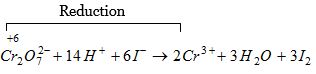
View full question & answer→MCQ 3931 Mark
In the following reaction, $3B{r_2} + 6CO_3^{2 - } + 3{H_2}O \rightarrow 5B{r^ - } + BrO_3^ - + 6HC{O_3}$
- A
Bromine is oxidised and carbonate is reduced
- B
Bromine is reduced and water is oxidised
- C
Bromine is neither reduced nor oxidised
- ✓
Bromine is both reduced and oxidised
AnswerCorrect option: D. Bromine is both reduced and oxidised
(d)$\mathop {3B{r_2}}\limits^0 + 6CO_3^{2 - } + 3{H_2}O \to \mathop {5B{r^ - }}\limits^{ - 1} + \mathop {BrO_3^ - }\limits^{ + 5\,\,\,\,\,\,\,\,} + 6HC{O_3}$. In this reaction bromine is oxidised as well as reduced.
View full question & answer→MCQ 3941 Mark
$Z{n^{2 + }}_{(aq) } + 2e\, \to \,Zn_{(s)}.$ This is
Answer(b)$\mathop {Z{n_{(aq)}}}\limits^{2 + \,\,\,\,\,} + 2{e^ - } \to \mathop {Z{n_{(s)}}}\limits^{0\,\,\,\,} $ reduction.
View full question & answer→MCQ 3951 Mark
${H_2}S$ reacts with halogens, the halogens
Answer(c)${H_2}S + {X_2}(Cl,\,Br,\,I\, = X) \to 2HX + S$. Here the halogen are reduced.
View full question & answer→MCQ 3961 Mark
In the reaction ${H_2}S + N{O_2} \to {H_2}O + NO + S $ , ${H_2}S$ is
Answer(a) In this reaction ${H_2}S$ is oxidised because the oxidation state of ‘$S$’ change from $-2$ to $0$.
View full question & answer→MCQ 3971 Mark
When a sulphur atom becomes a sulphide ion
- A
There is no change in the composition of atom
- ✓
- C
- D
Answer(b)$S + 2{e^ - } \to {S^{2 - }}$
View full question & answer→MCQ 3981 Mark
In the reaction between ozone and hydrogen peroxide, ${H_2}{O_2}$ acts as
- A
- ✓
- C
- D
Both oxidising and bleaching agent
Answer(b) ${H_2}{O_2}$ acts as a reducing agent in the reaction between ${O_3}$ and ${H_2}{O_2}$.
View full question & answer→MCQ 3991 Mark
To prevent rancidification of food material, which of the following is added
Answer(b) To prevent rancidification of food material we add anti-oxidant which are called oxidation inhibitor.
View full question & answer→MCQ 4001 Mark
Which one is oxidising agent in the reaction below
$2CrO_4^{2 - } + 2{H^ + } \to C{r_2}O_7^{2 - } + {H_2}O$
- A
${H^ + }$
- B
$C{r_2}O_4^ - $
- C
$C{r^{ + 2 }}$
- ✓
View full question & answer→MCQ 4011 Mark
The compound that can work both as oxidising and reducing agent is
- A
$KMn{O_4}$
- ✓
${H_2}{O_2}$
- C
$Ba{O_2}$
- D
${K_2}C{r_2}{O_7}$
AnswerCorrect option: B. ${H_2}{O_2}$
(b) Hydrogen peroxide $({H_2}{O_2})$ act as a both oxidising and reducing agent.
View full question & answer→MCQ 4021 Mark
Which one is oxidising substance
- A
${C_2}{H_2}{O_2}$
- B
$CO$
- C
${H_2}S$
- ✓
$C{O_2}$
AnswerCorrect option: D. $C{O_2}$
(d) $C{O_2}$ is an oxidizing agent.
View full question & answer→MCQ 4031 Mark
A reducing agent is a substance which can
Answer(b) A substance which is capable of reducing other substances and is capable of donating electrons during reduction is called a reducing agent or reductant.
View full question & answer→MCQ 4041 Mark
An oxidising agent is a substance, which
Answerb
Oxidising agent oxidises another substance and reduces it self i.e. accepts electron.
View full question & answer→MCQ 4051 Mark
In a chemical reaction, a reductant
- ✓
Loses electron $(s)$
- B
Gains electron $(s)$
- C
loses and gains electrons both
- D
AnswerCorrect option: A. Loses electron $(s)$
a
Reductant loses electron $(s)$
View full question & answer→MCQ 4061 Mark
In an oxidation process, oxidation number
- A
- ✓
- C
- D
First increases then decreases
Answer(b) In oxidation process oxidation state always increases.
View full question & answer→MCQ 4071 Mark
The process in which oxidation number increases is known as
Answera
The increase in oxidation state of an atom, through a chemical reaction, is known as an oxidation
$Cu \stackrel{\text { Oxidation }}{\longrightarrow} Cu ^{2+}\,+\,2$ electrons
Here oxidation number increases from $0$ to $+2$
View full question & answer→MCQ 4081 Mark
When $F{e^{2 + }}$ changes to $F{e^{3 + }}$ in a reaction
Answer(a) $F{e^{2 + }} \to F{e^{3 + }} + {e^ - }$ oxidation.
View full question & answer→MCQ 4091 Mark
- A
- ✓
- C
Increase in the valency of positive part
- D
Decrease in the valency of negative part
Answer(b) It is the process in which electrons are gained (electronation).
View full question & answer→MCQ 4101 Mark
- ✓
- B
- C
Increase in the valency of negative part
- D
Decrease in the valency of positive part
Answer(a) It is the process in which electrons are lost (de-electronation).
View full question & answer→MCQ 4111 Mark
In the reaction $3Mg + {N_2} \to M{g_3}{N_2}$
Answer(b) In the given reaction oxidation state of $Mg$ is changing from $0$ to $+2$ while in nitrogen it is changing from $0$ to $-3$. So oxidation of $Mg$ and reduction of nitrogen takes place.
View full question & answer→MCQ 4121 Mark
In the course of a chemical reaction an oxidant
- A
- ✓
- C
Both loses and gains electron
- D
Electron change takes place
Answer(b) Any substance which is capable of oxidising other substances and is capable of accepting/gaining electron during oxidation is called oxidising agent or oxidant.
View full question & answer→MCQ 4131 Mark
The conversion of $Pb{O_2}$ to $Pb{(N{O_3})_2}$is
- A
- ✓
- C
Neither oxidation nor reduction
- D
Both oxidation and reduction
Answer(b)$\mathop {Pb{O_2}}\limits^{ + 4\,\,\,\,\,\,\,\,\,\,\,} \to \mathop {Pb{{(N{O_3})}_2}}\limits^{ + 2\,\,\,\,\,\,\,\,\,\,\,\,\,\,\,\,\,\,\,\,\,\,} $. In this reaction reduction occurs.
View full question & answer→MCQ 4141 Mark
In acidic medium required number of moles of ferrous oxalate for reduction of $2.5\, moles$ of $KMnO_4$ is
- A
$2.5$
- ✓
$4.167$
- C
$1.5$
- D
$6.25$
AnswerCorrect option: B. $4.167$
View full question & answer→MCQ 4151 Mark
Which of the following are redox changes?
$(i)$ Hydrolysis of $XeF_2$
$(ii)$ Thermal decomposition of $Ag_2CO_3$
$(iii)$ Reaction of $Al$ with $NaOH$
$(iv)$ Hydrolysis Of $PCl_5$
$(v)$ Reaction of NaCl with conc. $H_2SO_4$
Correct options are
- A
$(i), (ii), (iv)$
- B
$(ii), (iv), (v)$
- C
$(i), (iii), (v)$
- ✓
$(i), (ii), (iii)$
AnswerCorrect option: D. $(i), (ii), (iii)$
View full question & answer→MCQ 4161 Mark
Comproportionation occurs between
- A
$C{l^ - }(aq.) + Cl{O^ - }(aq.) + O{H^ - }(aq.)$
- B
$P{H_3}(g) + {H_3}P{O_4}$ acid
- C
$N{a_2}S(aq.) + N{a_2}S{O_3}(aq.)$
- ✓
$MnO_4^ - (aq.) + M{n^{2 + }}(aq.) + ZnS{O_4}(aq.)$
AnswerCorrect option: D. $MnO_4^ - (aq.) + M{n^{2 + }}(aq.) + ZnS{O_4}(aq.)$
d
$Mn{O_4}^ - (aq.) + M{n^{2 + }}(aq.)\xrightarrow[{Comproportionation\,\,\,reaction}]{{Z{n^{2 + }}(aq.)}}Mn{O_2}$
View full question & answer→MCQ 4171 Mark
Which of the following compound undergoes disproportionation in presence of $SO_3$ gas ?
- ✓
$K_2MnO_4$
- B
$K_2CrO_4$
- C
$I_2$
- D
$Hg(NO_3)_2$
AnswerCorrect option: A. $K_2MnO_4$
a
The green solution of $MnO_4^{2-}(aq.)$ is stable only in strong basic medium, in neutral (or) acidic (or) tess basic medium it disproportionates into $MnO_2$ and $MnO_4^ -$ .
${K_2}Mn{O_4}(Green)\xrightarrow[{S{O_3}/acidic\,midium}]{{In\,presence\,\,of}}\,KMn{O_4}(Purple) + Mn{O_2}(Dark\,\,brown)$
View full question & answer→MCQ 4181 Mark
Which does not undergo comproportionation reaction ?
- A
${H_2}S\, + \,S{O_2}\, \to $
- B
${I^ - }(aq.) + \,IO_3^ - (aq.) + {H^ + }(aq.)\, \to $
- ✓
${K_2}Mn{O_4} + {H^ + }(aq.)\, \to $
- D
$MnO_4^ - + M{n^{2 + }}(aq.)\, \to $
AnswerCorrect option: C. ${K_2}Mn{O_4} + {H^ + }(aq.)\, \to $
c
${{\text{H}}_2}{\text{S}} \uparrow + {\text{S}}{{\text{O}}_2} \uparrow \xrightarrow{{ComproP.}}{\text{S}} \downarrow + {{\text{H}}_2}{\text{O}}$
${{\text{I}}^ - }(aq.) + {\text{IO}}_3^ - (aq \cdot ) + {{\text{H}}^ + }(aq \cdot )\xrightarrow{{ComproP.}}{{\text{I}}_2} + {{\text{H}}_2}{\text{O}}$
${{\text{K}}_2}{\text{Mn}}{{\text{O}}_4} + {{\text{H}}^ + }(aq.)\xrightarrow{{disprop.}}{\text{KMn}}{{\text{O}}_4} + {\text{Mn}}{{\text{O}}_2} \downarrow $
${\text{MnO}}_4^ - (aq.) + {\text{M}}{{\text{n}}^{2 + }}(aq.)\xrightarrow{{ComproP.}}{\text{Mn}}{{\text{O}}_2} \downarrow $
View full question & answer→MCQ 4191 Mark
$B{r_2} + NaOH\xrightarrow{{R.T.}}Y + Z$
If $Y$ gives precipitate with $AgNO_3 ,$ then $Z$ does not undergo reaction with
- A
$Cr^{3+}(aq.)$
- B
$Fe^{2+}(aq.)$
- ✓
$Al^{3+}(aq.)$
- D
$Sn^{2+}(aq.)$
AnswerCorrect option: C. $Al^{3+}(aq.)$
c
$\mathrm{Br}_{2}+\mathrm{NaOH} \longrightarrow \mathrm{NaBr}(Y)+\mathrm{NaBrO}(Z)$
$NaBrO$ is an oxidising agent which can oxidize
$\mathrm{Cr}^{3+} \longrightarrow \mathrm{Cr}^{6+}, \mathrm{Fe}^{2+}\rightarrow \mathrm{Fe}^{3+}, \mathrm{Sn}^{2+} \longrightarrow \mathrm{Sn}^{4+}$
but oxidation of $\mathrm{Al}^{3+}$ is not possible.
View full question & answer→MCQ 4201 Mark
${I^ - }(aq.) + MnO_4^ - (aq.)\xrightarrow{{{H^ + }}}X + M{n^{2 + }}(aq.)$
${I^ - }(aq.) + MnO_4^ - (aq.)\xrightarrow[{weakly\,\,O{H^ - }}]{{Neutral\,\,or}}Y + Mn{O_2}$
$MnO_4^ - (aq.) + M{n^{2 + }}(aq.)\xrightarrow{{ZnS{O_4}}}Z + 4{H^ + }$
Products $X,\,Y$ and $Z$ are respectively :
- ✓
$I_2,\,IO_3^-,\,MnO_2$
- B
$IO_3^-,\,I_2,\,MnO_2$
- C
$I_2,\,IO_3^-,\,MnO_4^{2-}$
- D
$IO_3^-,\,I_2,\,MnO_4^{2-}$
AnswerCorrect option: A. $I_2,\,IO_3^-,\,MnO_2$
a
$MnO_4^-$ in basic medium is better oxidant than acidic medium, hence oxidises $I^-(aq.)$ ion upto $IO_3^-(aq.)$ ion.
View full question & answer→MCQ 4211 Mark
Assign $A, B, C, D$ from given type of reaction.
$Mn{O_2} + 2KOH + \frac{1}{2}{O_2} \longrightarrow {K_2}Mn{O_4} + {H_2}O$
- A
for disproportionation reaction.
- B
for comproportionation reaction.
- ✓
for either intermolecular redox reaction or displacement reaction.
- D
for either thermal combination redox reaction or thermal decomposition redox reaction.
AnswerCorrect option: C. for either intermolecular redox reaction or displacement reaction.
View full question & answer→MCQ 4221 Mark
Assign $A, B, C, D$ from given type of reaction.
$FeCr_2O_4 +Na_2CO_3 +O_2 \longrightarrow Fe_2O_3 \downarrow +Na_2CrO_4$
- A
for disproportionation reaction.
- B
for comproportionation reaction.
- ✓
for either intermolecular redox reaction or displacement reaction.
- D
for either thermal combination redox reaction or thermal decomposition redox reaction.
AnswerCorrect option: C. for either intermolecular redox reaction or displacement reaction.
View full question & answer→MCQ 4231 Mark
Assign $A, B, C, D$ from given type of reaction.
$CuO + {H_2} \longrightarrow Cu \downarrow + {H_2}O$
- A
for disproportionation reaction.
- B
for comproportionation reaction.
- ✓
for either intermolecular redox reaction or displacement reaction.
- D
for either thermal combination redox reaction or thermal decomposition redox reaction.
AnswerCorrect option: C. for either intermolecular redox reaction or displacement reaction.
View full question & answer→MCQ 4241 Mark
Assign $A, B, C, D$ from given type of reaction.
$CuS{O_4}\left( {aq.} \right) + Zn\left( s \right) \longrightarrow ZnS{O_4} + Cu \downarrow $
- A
for disproportionation reaction.
- B
for comproportionation reaction.
- ✓
for either intermolecular redox reaction or displacement reaction.
- D
for either thermal combination redox reaction or thermal decomposition redox reaction.
AnswerCorrect option: C. for either intermolecular redox reaction or displacement reaction.
View full question & answer→MCQ 4251 Mark
Assign $A, B, C, D$ from given type of reaction. $C\left( s \right) + {O_2}\left( g \right)\xrightarrow{\Delta }C{O_2} \uparrow $
- A
for disproportionation reaction.
- B
for comproportionation reaction.
- C
for either intermolecular redox reaction or displacement reaction.
- ✓
for either thermal combination redox reaction or thermal decomposition redox reaction.
AnswerCorrect option: D. for either thermal combination redox reaction or thermal decomposition redox reaction.
View full question & answer→MCQ 4261 Mark
Manganese ions $(Mn^{2+})$ can be oxidised by Persulphate ions $S_2O_8^{2-}$ according to the following half-equations,
$S_2O_8^{2-} + 2e^- \longrightarrow 2SO_4^{2-}$
$Mn^{2+} + 4H_2O \longrightarrow MnO_4 + 8H^+ + 5e^-$
How many moles of $S_2O_8^{2-}$ are required to oxidise $1\, mole$ of $Mn^{ 2+}$ ?
- ✓
$2.5$
- B
$2.0$
- C
$11.0$
- D
$0.4$
View full question & answer→MCQ 4271 Mark
What volume of $O_2(g)$ measured at $1\, atm$ and $273\, K$ will be formed by action of $100\, ml$ of $0.5\, N\, KMnO_4$ on hydrogen peroxide in an acid solution? The skeleton equation for the reaction is ............... $\mathrm{litre}$
$KMn{O_4} + {H_2}S{O_4} + {H_2}{O_4} \to {K_2}S{O_4} + MnS{O_4} + {O_2} + {H_2}O$
- A
$0.12$
- B
$0.028$
- ✓
$0.56$
- D
$1.12$
AnswerCorrect option: C. $0.56$
View full question & answer→MCQ 4281 Mark
Which statement is false for the balanced equation given below
$CS_2 + 3O_2 \to 2SO_2 + CO_2$
- A
One mole of $CS_2$ will produce one mole of $CO_2$
- B
The reaction of $16\, g$ of oxygen produces $7.33\, g$ of $CO_2$
- C
The reaction of one mole of $O_2$ will produce $2/3\, mole$ of $SO_2$
- ✓
Six molecules of oxygen requires three molecules of $CS_2$
AnswerCorrect option: D. Six molecules of oxygen requires three molecules of $CS_2$
d
Here for $3$ molecules of Oxygen , we need $1$ molecule $CS _2$
Hence for $6$ molecules of Oxygen, we need $2$ molecules $CS _2$
View full question & answer→MCQ 4291 Mark
$2 \,mol$ of $FeSO_4$ are oxidised by $'X'\, mol$ of $KMnO_4$ whereas $2\, mol$ of $FeC_2O_4$ are oxidised by $'Y'\, mol$ of $KMnO_4$. The ratio of $X$ and $Y$ is
- ✓
$1 : 3$
- B
$1 : 2$
- C
$1 : 4$
- D
$1 : 5$
AnswerCorrect option: A. $1 : 3$
a
Meq of $\mathrm{FeSO}_{4}=$ Meq of $\mathrm{KMnO}_{4}$
$\begin{array}{l}
{2 \times 1=X \times 5} \\
{X=\frac{2}{5}}
\end{array}$
Meq of $\mathrm{FeC}_{2} \mathrm{O}_{4}=\mathrm{Meq}$ of $\mathrm{KMnO}_{4}$
$2 \times 3=Y \times 5$
$\mathrm{Y}=\frac{6}{5}$
$\therefore \frac{\mathrm{X}}{\mathrm{Y}}=\frac{2 / 5}{6 / 5}=1: 3$
View full question & answer→MCQ 4301 Mark
$MnO_4^ - + B{r^ - } + {H_2}O \to Mn{O_2} + BrO_3^ -$ $+ O{H^ - }$ In balanced reaction the coefficients of $MnO_4 ^-, BrO_3 ^-$ and $OH^-$are respectively
- A
$1, 1, 2$
- B
$2, 1, 4$
- ✓
$2, 1, 2$
- D
$1, 2, 2$
AnswerCorrect option: C. $2, 1, 2$
c
$2MnO_4^ - + B{r^ - } + {H_2}O \to Mn{O_2} + BrO_3^ - + 2O{H^ - }$
View full question & answer→MCQ 4311 Mark
Number of moles of $MnO_4^-$ required to oxidize one mole of ferrous oxalate completely in acidic medium will be .............. $\mathrm{moles}$
Answerc
$MnO_4^ - + \mathop {Fe{C_2}{O_4}}\limits^{ + 2\,\,\,\, + 3\,\,\,\,\,\,\,\,\,\,\,\,\,} \to M{n^{ + 2}} + F{e^{ + 3}} + \mathop {C{O_2}}\limits^{ + 4} $
$(\mathrm{v.f.}=5) \quad(\mathrm{v.f.}=3)$
$n \times 5=1 \times 3$
$\Rightarrow n=0.6$
View full question & answer→MCQ 4321 Mark
How many moles of hydrazine $(N_2H_4)$ can be oxidized into $N_2$ using $\frac{2}{3}$ mole of bromate ions $(BrO_3^- \to Br^- )$ :-
- A
$\frac{1}{3}$
- ✓
$1$
- C
$1.5$
- D
$\frac{2}{3}$
Answerb
$\mathrm{BrO}_{3}^{-} \rightarrow \mathrm{Br}^{-} ; \mathrm{n}$ $-$ factor $=(+5\, \mathrm{to}\,-1)$
$=6 \mathrm{e}^{-} \mathrm{gain}$
$\mathrm{N}_{2} \mathrm{H}_{4} \rightarrow \mathrm{N}_{2} ; \mathrm{n}$ -factor $=(-2 \text { to } 0) \times 2$
$=4 \mathrm{e}^{-} \,\mathrm{loss}$
Total loss $=$ Total gain
${\mathrm{n} \times 4 \mathrm{e}^{-}=\frac{2}{3} \times 6 \mathrm{e}^{-}} $
${\mathrm{n}=1\, \mathrm{mole}}$
View full question & answer→MCQ 4331 Mark
For the balanced redox reaction $aZn+b\, HNO_3 \to c\, Zn(NO_3)_2+d \,NH_4NO_3+3H_2O$, value of $b$ is
Answerc
$4 Z n+10 H N O_{3} \rightarrow 4 Z n\left(N O_{3}\right)_{2}+N H_{4} N O_{3}+3 H_{2} O$
View full question & answer→MCQ 4341 Mark
$1$ mole of $H_2C_2O_4$ is oxidised by $x$ mole of $MnO_4^-$ in strong basic medium and $1$ mole of $NaHC_2O_4$ is oxidised by $y$ mole of $MnO_4^-$ in acidic medium. Ratio of $x/y$ is
- A
$2 : 1$
- ✓
$5 : 1$
- C
$3 : 1$
- D
$1 : 3$
AnswerCorrect option: B. $5 : 1$
b
$\mathrm{H}_{2} \mathrm{C}_{2} \mathrm{O}_{4}$
$\mathrm{NaHC}_{2} \mathrm{O}_{4}$
$1=\frac{x}{Y \cdot 5}$
$\frac{x}{Y}=\frac{5}{1}$
$1 \times 2=X .1$
$1 \times 2=Y .5$
View full question & answer→MCQ 4351 Mark
Which of the following is a type of non-redox reaction?
AnswerCorrect option: D. $Xe{F_6} + {H_2}O \to $
d
(1) $\mathrm{XeF}_{2}+2 \mathrm{H}_{2} \mathrm{O} \longrightarrow \mathrm{Xe}+2 \mathrm{HF}+\mathrm{O}_{2}$
(2) $4 \mathrm{H}_{3} \mathrm{PO}_{3} \stackrel{\Delta}{\longrightarrow} \mathrm{PH}_{3}+3 \mathrm{H}_{3} \mathrm{PO}_{4}$
(3) $\mathrm{XeF}_{4}+\mathrm{H}_{2} \mathrm{O} \longrightarrow \mathrm{Xe}+\mathrm{XeO}_{3}+\mathrm{HF}+\mathrm{O}_{2}$
(4) $\mathrm{XeF}_{6}+3 \mathrm{H}_{2} \mathrm{O} \longrightarrow \mathrm{XeO}_{3}+6 \mathrm{HF}$
View full question & answer→MCQ 4361 Mark
Moles of $K_2Cr_2O_7$ used to oxidise $1$ $mole$ $Fe_{0.92}O$ to $Fe^{3+}$ are -
AnswerCorrect option: C. $\frac{{0.76}}{6}$
c
$n \times 6=\left(3-\frac{2}{0.92}\right) \times 0.92 \times 1$
$\mathrm{n}=\left(\frac{2.76-2}{6}\right)$
$=\frac{0.76}{6}$
View full question & answer→MCQ 4371 Mark
$KMnO_4$ + $HCl$ $\rightarrow$ $MnCl_2$ + $Cl_2$ + $KCl$ + $H_2O$ In the above reaction how many moles of $H_2O$ would be formed for each mole $Cl_2$ liberated
- A
$\frac {5}{4}$
- B
$\frac{4}{5}$
- C
$\frac{5}{8}$
- ✓
$\frac{8}{5}$
AnswerCorrect option: D. $\frac{8}{5}$
d
$\mathrm{KMnO}_{4}+8 \mathrm{HCl} \rightarrow \mathrm{MnCl}_{2}+\frac{5}{2} \mathrm{Cl}_{2}+\mathrm{KCl}+4 \mathrm{H}_{2} \mathrm{O}$
$\mathrm{nf}=5$
moles $\mathop {C{l_2}}\limits_{5/2} \,\,\,\mathop {{H_2}O}\limits_4 $
$1 \quad \frac{4}{5} \times 2=\frac{8}{5}$
View full question & answer→MCQ 4381 Mark
Which of the following reaction represent the redox reaction involving water :-
- A
$SiCl_4\,(l) + 2H_2O\,(l) \rightarrow SiO_2(s) + 4HCl(aq.)$
- B
$H_2O(l) + NH_3(aq.) \rightarrow NH_4^{+}(aq.) + OH^-(aq.)$
- ✓
$2F_2(g) + 2H_2O(l) \rightarrow 4H^+(aq.) + 4F^-(aq.) + O_2(g)$
- D
$P_4O_{10}(s) + 6H_2O(l) \rightarrow 4H_3PO_4(aq.)$
AnswerCorrect option: C. $2F_2(g) + 2H_2O(l) \rightarrow 4H^+(aq.) + 4F^-(aq.) + O_2(g)$
View full question & answer→MCQ 4391 Mark
In following reaction$yMnO_4^ - + x{H^ + } + {C_2}O_4^ - \to yM{n^{ + + }} + 2C{O_2} + \frac{x}{2}{H_2}O$, $x $ and $y $ are
- A
$2$ and $16$
- ✓
$16 $ and $2$
- C
$8$ and $16$
- D
$5 $ and $ 2$
AnswerCorrect option: B. $16 $ and $2$
(b) $2MnO_4^ - + 16{H^ + } + {C_2}O_4^{ - \, - }\, \to 2M{n^{ + 2}} + 2C{O_2} + 8{H_2}O$
View full question & answer→MCQ 4401 Mark
In balancing the half reaction ${S_2}O_3^{2 - } \to {S_{(s)}}$ the number of electrons that must be added is
- ✓
$4 $ on the left
- B
$3$ on the right
- C
$2$ on the left
- D
$2$ on the right
AnswerCorrect option: A. $4 $ on the left
(a)In this reaction $4$ electrons are needed for the reaction volume.
View full question & answer→MCQ 4411 Mark
In alkaline medium $Cl{O_2}$ oxidize ${H_2}{O_2}$ in ${O_2}$ and reduced itself in $C{l^ - }$ then how many mole of ${H_2}{O_2}$ will oxidize by one mole of $Cl{O_2}$
Answer(c) $Cl{O_2} \to C{l^ - }$
$Cl{O_2} + 2{H_2}O + 5{e^ - } \to C{l^ - } + 4O{H^ - }$
${H_2}{O_2} \to {O_2}$
${H_2}{O_2} + 2O{H^ - } \to {O_2} + 2{H_2}O + 2{e^ - }$
$Cl{O_2} + 2{H_2}O + 5{e^ - } \to C{l^ - } + 4O{H^ - }] \times 2$
${H_2}{O_2} + 2O{H^ - } \to {O_2} + 2{H_2}O + 2e] \times 2$
-------------------------------------------------------------------------------------------------
$2Cl{O_2} + 5{H_2}{O_2} + 2O{H^ - } \to 2C{l^ - } + 5{O_2} + 5{H_2}O$
$2Cl{O_2} \equiv 5{H_2}{O_2}$
$\therefore $ $Cl{O_2} = 2.5{H_2}{O_2}$
View full question & answer→MCQ 4421 Mark
How many moles of ${K_2}C{r_2}{O_7}$ can be reduced by $1\, mole$ of $S{n^{2 + }}$
Answer(a) $C{r_2}O_7^{2 - } + 14{H^ + } + 6{e^ - } \to 2C{r^{3 + }} + 7{H_2}O$
$(S{n^{2 + }} \to S{n^{4 + }} + 2{e^ - }) \times 3$
$\overline {C{r_2}O_7^{2 - } + 14{H^ + } + 3S{n^{2 + }} \to 3S{n^{4 + }} + 2C{r^{3 + }} + 7{H_2}O} $
It is clear from this equation that $3 $ moles of $S{n^{2 + }}$ reduce one mole of $Cr_2O_7^{2-}$,
hence $1$ mol. of $Sn^{+2}$ will reduce $\frac{1}{3}$ moles of $C{r_2}O_7^{2 - }$.
View full question & answer→MCQ 4431 Mark
Which of the following is not a disproportionation reaction
- A
$P_4 + OH^-\to PH_3 + H_2PO_2^-$
- B
$Cl_2 + OH^-\to Cl^-+ \mathop O\limits^{\circleddash} Cl$
- C
$Br_2 + OH^-\to Br^-+ BrO_3^-$
- ✓
$2KClO_3 \to 2KCl + 3O_2$
AnswerCorrect option: D. $2KClO_3 \to 2KCl + 3O_2$
d
Disproportionation reaction:
It is a redox reaction where one element works both ways with part of it being oxidized and another part is reduced. It does not have to be strictly ultramolecular, because the oxidizing and reducing agents need not come from the same molecule.
$(a) \,P _4+\overline{ O } H \longrightarrow PH _3+ H _3 PO _2^{-}$
Phosphorus is oxidized and reduced.
$(b) \,Cl _2+\overline{ O } H \longrightarrow Cl ^{-}+ ClO ^{-}$
Chlorine is oxidized and reduced.
$(c) \,Br _2+\overline{ O } H \longrightarrow Br ^{-}+ BrO _3^{-}$
Bromine is oxidized and reduced
$(d) \,2 KClO _3 \longrightarrow 2 KCl +3 O _2$
Here, chlorine is reduced from $+5$ to $-1$ oxidation state while oxygen is oxidized from $-2$ to $0$ oxidation state.
$\therefore$ It is not a disproportionation reaction.
View full question & answer→MCQ 4441 Mark
The reaction of white phosphorus with aqueous $NaOH$ gives phosphine along with another phosphorus containing compound. The reaction is known as
- A
- ✓
Disproportionation reaction
- C
- D
AnswerCorrect option: B. Disproportionation reaction
b
$\mathop {{P_4}}\limits^0 + NaOH + 3{H_2}O \to \mathop {P{H_3}}\limits^{ - 3} + 3\mathop {Na{H_2}}\limits^{ + 1} \mathop {P{O_2}}\limits^{ + 1} $
View full question & answer→MCQ 4451 Mark
Oxidation state of sulphur in tetrathionic acid is
- A
$+6$
- B
$+4$
- C
$+6$ and $0$
- ✓
$+5$ and $0$
AnswerCorrect option: D. $+5$ and $0$
d
$\left[ {\begin{array}{*{20}{c}}
{\,O\,\,\,\,\,\,\,\,\,\,\,\,\,\,\,\,\,O} \\
{||\,\,\,\,\,\,\,\,\,\,\,\,\,\,\,\,\,\,\,||} \\
{H - O - S - S - S - O - H} \\
{||\,\,\,\,\,\,\,\,\,\,\,\,\,\,\,\,\,\,||} \\
{O\,\,\,\,\,\,\,\,\,\,\,\,\,\,\,\,O}
\end{array}} \right]$
View full question & answer→MCQ 4461 Mark
Which of the following pair will have different oxidation number of oxygen ?
- A
$BaO_2,\,H_2O_2$
- B
$CO_2,\,SO_3$
- ✓
$H_2O_2,\,O_2F_2$
- D
$KO_2,\, RbO_2$
AnswerCorrect option: C. $H_2O_2,\,O_2F_2$
c
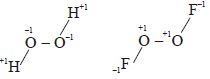
View full question & answer→MCQ 4471 Mark
Oxidation state of $'S'$ in peroxodisulphuric acid and sodium tetrathionate
- ✓
$+6, +5,0$
- B
$+6 ,+6, +6$
- C
$+6, + 4, + 2$
- D
$+6, + 2, 0$
AnswerCorrect option: A. $+6, +5,0$
a
Peroxydisulfuric acid is the inorganic compound with the chemical formula $H _2 S _2 O _8$. It contains sulfur in its $+6$ oxidation state and a peroxide group.
The tetrathionate anion, $S _4 O _6^{2-}$, is a sulphur oxoanion derived from the compound tetrathionic acid, $H _2 S _4 O _6$. Two of the sulphur atoms present in the ion are in oxidation state $0$ and two are in oxidation state $+5$.
View full question & answer→MCQ 4481 Mark
The oxidation states of $S-$ atoms in caro's and marshal's acid are
- ✓
$+ 6,\,+6$
- B
$+6, \,+4$
- C
$+6,\, -6$
- D
$+4, \,+6$
AnswerCorrect option: A. $+ 6,\,+6$
a
$\mathrm{H}_{2} \mathrm{O}_{5}$ Caro's Acid
$\begin{array}{*{20}{c}} {O\,\,\,\,\,\,\,\,\,\,\,\,} \\ {||\,\,\,\,\,\,\,\,\,\,\,\,} \\ {H - O - S - O - O - H} \\ {||\,\,\,\,\,\,\,\,\,\,\,} \\ {O\,\,\,\,\,\,\,\,\,\,} \end{array}$
$\mathrm{H}_{2} \mathrm{S}_{2} \mathrm{O}_{8}$ Marshall's Acid
$\begin{array}{*{20}{c}} {O\,\,\,\,\,\,\,\,\,\,\,\,\,\,\,\,\,\,\,\,\,\,\,\,\,\,\,\,\,\,O} \\ {||\,\,\,\,\,\,\,\,\,\,\,\,\,\,\,\,\,\,\,\,\,\,\,\,\,\,\,\,\,\,\,||} \\ {H - O - S - O - O - S - O - H} \\ {||\,\,\,\,\,\,\,\,\,\,\,\,\,\,\,\,\,\,\,\,\,\,\,\,\,\,\,\,\,\,||} \\ {O\,\,\,\,\,\,\,\,\,\,\,\,\,\,\,\,\,\,\,\,\,\,\,\,\,\,\,\,O} \end{array}$
Both these acids have peroxy link.
View full question & answer→MCQ 4491 Mark
What is the equivalent weight of hydrochloric acid in given redox reaction $Mn{O_2}\, + \,4HCl\, \to \,MnC{l_2}\, + \,2{H_2}O\, + \,C{l_2}$
If molar mass of hydrochloric acid is $M.$
Answerd
n factor for $4 \mathrm{mol} \mathrm{HCl}$ is 2
n factor for $1 \mathrm{mol}$ HCI $=\frac{2}{4}=\frac{1}{2}$
Eq. wt. of $\mathrm{HCl}=\frac{\mathrm{M}}{\text { n.factor }}=\frac{\mathrm{M}}{1 / 2}=2 \mathrm{M}$
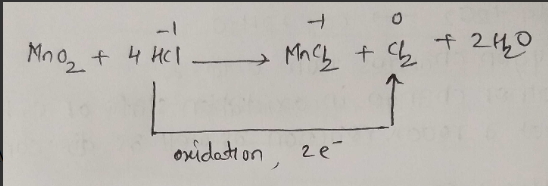
View full question & answer→MCQ 4501 Mark
What is the oxidation state of osmium in $7B$ and $7C$, respectively ?

- A
$6, 8$
- ✓
$8, 6$
- C
$6, 6$
- D
$8, 8$
AnswerCorrect option: B. $8, 6$
b
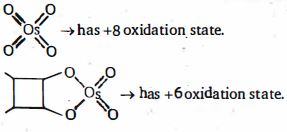
View full question & answer→MCQ 4511 Mark
Calculate the correct increasing order of average oxidation number of sulphur in
$S_8,\,S_2O_3^{2-},\, S_2O_7^{-2},\, S_4O_6^{-2},\, SO_3^{-2}$
- ✓
${S_8} < {S_2}O_3^{ - 2} < {S_4}O_6^{ - 2} < SO_3^{-2} < {S_2}O_7^{ - 2}$
- B
${S_2}O_3^{ - 2} < {S_4}O_6^{ - 2} < {S_8} < SO_4^{ - 2} < {S_2}O_7^{ - 2}$
- C
${S_4}O_6^{ - 2} < {S_2}O_3^{ - 2} < {S_8} < SO_4^{ - 2} < {S_2}O_7^{ - 2}$
- D
${S_8} < {S_4}O_6^{ - 2} < {S_2}O_3^{ - 2} < SO_3^{ - 2} < {S_2}O_7^{ - 2}$
AnswerCorrect option: A. ${S_8} < {S_2}O_3^{ - 2} < {S_4}O_6^{ - 2} < SO_3^{-2} < {S_2}O_7^{ - 2}$
View full question & answer→MCQ 4521 Mark
The correct set of oxidation numbers of $Br$ in $Br_3O_8$ is
- A
$6, 6, 6$
- ✓
$6, 4, 6$
- C
$7, 2, 7$
- D
$7, 6, 3$
AnswerCorrect option: B. $6, 4, 6$
b
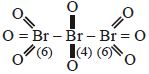
View full question & answer→MCQ 4531 Mark
A compound containing $x, y$ and $z$ atoms oxidation no of $x$ is $+3,\, y$ is $-5$ and $z$ is $+1$ then the possible formula of compound is
- A
$xyz$
- ✓
$xyz_2$
- C
$x_2yz$
- D
$(xy)_2z$
AnswerCorrect option: B. $xyz_2$
b
$(1)$ $\mathrm{xyz}$
$+3-5+1 \neq 0$
$(2)$ $x y z_{2}$
$+3-5+1 \times 2=0$
$(3)$ $x_{2} y z$
$3 x 2-5+1 \neq 0$
$(4) (\mathrm{xy})_{2} \mathrm{z} $
$(+3-5) \times 2+1 \neq 0$
View full question & answer→MCQ 4541 Mark
$3\, mole\, N_2H_4$ will lose $30 \,mole$ electrons to give new compound. Calculate oxidation state of $N$ in new compound? (Oxidation state of $H$ remains unchanged)
Answerd
$N_2H_4 \to (N_2H_4)^{10+}$
$2x + 4 = +10; x = +3$
View full question & answer→MCQ 4551 Mark
The equivalent weight of $Na_2S_4O_6$ in the reaction $2Na_2S_2O_3 + I_2 \to Na_2S_4O_6 + 2NaI$ is :-
- A
$M$
- B
$\frac{M}{8}$
- C
$\frac{M}{0.5}$
- ✓
$\frac{M}{2}$
AnswerCorrect option: D. $\frac{M}{2}$
d
$\mathop {N{a_2}{S_2}{O_3}}\limits^{( + 2)} \to \mathop {N{a_2}{S_4}{O_6}}\limits^{( + 2.5)} $
$n-$factor $\left(\mathrm{Na}_{2} \mathrm{S}_{4} \mathrm{O}_{6}\right)=(+2.5\, \mathrm{to}\,+2) \times 4$
$=2$
$\therefore E=\frac{M}{2}$
View full question & answer→MCQ 4561 Mark
Which of the following has been arranged in order of increasing oxidation number of nitrogen ?
- A
$NH_3 < N_2O_5 < NO < N_2$
- B
$NO_2^+ < NO_3^- < NO_2^- < N_3^-$
- ✓
$NH_4^+ < N_2H_4 < NH_2OH < N_2O$
- D
$NO_2 < NaN_3 < NH_4^+ < N_2O$
AnswerCorrect option: C. $NH_4^+ < N_2H_4 < NH_2OH < N_2O$
c
$\mathop {NH_4^ + }\limits_{ \downarrow ( - 3)} < \mathop {{N_2}{H_4}}\limits_{ \downarrow ( - 2)} < \mathop {N{H_2}OH}\limits_{ \downarrow ( - 1)} < \mathop {{N_2}O}\limits_{( + 1)} $
View full question & answer→MCQ 4571 Mark
Highest fluoride and highest oxide of $Mn$ are respectively
- A
$MnF_7, Mn_2O_7$
- B
$MnF_6, MnO_3$
- ✓
$MnF_4, Mn_2O_7$
- D
$MnF_7, MnO_2$
AnswerCorrect option: C. $MnF_4, Mn_2O_7$
View full question & answer→MCQ 4581 Mark
Which is correctly matched
Compound $\rightarrow$ O.State of $C.M.I.$
- A
Ferrocene $\rightarrow$ $+3$
- B
Sodium Nitropruside $\rightarrow$ $+1$
- C
Brown Ring complex $\rightarrow$ $+3$
- ✓
View full question & answer→MCQ 4591 Mark
Oxidation number of $Cl$ in $CaOCl_2$ (bleaching powder is)
- A
Zero, since it contains $Cl_2$
- B
$-1$, since it contains $Cl^-$
- C
$+1$, since it contains $ClO^-$
- ✓
$+1$ and $-1$ since it contains $ClO^-$ and $Cl^-$
AnswerCorrect option: D. $+1$ and $-1$ since it contains $ClO^-$ and $Cl^-$
d
$CaOCl_2$ $Ca(OCl)^-$ $Cl^-$
$\mathop {\mathop {Cl}\limits_ \downarrow }\limits_{ + 1} $ $\mathop {\mathop {Cl}\limits_ \downarrow }\limits_{ - 1} $
View full question & answer→MCQ 4601 Mark
For the the reaction
${I^ - } + \,ClO_3^- + \,{H_2}S{O_4}\, \to \,C{l^ - }\, + \,HSO_4^ - \, + \,{I_2}$
(no free $H^+$ is present). Select the correct statement in the balanced equation (Coefficients in smallest whole number ratio.)
AnswerCorrect option: C. Stoichiometric coefficient of $HSO_4^-$ is $6$
c
Oxidation half reaction
$2{I^ - } \to {I_2} + 2{e^ - }......(1)$
Reduction half reaction
$6 \mathrm{H}^{+}+\mathrm{ClO}_{3}^{-}+6 \mathrm{e}^{-} \rightarrow \mathrm{Cl}^{-}+3 \mathrm{H}_{2} \mathrm{O}......(2)$
Multiplying equation $( 1)$ by $3$ and add in $( 2)$
$6 \mathrm{I}^{-}+\mathrm{ClO}_{3}^{-}+6 \mathrm{H}^{+} \rightarrow \mathrm{Cl}^{-}+3 \mathrm{I}_{2}+3 \mathrm{H}_{2} \mathrm{O}$
$6 \mathrm{I}^{-}+\mathrm{ClO}_{3}^{-}+6 \mathrm{H}_{2} \mathrm{SO}_{4} \rightarrow \mathrm{Cl}^{-}+3 \mathrm{I}_{2}+3 \mathrm{H}_{2} \mathrm{O}+6 \mathrm{HSO}_{4}^{-}$
View full question & answer→MCQ 4611 Mark
Oxidation numbers of two $Cl$ atoms in bleaching powder, $CaOC{l_2}$ are
- A
$-1, -1$
- ✓
$+ 1, -1$
- C
$+ 1, + 1$
- D
$0, -1$
AnswerCorrect option: B. $+ 1, -1$
(b) Two $Cl$ atom shows $+1$ and $-1$ oxidation state.
View full question & answer→MCQ 4621 Mark
The sum of the oxidation numbers of all the carbons in ${C_6}{H_5}CHO$ is
Answer(d) In benzaldehyde all carbon atoms show $-4$ oxidation state.
View full question & answer→MCQ 4631 Mark
In which of the following reaction $H_2O_2$ acts as reducing agent
$(I)$ $H_2O_2 + 2H^+ + 2e^-\to 2H_2O$
$(II)$ $H_2O_2 + 2e^-\to O_2 + 2H^+$
$(III)$ $H_2O_2 + 2e^-\to 2 OH^-$
$(IV)$ $H_2O_2 + 2OH^-+ 2e^-\to O_2 + 2H_2O$
- A
$I$ and $II$
- B
$III$ and $IV$
- C
$I$ and $III$
- ✓
$II$ and $IV$
AnswerCorrect option: D. $II$ and $IV$
d
In the reactions (II) and (IV), $\mathrm{H}_{2} \mathrm{O}_{2}$ is oxidized and acts as reducing agent.
In the reactions (I) and (III), $\mathrm{H}_{2} \mathrm{O}_{2}$ is reduced and acts as oxidizing agent.
(I) $\mathrm{H}_{2} \mathrm{O}_{2}+2 \mathrm{H}^{+}+2 \mathrm{e} \rightarrow 2 \mathrm{H}_{2} \mathrm{O}$ A molecule of $\mathrm{H}_{2} \mathrm{O}_{2}$ loses an $\mathrm{O}$ atom and is reduced.
(II) $\mathrm{H}_{2} \mathrm{O}_{2}-2 \mathrm{e} \rightarrow \mathrm{O}_{2}+2 \mathrm{H}^{+}$ A molecule of $\mathrm{H}_{2} \mathrm{O}_{2}$ loses 2 electrons and is oxidized.
(III) $\mathrm{H}_{2} \mathrm{O}_{2}+2 \mathrm{e} \rightarrow 2\left(\mathrm{OH}^{-}\right)$ A molecule of $\mathrm{H}_{2} \mathrm{O}_{2}$ gains 2 electrons and is reduced.
(IV) $\mathrm{H}_{2} \mathrm{O}_{2}+2 \mathrm{OH}^{-}-2 \mathrm{e} \rightarrow \mathrm{O}_{2}+2 \mathrm{H}_{2} \mathrm{O}$ A molecule of $\mathrm{H}_{2} \mathrm{O}_{2}$ loses hydrogen and is oxidized.
View full question & answer→MCQ 4641 Mark
Identify the correct set which can only act as oxidants
- A
$NO_3^-,\, SO_3, Na$
- ✓
$Fe^{+3}, \,NO_3^-,\, SO_3$
- C
$I^-,\, Na$
- D
$I^-,\, NO_3^ -$
AnswerCorrect option: B. $Fe^{+3}, \,NO_3^-,\, SO_3$
b
$\mathop {F{e^{ + 3}}}\limits_{ + 3} ,\,\mathop {NO_3^ - }\limits_{ + 5} ,\mathop {S{O_3}}\limits_{ + 6} $
Central atom has maximum oxidation state, so they will only act as oxidising agent.
View full question & answer→MCQ 4651 Mark
In which of the following reaction conc. $H_2SO_4$ is acts as an oxidising agent?
- A
$ZnO + 2H_2SO_4 \to ZnSO_4 + H_2O$
- ✓
$2HI + H_2SO_4 \to I_2+SO_2+2H_2O$
- C
$CuF_2 + H_2SO_4 \to CuSO_4 + 2HF$
- D
$Ba(OH)_2 + H_2SO_4 \to BaSO_4 + 2H_2O$
AnswerCorrect option: B. $2HI + H_2SO_4 \to I_2+SO_2+2H_2O$
b
Among the above four $(B)$ represent the oxidizing behavior of $H _2 SO _4$.
In $(B)$ reaction it oxidizes $HI$ and itself reduces to $SO _2$ oxidation state of central atom sulphur decreases from $+6$ to $+4$.
View full question & answer→MCQ 4661 Mark
Which of the following groups of molecules act both as oxidising agent as well as reducing agent
- A
$KMnO_4,\, O_3,\, SO_3$
- B
$HClO_4,\, HNO_2,\, H_2O_2$
- ✓
$HNO_2,\, SO_2,\, H_2O_2$
- D
$HNO_3,\, SO_2,\, H_2SO_4$
AnswerCorrect option: C. $HNO_2,\, SO_2,\, H_2O_2$
c
When an atom present in its intermediate oxidation state then it can act both oxidizing agents as well as a reducing agent.
1.1n KMnO $_{4}, \mathrm{Mn}$ is in +7 oxidation state so it cannot acts as reducing agent.
$\mathrm{O}_{3}$ can only act as an oxidising agent due to its unstable nature.
In $\mathrm{SO}_{3}, \mathrm{S}$ is in +6 oxidation state so it cannot acts as reducing agent.
2.In $\mathrm{HClO}_{4}, \mathrm{Cl}$ is in +7 oxidation state so it cannot acts as reducing agent.
HN $\mathrm{O}_{2}$ can act both oxidizing as well as reducing agent because N is in +3 oxidation state.
In $\mathrm{H}_{2} \mathrm{O}_{2}, \mathrm{O}$ is in -1 oxidation state so can act both oxidizing as well as reducing agent.
3.In HN O can act both oxidizing as well as reducing agent because N is in +3 oxidation state.
In $\mathrm{H}_{2} \mathrm{O}_{2}, \mathrm{O}$ is in -1 oxidation state so can act both oxidizing as well as reducing agent.
ln $\mathrm{SO}_{2}, \mathrm{S}$ is in +4 oxidation state so it can act as both oxidizing agent as well as reducing agent.
4.HN O $_{2}$ can act both oxidizing as well as reducing agent because $\mathrm{N}$ is in +3 oxidation state.
In $\mathrm{SO}_{2}, \mathrm{S}$ is in +4 oxidation state so it can act as both oxidizing agent as well as reducing agent.
But $\mathrm{H}_{2} \mathrm{SO}_{4}$ cannot acts as reducing agent because S is present in its higher oxidation state.
So $(\mathrm{C})$ is a correct answer.
View full question & answer→MCQ 4671 Mark
Which of the following reaction depicts oxidizing behaviour of $H_2SO_4$ ?
- A
$Ca(O{H_2}) + {H_2}S{O_4} \to CaS{O_4} + 2{H_2}O$
- B
$NaCl + {H_2}S{O_4} \to NaHS{O_4} + HCl$
- C
$2PC{l_5} + {H_2}S{O_4} \to 2POC{l_3} + 2HCl + S{O_2}C{l_2}$
- ✓
$2HI + {H_2}S{O_4} \to {I_2} + S{O_2} + 2{H_2}O$
AnswerCorrect option: D. $2HI + {H_2}S{O_4} \to {I_2} + S{O_2} + 2{H_2}O$
d
$2 \mathrm{HI}+\mathrm{H}_{2} \mathrm{SO}_{4} \rightarrow \mathrm{I}_{2}+\mathrm{SO}_{2}+2 \mathrm{H}_{2} \mathrm{O}$
In this reaction the oxidation state of I increases by 1 hence, this is oxidation reaction and $\mathrm{HI}$ behaves as the reducing agent.
Also, the oxidation state of sulphur is decreasing by 2 means this is a reduction reaction and $\mathrm{H}_{2} \mathrm{SO}_{4}$ behaves as an oxidizing agent
View full question & answer→MCQ 4681 Mark
When $Cl_2$ gas reacts with hot and concentrated sodium hydroxide solution, the oxidation number of chlorine changes from
- A
zero to $+1$ and zero to ${-5}$
- ✓
zero to ${-1}$ and zero to $+5$
- C
zero to ${-1}$ and zero to $+3$
- D
zero to $+1$ and zero to $-3$
AnswerCorrect option: B. zero to ${-1}$ and zero to $+5$
b
The reaction of chlorine gas with hot and concentrated sodium hydroxide solution is
$3 \mathrm{Cl}_{2}+6 \mathrm{NaOH} \rightarrow \quad \mathrm{NaClO}_{3}+5 \mathrm{NaCl}+3 \mathrm{H}_{2} \mathrm{O}$
Oxidation number of $\mathrm{Cl}$ is 0 in $\mathrm{Cl}_{2},-1$ in $\mathrm{NaCl}$ and $+5$ in $\mathrm{NaClO}_{3}$
View full question & answer→MCQ 4691 Mark
A mixture of potassium chlorate, oxalic acid and sulphuric acid is heated. During the reaction which element undergoes maximum change in the oxidation number ?
Answerc
When a mixture of potassium chlorate, oxalic acid and sulphuric acid is heated, the following reaction occurs:
$\mathop {KCl{O_3}}\limits^{ + 1 + 5 - 2} {\mkern 1mu} + \mathop {{H_2}{C_2}{O_4}}\limits^{ + 1 + 3 - 2} {\mkern 1mu} + \mathop {{H_2}S{O_4}}\limits^{ + 1 + 6 - 2} {\mkern 1mu} $$ \rightarrow \mathop {{K_2}S{O_4}}\limits^{ + 1 + 6 - 2} {\mkern 1mu} + \mathop {KCl}\limits^{ + 1 - 1} {\mkern 1mu} + \mathop {C{O_2}}\limits^{ + 4 - 2} {\mkern 1mu} + \mathop {{H_2}O}\limits^{ + 4 - 2} {\mkern 1mu} $
Thus, $Cl$ is the element which undergoes maximum change in the oxidation state.
View full question & answer→MCQ 4701 Mark
Oxidation numbers of $P$ in $PO_4^{3-},$ of $S$ in $SO_4^{2-}$ and that of $Cr$ in $Cr_2O_7^{2-}$ are respectively
- A
$+3, +6$ and $+5$
- B
$+5, +3$ and $+6$
- C
$-3, +6$ and $+6$
- ✓
$+5, +6$ and $+6$
AnswerCorrect option: D. $+5, +6$ and $+6$
d
(i) Sum of oxidation states of all atoms $=$ charge of ion.
(ii) oxidation number of oxygen $=-2$
Let the oxidation state of $\mathrm{P}$ in $\mathrm{PO}_{4}^{3-}$ " is $\mathrm{x}$. $\mathrm{PO}_{4}^{3-}$
$x+4(-2)=-3$
$x-8=-3$
$x=+5$
Let the oxidation state of $\mathrm{s}$ in $\mathrm{SO}_{4}^{2-}$ is $\mathrm{y}$
$y+4(-2)=-2$
$y-8=-2$
$y=+6$
Let the oxidation state of $\mathrm{Cr}$ in $\mathrm{Cr}_{2} \mathrm{O}_{7}^{2-}$ is $\mathrm{z}$
$2 \times z+7(-2)=-2$
$2 z-14=-2$
$z=+6$
Hence, oxidation state of $\mathrm{P}, \mathrm{S}$ and $\mathrm{Cr}$ are $+5,+6$ and $+6$
View full question & answer→MCQ 4711 Mark
Number of moles of $MnO_4^-$ required to oxidize one mole of ferrous oxalate completely in acidic medium will be .......... $\mathrm{moles}$
- A
$7.5$
- B
$0.2$
- C
$0.6$
- ✓
$0.4$
Answerd
In acidic medium $M n O_{4}^{-}$ oxidises ferrous oxalate as follows:
$2 M n O_{4}^{-}+5 C_{2} O_{4}^{2-}+16 H^{+} \rightarrow$$2 M n^{2+}+10 C O_{2}+8 H_{2} O$
$\therefore 5$ moles of oxalate ions are oxidised by $2$ moles of $M n O_{4}^{-}$
$\therefore 1$ mole of oxalate ion is oxidised by
$\frac{2}{5} \text { mole of } M n O_{4}^{-}$
$=0.4$ mole of $\mathrm{MnO}_{4}^{-}$
View full question & answer→MCQ 4721 Mark
Which is the best description of the behaviour of bromine in the reaction given below ${H_2}O + B{r_2} \to HOBr + HBr$
- A
- B
- C
- ✓
Both oxidised and reduced
AnswerCorrect option: D. Both oxidised and reduced
(d) ${H_2}O + \mathop {B{r_2}}\limits_0 \to \,\mathop {HOBr}\limits_{ + 1} + \mathop {HBr}\limits_{ - 1} $
In the above reaction the oxidation number of $B{r_2}$ increases from zero (in $B{r_2}$) to $+1$ (in $HOBr$) and decrease from zero ($B{r_2}$) to $-1$ (in $HBr$). Thus $B{r_2}$ is oxidised as well as reduced & hence it is a redox reaction.
View full question & answer→MCQ 4731 Mark
The oxidation states of sulphur in the anions $SO_3^{2 - },{S_2}O_4^{2 - }$ and ${S_2}O_6^{2 - }$ follow the order
- A
${S_2}O_6^{2 - } < {S_2}O_4^2 < SO_3^{2 - }$
- ✓
${S_2}O_4^{2 - } < SO_3^{2 - } < {S_2}O_6^{2 - }$
- C
$SO_3^{2 - } < {S_2}O_4^{2 - } < {S_2}O_6^{2 - }$
- D
${S_2}O_4^2 < {S_2}O_6^{2 - } < SO_3^{2 - }$
AnswerCorrect option: B. ${S_2}O_4^{2 - } < SO_3^{2 - } < {S_2}O_6^{2 - }$
(b) ${S_2}O_4^{2 - } < SO_3^{2 - } < {S_2}O_6^{2 - }$
Oxi. state of sulphur in ${S_2}O_4^{2 - } = + 3$
Oxi. state of sulphur in $SO_3^{2 - } = + 4$
Oxi state of sulphur in ${S_2}O_6^{2 - } = + 5$.
View full question & answer→MCQ 4741 Mark
A compound contains atoms of three elements in $A, B$ and $C$. If the oxidation number of $A$ is $+2, B$ is $+5$ and that of $C$ is $-2$, the possible formula of the compound is
- ✓
${A_3}{(B{C_4})_2}$
- B
${A_3}{({B_4}C)_2}$
- C
$AB{C_2}$
- D
${A_2}{(B{C_3})_2}$
AnswerCorrect option: A. ${A_3}{(B{C_4})_2}$
(a) ${A_3}{(B{C_4})_2}$ $ = 3 \times 2 + {[5 + ( - 2 \times 4)]_2} = 0$.
View full question & answer→MCQ 4751 Mark
When $KMn{O_4}$ is reduced with oxalic acid in acidic solution, the oxidation number of $Mn$ changes from
- A
$7$ to $4$
- B
$6$ to $4$
- ✓
$7$ to $2$
- D
$4$ to $2$
AnswerCorrect option: C. $7$ to $2$
(c) $5\mathop {|\,\,\,\,\,\,\,\,\,\,}\limits_{COOH}^{COOH} + \mathop {2KMn{O_4}}\limits^{ + 7} + 3{H_2}S{O_4} \to $${K_2}S{O_4} + \mathop {2MnS{O_4}}\limits^{ + 2\,\,\,\,\,\,\,\,\,} + 10C{O_2} + 8{H_2}O$
In this reaction oxidation state of $Mn$ change from $+ 7$ to $+ 2.$
View full question & answer→MCQ 4761 Mark
Which of the following is redox reaction
AnswerCorrect option: D. Nitrogen oxides form nitrogen and oxygen by lightning
d
$\mathop {2{N_2}}\limits^0 + \mathop {{O_2}}\limits^{0{\mkern 1mu} {\mkern 1mu} } \to \mathop {\mathop {2N}\limits^{{\mkern 1mu} {\mkern 1mu} {\mkern 1mu} {\mkern 1mu} + 2} {\mkern 1mu} \mathop {{\text{ }}O}\limits^{ - 2} }\limits^{\mkern 1mu} $
Here $O.N.$ of $N$ increases from $O$ in ${N_2}$ to $+2 $ in $NO, 2- $ and that of decreased from $O$ in ${O_2}$ to $-2 $ in $O,$ therefore, it is a redox reaction.
View full question & answer→MCQ 4771 Mark
Which substance is serving as a reducing agent in the following reaction $14{H^ + } + C{r_2}O_7^{2 - } + 3Ni \to 2C{r^{3 + }} + 7{H_2}O + 3N{i^{2 + }}$
- A
${H_2}O$
- ✓
$Ni$
- C
${H^ + }$
- D
$C{r_2}O_7^{2 - }$
Answer(b) The oxidation number of $Ni$ changes from $0$ to $ + 1$
View full question & answer→MCQ 4781 Mark
The oxidation state of $I$ in ${H_4}IO_6^ - $ is
Answer(a) $\mathop {{H_4}IO_6^ - }\limits^ * $
$4 + x - 12 = - \,1$; $x = - 1 + 8$$ = + \,7$.
View full question & answer→MCQ 4791 Mark
Which of the following is incorrect about $K _{2} Cr _{2} O _{7} ?$
AnswerCorrect option: C. It is stable in both acid $\&$ base
c
In redox reactions potassium dichromate is used as an oxidizing agent.
$2 CrO _{4}^{2-} \frac{\text { In acidic medium }}{ H ^{+}} \rightarrow Cr _{7} O _{7}^{2-}+ H _{2} O$
Potassium dichromate is orange in color and used in redox titrations. But it is not stable in both acid and base.
View full question & answer→MCQ 4801 Mark
In order to oxidise a mixture of one mole of each of $FeC _{2} O _{4}$ $Fe _{2}\left( C _{2} O _{4}\right)_{3}, FeSO _{4}$ and $Fe _{2}\left( SO _{4}\right)_{3}$ in acidic medium, the number of moles of $KMnO _{4}$ required is:
Answera
Consider the reaction,
$MnO _{4}^{-}+5 e^{-} \rightarrow Mn ^{2+}$
The reaction equation of compound $FeC _{2} O _{4}$ is,
$FeC _{2} O _{4} \rightarrow Fe ^{3+}+2 CO _{2}+3 e^{-}$
So, $1$ mole of $FeC _{2} O _{4}$ requires $\frac{3}{5}$ moles of $KMnO _{4}$.
The reaction equation of compound $Fe _{2}\left( C _{2} O _{4}\right),$ is,
$Fe _{2}\left( C _{2} O _{4}\right)_{3} \rightarrow Fe ^{3+}+ CO _{2}+6 e^{-}$
So, $1$ mole of $Fe _{2}\left( C _{2} O _{4}\right)_{3}$ requires $\frac{6}{5}$ moles of $KMnO _{4}$.
The reaction equation of compound $FeSO _{4}$ is,
$FeSO _{4} \rightarrow Fe ^{3+}+e^{-}$
So, $1$ mole of $FeSO _{4}$ requires $\frac{1}{5}$ moles of $KMnO _{4}$.
since $Fe _{2}\left( SO _{4}\right)_{3}$ does not oxidize.
The total number of required moles is,
$n=\frac{3}{5}+\frac{6}{5}+\frac{1}{5}$
$n=2$
View full question & answer→MCQ 4811 Mark
Consider the following reaction occuring in basic medium $2MnO_4^- (aq) + Br^- (aq) \to 2MnO_2 (s) + BrO_3^- (aq)$ How the above reaction can be balanced further?
- A
By adding $2\,OH^-$ ions on right side
- B
By adding one $H_2O$ molecule to left side
- C
By adding $2H^+$ ions on right side
- ✓
Both $(a)$ and $(b)$
AnswerCorrect option: D. Both $(a)$ and $(b)$
d
Since reaction is occuring in basic medium therefore $2OH^-$ are added on right side.
$2MnO_4^ - (aq) + B{r^ - }(aq) \to $ $2Mn{O_2}(s) + BrO_3^ - (aq) + 2O{H^ - }(aq)$
Now, hydrogen atoms can be balanced by adding one $H_2O$ molecules to the left side
$2MnO_4^ - (aq) + B{r^ - }(aq) + {H_2}O(l)$ $ \to 2Mn{O_2}(s) + BrO_3^ - (aq) + 2O{H^ - }(aq)$
View full question & answer→MCQ 4821 Mark
Which of the following species can function both as oxidizing as well as reducing agent ?
- A
$Cl^-$
- B
$ClO_4^-$
- ✓
$ClO^-$
- D
$MnO_4^-$
AnswerCorrect option: C. $ClO^-$
c
Species $O.N.$
$Cl^-$ $-1$
$ClO_4^-$ $+7$
$ClO^-$ $+1$
$MnO_4^-$ $+7$
$NO_3^-$ $+5$
In $ClO^-$ chlorine is in $+1$ oxidation state which can be increased or decreased thus it acts as an oxidising or reducing agent. In other given species the underlined elements are either minimum or maximum oxidation state.
View full question & answer→MCQ 4831 Mark
Which of the following involves transfer of five electrons ?
- ✓
$MnO_4^- \to Mn^{2+}$
- B
$CrO_4^{2 - } \to C{r^{3 + }}$
- C
$MnO_4^{2 - } \to Mn{O_2}$
- D
$C{r_2}O_7^{2 - } \to C{r^{3 + }}$
AnswerCorrect option: A. $MnO_4^- \to Mn^{2+}$
a
$O.N.$ of $Mn$ in $MnO_4^-$ is $+7$ and in $Mn^{+2}$ it is $+2$. The difference is of $5$ electrons.
View full question & answer→MCQ 4841 Mark
Which of the following is a redox reaction ?
AnswerCorrect option: C. Nitrogen oxides from nitrogen and oxygen by lightening
c
$N_2 + O_2 \to 2NO,$ $O.N.$ of $N$ changes from $0$ to $+2$ (oxidation) and $O.N.$ of $O$ changes from $0$ to $-2$ (reduction).
View full question & answer→MCQ 4851 Mark
The strength of an aqueous solution of $I_2$ can be determined by titrating the solution with standard solution of:
Answerb
$I_2 + 2Na_2S_2O_3 \to Na_2S_4O_6 + 2NaI$
View full question & answer→MCQ 4861 Mark
The oxidation states of sulphur in $S_8, S_2F_2, H_2S$ respectively, are
- ✓
$0, +1$ and $-2$
- B
$+ 2, +1$ and $-2$
- C
$0, +1$ and $+ 2$
- D
$-2, +1$ and $-2$
AnswerCorrect option: A. $0, +1$ and $-2$
a
Oxidation number of $S$ in ${S_8} = \frac{0}{8} = 0$
Let oxidation number of $S$ in ${S_2}{F_2}$ be $x$
$2x + 2( - 1) = 0$
$2x - 2 = 0$
$2x = 2;\,x = + 1$
Let oxidation number of $S$ in $H_2S$ be $x$.
$2( + 1) + x = 0$
$2 + x = 0$
$x = - 2$
View full question & answer→MCQ 4871 Mark
The oxidation states of iodine in $HIO_4, H_3IO_5$ and $H_5IO_6$ are respectively
- A
$+ 1, + 3, + 7$
- B
$+ 7, + 7, + 3$
- ✓
$+ 7, + 7, + 7$
- D
$+ 7, + 5, + 3$
AnswerCorrect option: C. $+ 7, + 7, + 7$
c
Calculating the oxidation states of $I$, we get
${H_5}I{O_6};5 + x - 12 = 0$ or $x = + 7$
${H_3}I{O_5};3 + x - 10 = 0$ or $x = + 7$
$HI{O_4};1 + x - 8 = 0$ or $x = + 7$
Thus, the correct answer is $ + 7, + 7, + 7$
View full question & answer→MCQ 4881 Mark
Which of the following molecules can act as an oxidizing as well as a reducing agent ?
- A
$H_2S$
- B
$SO_3$
- ✓
$H_2O_2$
- D
$F_2$
AnswerCorrect option: C. $H_2O_2$
c
$H_2O_2$ can act both as an oxidising as well as a reducing agent.
Oxidising agent
$PbS + 4{H_2}{O_2} \to \mathop {PbS{O_4}}\limits_{White\,ppt.} + 4{H_2}O$
Reducing agent
$\mathop {A{g_2}O}\limits_{(moist)} + {H_2}{O_2} \to 2Ag + {H_2}O + {O_2}$
View full question & answer→MCQ 4891 Mark
In the balanced chemical reaction,$IO_3^ - + a\;{I^ - } + b\;{H^ + } \to c\;{H_2}O + d\;{I_2}$ $a, b, c$ and $d $ respectively correspond to
- ✓
$5, 6, 3, 3$
- B
$5, 3, 6, 3$
- C
$3, 5, 3, 6$
- D
$5, 6, 5, 5$
AnswerCorrect option: A. $5, 6, 3, 3$
(a) $IO_3^-+ aI^-+ bH^+ \rightarrow cH_2O + dI_2$
step $1 : I^{-1} \rightarrow I_2$ $ (oxidation)$
$IO_3^-\rightarrow I_2$ $ (reduction)$
step $2 : 2IO_3^-+ 12H^+ I_2 + 6H_2O$
step $3 : 2IO_3^-+ 12H^+ 10e^- \rightarrow I_2 + 6H_2O$
$2I^- \rightarrow I_2 + 2e$
step $4 : 2IO_3-+ 12H^+ 10e^- \rightarrow I_2 + 6H_2O$
$[2I^- \rightarrow I_2 + 2e]$
step $5 : 2IO_3^-+ 10I^-+ 12H^+ \rightarrow 6I_2 + 6H_2O$
$IO_3^-+ 5I^-+ 6H^+ \rightarrow 3I_2 + 3H_2O$
$comparing, a = 5, b = 6, c = 3, d = 3$
View full question & answer→MCQ 4901 Mark
$MnO_4^{2 - }$ ($1$ mole) in neutral aqueous medium is disproportionate to
- ✓
$2/3$ mole of $MnO_4^ - $ and $1/3$ mole of $Mn{O_2}$
- B
$1/3$ mole of $MnO_4^ - $ and $2/3 $ mole of $Mn{O_2}$
- C
$1/3$ mole of $M{n_2}{O_7}$ and $1/3$ mole of $Mn{O_2}$
- D
$2/3 $ mole of $M{n_2}{O_7}$ and $1/3 $ mole of $Mn{O_2}$
AnswerCorrect option: A. $2/3$ mole of $MnO_4^ - $ and $1/3$ mole of $Mn{O_2}$
(a) $MnO_4^{2 - }$ in neutral aqueous medium is disproportionate to $\frac{2}{3}$ mole of $MnO_4^ - $ and $\frac{1}{3}$ mole of $Mn{O_2}$.
View full question & answer→MCQ 4911 Mark
Oxidation state of $Fe$ in $F{e_3}{O_4}$ is
- A
$\frac{3}{2}$
- B
$\frac{4}{5}$
- C
$\frac{5}{4}$
- ✓
$\frac{8}{3}$
AnswerCorrect option: D. $\frac{8}{3}$
(d) $\mathop F\limits^ * {e_3}{O_4}$
$3x + ( - 8) = 0$; $3x - 8 = 0$
$3x = 8$; $x = \frac{8}{3}$.
View full question & answer→MCQ 4921 Mark
In the reaction $Zn + 2{H^ + } + 2C{l^ - } \to Z{n^{2 + }} + 2C{l^ - } + {H_2}$, the spectator ion is
- ✓
$C{l^ - }$
- B
$Z{n^{2 + }}$
- C
${H^ + }$
- D
AnswerCorrect option: A. $C{l^ - }$
(a) The ion which is not affected during the course of reaction is known as spectator ion.
View full question & answer→MCQ 4931 Mark
$HN{O_2}$ acts both as reductant and oxidant, while $HN{O_3}$ acts only as oxidant. It is due to their
- A
- ✓
- C
- D
Minimum number of valence electrons
Answer(b) In $\mathop {HN{O_2}}\limits^ * $ oxidation number of $N = + 3$
$\mathop {HN{O_3}}\limits^ * $ oxidation number of $N = + 5.$
View full question & answer→MCQ 4941 Mark
The oxide which cannot act as a reducing agent is
- A
$S{O_2}$
- B
$N{O_2}$
- ✓
$C{O_2}$
- D
$Cl{O_2}$
AnswerCorrect option: C. $C{O_2}$
(c) $C{O_2}$ is a acidic oxide.
View full question & answer→MCQ 4951 Mark
The equivalent weight of phosphoric acid $({H_3}P{O_4})$ in the reaction $NaOH + {H_3}P{O_4} \to Na{H_2}P{O_4} + {H_2}O$ is
Answer(d) Molecular weight of ${H_3}P{O_4}$ is $ 98 $ and change in its valency = $1$ equivalent wt. of ${H_3}P{O_4}$ $ = \frac{{{\rm{Molecular}}\,{\rm{weight}}}}{{{\rm{Change}}\,\,{\rm{in}}\,\,{\rm{valency}}}} = \frac{{98}}{1} = 98$.
View full question & answer→MCQ 4961 Mark
Oxidation number of osmium $(Os)$ in $Os{O_4}$ is
Answer(d) $\mathop {Os\,{O_4}}\limits^{ * \,\,\,\,\,\,\,\,\,\,} $
$x + 4( - 2) = 0$
$x - 8 = 0$
$x = + 8$.
View full question & answer→MCQ 4971 Mark
Following reaction describes the rusting of iron
$4Fe + 3{O_2}\, \to \,4F{e^{3 + }} + 6{O^{2 - }}$
Which one of the following statement is incorrect
AnswerCorrect option: B. Metallic iron is reduced to $F{e^{3 + }}$
b
'The following reaction describes the rusting of iron.
$4 \mathrm{Fe}+3 \mathrm{O}_2 \rightarrow 4 \mathrm{Fe}^{3+}+6 \mathrm{O}^{2-}$
Here, metallic iron loses electrons to form $\mathrm{Fe}^{3+}$. Hence, it has been oxidised.
Therefore, statement is option B is incorrect.
View full question & answer→MCQ 4981 Mark
What is the oxidation number of sulphur in $N{a_2}{S_4}{O_6}$
- A
$\frac{2}{3}$
- B
$\frac{3}{2}$
- C
$\frac{3}{5}$
- ✓
$\frac{5}{2}$
AnswerCorrect option: D. $\frac{5}{2}$
(d) $N{a_2}{\mathop S\limits^*{_4}}{O_6}$
$2 + 4x - 12 = 0$
$4x = 10$$x = \frac{{10}}{4}$$x = \frac{5}{2}$.
View full question & answer→MCQ 4991 Mark
Which of the following cannot give iodometric titrations
- A
$F{e^{3 + }}$
- B
$C{u^{2 + }}$
- ✓
$P{b^{2 + }}$
- D
$A{g^ + }$
AnswerCorrect option: C. $P{b^{2 + }}$
(c) Atom in highest oxidation state can oxidize iodide to liberate ${I_2}$ which is volumetrically measured by iodometric titration using hypo.
$2{I^ - } \to {I_2}$
$P{b^{ + 2}} \to $ Lowest oxidation state can not oxidise iodide to ${I_2}$.
View full question & answer→MCQ 5001 Mark
Identify the element which can have highest oxidation numbers
Answer(c) Chlorine have oxidation state $-1$ to $+ 7.$
View full question & answer→