MCQ
Which of the following is non-reducing sugar?
  • A
    Glucose
  • Sucrose
  • C
    Maltose
  • D
    Lactose

Answer

Correct option: B.
Sucrose
b
Sucrose is non-reducing sugar because anomeric carbon of both the monosaccharide units are involved in glycoside or actal formation.

Need a full question paper?

Generate a complete, print-ready paper with questions like this in minutes — across 16+ boards, with answer keys.
Start Generating Free

Similar questions

The hydrogen electrode is dipped in a solution of $\mathrm{pH}=3$ at $25^{\circ} \mathrm{C}$. The potential of the electrode will be_________ $\times 10^{-2} \mathrm{~V}$.$\left(\frac{2.303 \mathrm{RT}}{\mathrm{F}}=0.059 \mathrm{~V}\right)$
Which one is wrong in the following statements
Alcohols containing only up to $.......$ carbon atoms are completely miscible with water.
When a certain amount of solid $A$ is dissolved in $100\,g$ of water at $25^{\circ}\,C$ to make a dilute solution, the vapour pressure of the solution is reduced to one-half of that of pure water. The vapour pressure of pure water is $23.76\,mm\,Hg$. The number of moles of solute $A$ added is $...........$ (Nearest Integer)
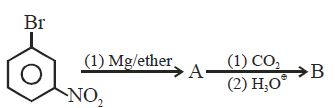
What will vbe the final product $B$ in following reaction?
The vapour pressure of a liquid depends on
The flucculation value of $\mathrm{HCl}$ for arsenic sulphide sol. is $30\; \mathrm{m}\; mole \;\mathrm{L}^{-1} .$ If $\mathrm{H}_{2} \mathrm{SO}_{4}$ is used for the flocculation of arsenic sulphide, the amount, in grams, of $\mathrm{H}_{2} \mathrm{SO}_{4}$ in $250\; \mathrm{ml}$ required for the above purpose is (molecular mass of $\left.\mathrm{H}_{2} \mathrm{SO}_{4}=98 \;\mathrm{g} / \mathrm{mol}\right)$
Cereals are major sources of?
For the following reactions

$\mathrm{CH}_{3} \mathrm{CH}_{2} \mathrm{CH}_{2} \mathrm{Br}+\mathrm{Z}^{-}$$\xrightarrow[{{\text{Sublimation}}}]{{{k_s}}} \mathrm{CH}_{3} \mathrm{CH}_{2} \mathrm{CH}_{2} \mathrm{Z}+\mathrm{Br}^{-}$

$\mathrm{CH}_{3} \mathrm{CH}_{2} \mathrm{CH}_{2} \mathrm{Br}+\mathrm{Z}^{-}$$\xrightarrow[{{\text{elimination}}}]{{{k_e}}}\mathrm{CH}_{3} \mathrm{CH}= \mathrm{CH}_{2} +\mathrm{HZ}+\mathrm{Br}^{-}$

where 

$\mathrm{Z}^{-}=\mathrm{CH}_{3} \mathrm{CH}_{2} \mathrm{O}^{-}(\mathrm{A})$ or $\begin{array}{*{20}{c}}
  {\,C{H_3}} \\ 
  {|\,\,\,\,\,} \\ 
  {C{H_3} - C - {O^ - }(B)} \\ 
  {|\,\,\,\,} \\ 
  {\,\,C{H_3}} 
\end{array}$

$\mathrm{k}_{\mathrm{s}}$ and $\mathrm{k}_{\mathrm{e}},$ are $,$ respectively, the rate constants for the substitution and elimination, and $\mu=\frac{\mathrm{k}_{\mathrm{s}}}{\mathrm{k}_{\mathrm{e}}},$ the correct options is

The treatment of zinc with very dilute nitric acid produces