MCQ
Which of the following is not a convex set?
  • A
    ${(x, y) ; 2x + 5y \leq 7}$
  • B
    ${(x, y) : x^{_2} + y^2 \leq 4}$
  • ${x : |x| = 5}$
  • D
    ${(x, y) : 3x^2 + 2y^2 \leq 6}$

Answer

Correct option: C.
${x : |x| = 5}$
$|x| = 5$ is not a convex set as any two points from negative and positive $x-$axis if are joined will not lie in set.

Need a full question paper?

Generate a complete, print-ready paper with questions like this in minutes — across 16+ boards, with answer keys.
Start Generating Free

Similar questions

The objective function of an LPP is
The line x = 1, y = 2 is:
The direction cosines of any normal to the xy plane are:
The equation of the curve aatisfying the differential $\text{y}(\text{x}+\text{y}^{3})\text{dx}=\text{x}(\text{y}^{3}-\text{x})$ dy and passing through the point (1, 1) is:
  1. $\text{y}^{3}-2\text{x}+3\text{x}^{2}\text{y}=0$
  2. $\text{y}^{3}+2\text{x}+3\text{x}^{2}\text{y}=0$
  3. $\text{y}^{3}+2\text{x}-3\text{x}^{2}\text{y}=0$
  4. None of these.
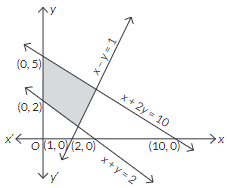
The feasible region corresponding to the linear constraints of a Linear Programming Problem is given belowImage

Which of the following is not a constraint to the given Linear Programming Problem?
The area of the quadrilateral ABCD, where A(0, 4, 1), B(2, 3, -1), C(4, 5, 0) and D(2, 6, 2) is equal to:
The straight line $\frac{\text{x}-3}{3}=\frac{\text{y}-2}{1}=\frac{\text{z}-1}{0}$ is:
  1. Parallel to x-axis
  2. Parallel to y-axis
  3. Parallel to z-axis
  4. Perpendicular to z-axis
If $\text{A} = \begin{bmatrix}\cos\alpha&-\sin\alpha\\ \sin\alpha&\cos\alpha\end{bmatrix},\text{then}\ \text{A + A}'=\text{I}$, if the value of a is:
  1. $\frac{\pi}{6}$
  2. $\frac{\pi}{3}$
  3. $\text{n}$
  4. $\frac{3\pi}{2}$
If the function f : R → A given by $\text{f(x)}=\frac{\text{x}^2}{\text{x}^2+1}$ is a surjection, then A =
  1. R
  2. [0, 1]
  3. [0, 1)
  4. [0, 1)
Choose the correct answer from the given four options:
The area of the region bounded by the curve $\text{y}=\sin\text{x}$ between the ordinates x = 0, $\text{x}=\frac{\pi}{2}$ and the x-axis is:
  1. $2\text{ sq. units}$
  2. $4\text{ sq. units}$
  3. $3\text{ sq. units}$
  4. $1\text{ sq. units}$