MCQ
Which of the following is not a vector quantity?
  • A
    Acceleration.
  • B
    Velocity.
  • C
    Speed.
  • D
    Displacement.

Answer

  1. Speed.

Need a full question paper?

Generate a complete, print-ready paper with questions like this in minutes — across 16+ boards, with answer keys.

Start Generating Free

Similar questions

The displacement time graph of a particle executing S.H.M. is shown in Fig.Which of the following statement is/ are true?
A pendulum bob has a speed of $3\, m/s$ at its lowest position. The pendulum is $0.5\, m$ long. The speed of the bob, when the length makes an angle of ${60^o}$ to the vertical, will be ..... $m/s$ (If $g = 10\,m/{s^2}$)
In the previous question, the smallest kinetic energy at the bottom of the incline will be achieved by:
Certain quantity of water cools from $70^o  C$ to $60^o C$ in the first $5$ minutes and to $54^o C$ in the next $5$ minutes. The temperature of the surroundings is ..... $^oC$
In an inelastic collision:
  1. The initial kinetic energy is equal to the final kinetic energy.
  2. The final kinetic energy is less than the initial kinetic energy.
  3. The kinetic energy remains constant.
  4. The kinetic energy first increases then decreases.
A uniform disc of mass $m$ and radius $R$ is pivoted at point $P$ and is free to rotate in vertical plane. The centre $C$ of disc is initially in horizontal position with $P$ as shown in figure. If it is released from this position, then its angular acceleration when the line $P C$ is inclined to the horizontal at an angle $\theta$ is ............
Which one of the following statements is correct?
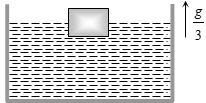
A cubical block is floating in a liquid with half of its volume immersed in the liquid. When the whole system accelerates upwards with acceleration of $g/3,$  the fraction of volume immersed in the liquid will be
$40$ calories of heat is needed to raise the temperature of $1\, mole$ of an ideal monoatomic gas from $20°C$ to $30°C$ at a constant pressure. The amount of heat required to raise its temperature over the same interval at a constant volume $(R = 2\,calorie\,mol{e^{ - 1}}{K^{ - 1}})$ is  ..... $calorie$