MCQ
Which of the following is not equal to watt
  • A
    Joule/second
  • B
    Ampere $ \times $ volt
  • C
    (Ampere)$^{2}$ $ \times $ ohm
  • Ampere/volt

Answer

Correct option: D.
Ampere/volt
d
(d) Watt$=$Joule/second $=$ Ampere$\times $ volt $=$ Ampere$^{2}×$Ohm

Need a full question paper?

Generate a complete, print-ready paper with questions like this in minutes — across 16+ boards, with answer keys.

Start Generating Free

Similar questions

Hydrogen gas is filled in a balloon at $20^\circ C$. If temperature is made $40^\circ C$, pressure remaining same, what fraction of Hydrogen will come out
What kind of motion is rectilinear motion?
A particle of mass $m$ is tied to one end of $a$ string of length $l$. The particle is held horizontal with the string $mg$ taut. It is then projected upward with $a$ velocity $u$. The tension in the string is $\frac{{mg}}{2}$ when it is inclined at an angle $30^o$ to the horizontal. The value of $u$ is
Two droplets merge with each other and forms a large droplet. In this process
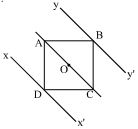
Let $I_1, I_2$ and $I_3$ be the moment of inertia of a uniform square plate about axes $AOC, xDx'$ and $yBy'$ respectively as shown in the figure. The moments of inertia of the plate $I_1 : I_2 : I_3$ are in the ratio.
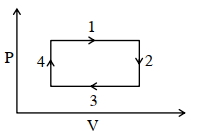
An ideal gas undergoes a four step cycle as shown in the $P-V$ diagram below. During this cycle, in which step heat is absorbed by the gas
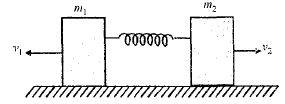
A spring is compressed between two blocks of masses $m_1$ and $m_2$  placed on a horizontal frictionless surface as shown in the figure. When the blocks arc released, they have initial velocity of $v_1$ and $v_2$ as shown. The blocks travel distances $x_1$ and $x_2$ respectively before coming to rest. The ratio $\left( {\frac{{{x_1}}}{{{x_2}}}} \right)$ is
A rubber ball is dropped from a height of $5 \,m$ on a planet where the acceleration due to gravity is not known. On bouncing, it rises to $1.8\, m$. The ball loses its velocity on bouncing by a factor of
A block is placed on a rough horizontal plane. A time dependent horizontal force $F = Kt$ acts on the block. Here $K$ is a positive constant. Acceleration-time graph of the block is
The ratio of frequencies of two pendulums oscillating are 2 : 3, then their lengths are in ratio: