Which of the following is the incorrect graph for a sphere falling in a viscous liquid? (Given at $t = 0$, velocity $v = 0$ and displacement $x = 0$.)
- A
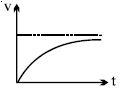
- B
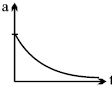
- C
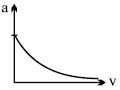
- D
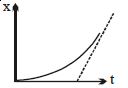
Diffcult


Download our appand get started for free
Experience the future of education. Simply download our apps or reach out to us for more information. Let's shape the future of learning together!No signup needed.*
Similar Questions
- 1A wide vessel with a small hole at the bottom is filled with two liquids. The density and heightof one liquid are $\rho_1$ and $h_1$ and that of the otherare $\rho_2$ and $h_2 \ (\rho_1 >\rho_2)$. The velocity of liquid coming out of the hole is :View Solution
- 2View SolutionThe venturi-meter works on :
- 3Karman line is a theoretical construct that separates the earth's atmosphere from outer space. It is defined to be the height at which the lift on an aircraft flying at the speed of a polar satellite $(8 \,km / s )$ is equal to its weight. Taking a fighter aircraft of wing area $30 \,m ^2$, and mass $7500 \,kg$, the height of the Karman line above the ground will be in the range .............. $km$ (assume the density of air at height $h$ above ground to be $\rho( h )=1.2 e ^{\frac{ h }{10}} \,kg / m ^3$ where $h$ is in $km$ and the lift force to be $\frac{1}{2} \rho v^2 A$, where $v$ is the speed of the aircraft and $A$ its wing area).View Solution
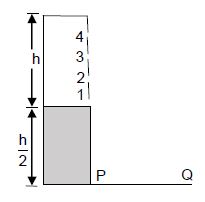
- 4A cylinder of height $h$ is filled with water and is kept on a block of height $h / 2$ . The level of water in the cylinder is kept constant. Four holes numbered $1, 2, 3$ and $4$ are at the side of the cylinder and at heights $0,\ h / 4,\ h / 2$ and $3h / 4$ respectively. When all four holes are opened together, the hole from which water will reach farthest distance on the plane $PQ$ is the hole numberView Solution
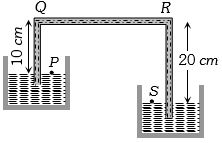
- 5A siphon in use is demonstrated in the following figure. The density of the liquid flowing in siphon is $ 1.5 gm/cc. $ The pressure difference between the point $P$ and $S$ will beView Solution
- 6A manometer connected to a closed tap reads $4.5 \times {10^5}$ pascal. When the tap is opened the reading of the manometer falls to $4 \times {10^5}$ pascal. Then the velocity of flow of water is ........ $m{s^{ - 1}}$View Solution
- 7Consider two solid spheres $\mathrm{P}$ and $\mathrm{Q}$ each of density $8 \mathrm{gm} \mathrm{cm}^{-3}$ and diameters $1 \mathrm{~cm}$ and $0.5 \mathrm{~cm}$, respectively. Sphere $\mathrm{P}$ is dropped into a liquid of density $0.8 \mathrm{gm} \mathrm{cm}^{-3}$ and viscosity $\eta=3$ poiseulles. Sphere $Q$ is dropped into a liquid of density $1.6 \mathrm{gm} \mathrm{cm}^{-3}$ and viscosity $\eta=2$ poiseulles. The ratio of the terminal velocities of $\mathrm{P}$ and $\mathrm{Q}$ isView Solution
- 8A hydraulic press can lift $100\, kg$ when a mass $'m'$ is placed on the smaller piston. It can lift ......... $kg$ when the diameter of the larger piston is increased by $4$ times and that of the smaller piston is decreased by $4$ times keeping the same mass $'m'$ on the smaller piston.View Solution
- 9A plane is in level flight at constant speed and each of its two wings has an area of $40 \mathrm{~m}^2$. If the speed of the air is $180 \mathrm{~km} / \mathrm{h}$ over the lower wing surface and $252 \mathrm{~km} / \mathrm{h}$ over the upper wing surface, the mass of the plane is______ $\mathrm{kg}$. (Take air density to be $1 \mathrm{~kg} \mathrm{~m}^{-3}$ and $\mathrm{g}=10 \mathrm{~ms}^{-2}$ )View Solution
- 10A cubical block is floating in a liquid with one fourth of its volume immersed in the liquid. If whole of the system accelerates upward with acceleration $g / 4$, the fraction of volume immersed in the liquid will be ..........View Solution