Consider two solid spheres $\mathrm{P}$ and $\mathrm{Q}$ each of density $8 \mathrm{gm} \mathrm{cm}^{-3}$ and diameters $1 \mathrm{~cm}$ and $0.5 \mathrm{~cm}$, respectively. Sphere $\mathrm{P}$ is dropped into a liquid of density $0.8 \mathrm{gm} \mathrm{cm}^{-3}$ and viscosity $\eta=3$ poiseulles. Sphere $Q$ is dropped into a liquid of density $1.6 \mathrm{gm} \mathrm{cm}^{-3}$ and viscosity $\eta=2$ poiseulles. The ratio of the terminal velocities of $\mathrm{P}$ and $\mathrm{Q}$ is
IIT 2016, Diffcult


Download our appand get started for free
Experience the future of education. Simply download our apps or reach out to us for more information. Let's shape the future of learning together!No signup needed.*
Similar Questions
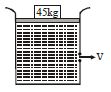
- 1A large cylindrical tank of cross-sectional area $1\ m^2 $ is filled with water. It has a small hole at a height of $1\ m $ from the bottom. $A$ movable piston of mass $5$ $kg$ is fitted on the top of the tank such that it can slide in the tank freely without friction. A load of $45$ $kg$ is applied on the top of water by piston, as shown in figure. The value of $v$ when piston is $7$ $m$ above the bottom is $(g = 10\ m/s^2)$ ....... $m/s$View Solution
- 2A small sphere of radius $r$ falls from rest in a viscous liquid. As a result, heat is produced due to viscous force. The rate of production of heat when the sphere attains its terminal velocity, is proportional toView Solution
- 3A cylindrical tank of height $1$ $m$ and cross section area $A$ $=$ $4000$ $cm^2$ is initially empty when it is kept under a tap of cross sectional area $1$ $cm^2$. Water starts flowing from the tap at $t$ $=$ $0$, with a speed $= $ $2$ $m/s$. There is a small hole in the base of the tank of cross-sectional area $0.5$ $cm^2$. The variation of height of water in tank (in meters) with time $t$ is best depicted byView Solution
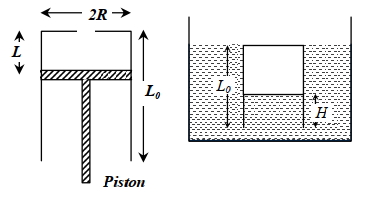
- 4A fixed thermally conducting cylinder has a radius $\mathrm{R}$ and height $\mathrm{L}_0$. The cylinder is open at its bottom and has a small hole at its top. A piston of mass $M$ is held at a distance $L$ from the top surface, as shown in the figure. The atmospheric pressure is $\mathrm{P}_0$.View Solution
$1.$ The piston is now pulled out slowly and held at a distance $2 \mathrm{~L}$ from the top. The pressure in the cylinder between its top and the piston will then be
$(A)$ $\mathrm{P}_0$ $(B)$ $\frac{\mathrm{P}_0}{2}$ $(C)$ $\frac{P_0}{2}+\frac{M g}{\pi R^2}$ $(D)$ $\frac{\mathrm{P}_0}{2}-\frac{\mathrm{Mg}}{\pi \mathrm{R}^2}$
$2.$ While the piston is at a distance $2 \mathrm{~L}$ from the top, the hole at the top is sealed. The piston is then released, to a position where it can stay in equilibrium. In this condition, the distance of the piston from the top is
$(A)$ $\left(\frac{2 \mathrm{P}_0 \pi \mathrm{R}^2}{\pi \mathrm{R}^2 \mathrm{P}_0+\mathrm{Mg}}\right)(2 \mathrm{~L})$ $(B)$ $\left(\frac{\mathrm{P}_0 \pi R^2-\mathrm{Mg}}{\pi R^2 \mathrm{P}_0}\right)(2 \mathrm{~L})$
$(C)$ $\left(\frac{\mathrm{P}_0 \pi \mathrm{R}^2+\mathrm{Mg}}{\pi \mathrm{R}^2 \mathrm{P}_0}\right)(2 \mathrm{~L})$ $(D)$ $\left(\frac{\mathrm{P}_0 \pi \mathrm{R}^2}{\pi \mathrm{R}^2 \mathrm{P}_0-\mathrm{Mg}}\right)(2 \mathrm{~L})$
$3.$ The piston is taken completely out of the cylinder. The hole at the top is sealed. A water tank is brought below the cylinder and put in a position so that the water surface in the tank is at the same level as the top of the cylinder as shown in the figure. The density of the water is $\rho$. In equilibrium, the height $\mathrm{H}$ of the water column in the cylinder satisfies
$(A)$ $\rho g\left(\mathrm{~L}_0-\mathrm{H}\right)^2+\mathrm{P}_0\left(\mathrm{~L}_0-\mathrm{H}\right)+\mathrm{L}_0 \mathrm{P}_0=0$
$(B)$ $\rho \mathrm{g}\left(\mathrm{L}_0-\mathrm{H}\right)^2-\mathrm{P}_0\left(\mathrm{~L}_0-\mathrm{H}\right)-\mathrm{L}_0 \mathrm{P}_0=0$
$(C)$ $\rho g\left(\mathrm{~L}_0-\mathrm{H}\right)^2+\mathrm{P}_0\left(\mathrm{~L}_0-\mathrm{H}\right)-\mathrm{L}_0 \mathrm{P}_0=0$
$(D)$ $\rho \mathrm{g}\left(\mathrm{L}_0-\mathrm{H}\right)^2-\mathrm{P}_0\left(\mathrm{~L}_0-\mathrm{H}\right)+\mathrm{L}_0 \mathrm{P}_0=0$
Give the answer question $1,2$ and $3.$
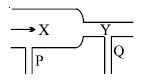
- 5A steady flow of water passes along a horizontal tube from a wide section $X$ to the narrower section $Y$, see figure. Manometers are placed at $P$ and $Q$ at the sections. Which of the statements $A, B, C, D, E$ is most correct?View Solution
- 6Radius of an air bubble at the bottom of the lake is $r$ and it becomes $ 2r $ when the air bubbles rises to the top surface of the lake. If $P $ $cm$ of water be the atmospheric pressure, then the depth of the lake isView Solution
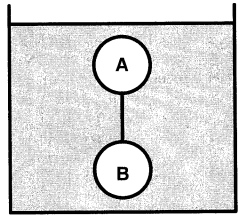
- 7Two solid spheres $A$ and $B$ of equal volumes but of different densities $d_A$ and $d_B$ are connected by a string. They are fully immersed in a fluid of density $d_F$. They get arranged into an equilibrium state as shown in the figure with a tension in the string. The arrangement is possible only ifView Solution
$(A)$ $d_Ad_F$ $(B)$ $d_B > d_F$ $(C)$ $d_A>d_F$ $(D)$ $d_A+d_B=2 d_F$
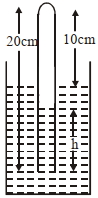
- 8A $20 \,cm$ long tube is closed at one end. It is held vertically, and its open end is dipped in water until only half of it is outside the water surface. Consequently, water rises in it by height $h$ as shown in the figure. The value of $h$ is closest to .............. $\,m / s$ (assume that the temperature remains constant, $P _{\text {armosphere }}=10^5 \,N / m ^2$, density. of water $=10^3 \,kg / m ^3$, and acceleration due to gravity $g =10 \,m / s ^2$ )View Solution
- 9A manometer connected to a closed tap reads $3.5 × 10^5 N/m^2$. When the valve is opened, the reading of manometer falls to $3.0 × 10^5 N/m^2$, then velocity of flow of water is ........ $m/s$View Solution
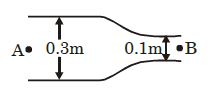
- 10Water is flowing through a horizontal tube according to the figure. Its diameter at two points are $0.3\,m$ and $0.1\,m$ respectively. Pressure difference between these two points is equal to $0.8\,m$ of water column. Find rate of flow of water in the tube ..... $ltr/s$View Solution