MCQ
Which of the following is the most polar
  • A
    $CC{l_4}$
  • B
    $CHC{l_3}$
  • $C{H_3}OH$
  • D
    $C{H_3}Cl$

Answer

Correct option: C.
$C{H_3}OH$
(c) Dipole moment of $C{H_3}OH$ is maximum in it.

Need a full question paper?

Generate a complete, print-ready paper with questions like this in minutes — across 16+ boards, with answer keys.

Start Generating Free

Similar questions

Dissolving $1.24 g$ of white phosphorous in boiling $NaOH$ solution in an inert atmosphere gives a gas $Q$. The amount of $CuSO _4$ (in g) required to completely consume the gas $Q$ is. . . .  [Given : Atomic mass of $H =1, O =16, Na =23, P =31, S =32, Cu =63$ ]
The 'Spin only' Magnetic moment for $\left[\mathrm{Ni}\left(\mathrm{NH}_3\right)_6\right]^{2+}$ is_____ $\times 10^{-1} \mathrm{BM}$.

$($ given $=$ Atomic number of $\mathrm{Ni}: 28)$

$\mathrm{CuSO}_4$ decolourises on addition of $\mathrm{KCN}$, the product is
The percentage Ionic character of the $HBr$ molecule, if the dipole moment is $0.63\, D$ & $HBr$ bond length $187.5\, Pm$ is ?............... $\%$
For diatomic molecules, the correct statement($s$) about the molecular orbitals formed by the overlap to two $2 p_z$ orbitals is(are)

$(A)$ $\sigma$ orbital has a total of two nodal planes.

$(B)$ $\sigma^*$ orbital has one node in the $x z$-plane containing the molecular axis.

$(C)$ $\pi$ orbital has one node in the plane which is perpendicular to the molecular axis and goes through the center of the molecule.

$(D)$ $\pi^*$ orbital has one node in the $x y$-plane containing the molecular axis.
Among the following molecules / ions $C_2^{2-} ,N_2^{2-} ,O_2^{2-},O_2$ which one is diamagnetic and has the shortest bond length ?
Name of ${(C{H_3})_2}HC - O - C{H_2} - C{H_2} - C{H_3}$ is
Assertion : $[Al(H_2O)_6]^{3+}$ is a stronger acid than $[Mg(H_2O)_6]^{2+}$.
Reason : Size of $[Al(H_2O)_6]^{3+}$ is smaller than $[Mg(H_2O)_6]^{2+}$ and possesses more effective nuclear charge.
The total number of electrons present in all the $s-$ orbitals, all the $p-$ orbitals and all the $d-$ orbitals of cesium ion are respectively
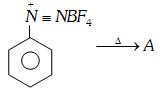
In this process product  $A $ is