Question
Which of the following is true

Answer

(b)With rise in temperature their magnetic susceptibility decreases i.e. ${\chi _m} \propto \frac{1}{T}$

Need a full question paper?

Generate a complete, print-ready paper with questions like this in minutes — across 16+ boards, with answer keys.

Start Generating Free

Similar questions

Consider two sound sources $S_1$ and $s_2$ having same frequency $100\,\,Hz$ and the observer $O$ located between them as shown in the fig. All the three are moving with same velocity in same direction. The beat frequency of the observer is .... $Hz$
A particle is projected from the ground at an angle of $\theta $ with the horizontal with an initial speed of $u$. Time after which velocity vector of the projectile is perpendicular to the initial velocity is
The electric field intensity at a point in vacuum is equal to
A lens which has focal length of $4 \;cm$ and refractive index of $1.4$ is immersed in a liquid of refractive index $1.6,$ then the focal length will be.......$cm$
The bit rate for a signal, which has a sampling rate of $8 \,kHz$ and where $16 $ quantisation levels have been used is.........$bits/sec$
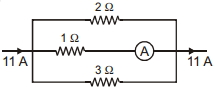
The ammeter reading in the circuit below is .............. $A$
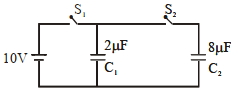
A $2\, \mu F$ capacitor $C _{1}$ is first charged to a potential difference of $10\, V$ using a battery.Then the battery is removed and the capacitor is connected to an uncharged capacitor $C _{2}$ of $8\, \mu F$. The charge in $C _{2}$ on equilibrium condition is $\ldots\,\mu C$. (Round off to the Nearest Integer)
A liquid is kept in a closed vessel. If a glass plate (negligible mass) with a small hole is kept on top of the liquid surface, then the vapour pressure of the liquid is the vessel is
An engine whistling at a constant frequency $n_0$ and moving with a constant velocity goes past a stationary observer. As the engine crosses him, the frequency of the sound heard by him changes by a factor $f$. The actual difference in the frequencies of the sound heard by him before and after the engine crosses him is 
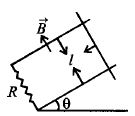
A copper rod of mass $m$ slides under gravity on two smooth parallel rails, with separation $l$ and set at an angle of $\theta$ with the horizontal. At the bottom, rails are joined by a resistance $R$. There is a uniform magnetic field $B$ normal to the plane of the rails, as shown in the figure. The terminal speed of the copper rod is