MCQ
Which of the following is true
  • A
    Diamagnetism is temperature dependent
  • Paramagnetism is temperature dependent
  • C
    Paramagnetism is temperature independent
  • D
    None of these

Answer

Correct option: B.
Paramagnetism is temperature dependent
b
(b)With rise in temperature their magnetic susceptibility decreases i.e. ${\chi _m} \propto \frac{1}{T}$

Need a full question paper?

Generate a complete, print-ready paper with questions like this in minutes — across 16+ boards, with answer keys.
Start Generating Free

Similar questions

A simple pendulum is attached to the roof of a lift. If time period of oscillation, when the lift is stationary is $T$. Then frequency of oscillation, when the lift falls freely, will be
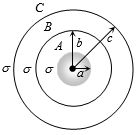
Three concentric metallic shells $A, B$ and $C$ of radii $a, b$ and $c (a < b < c)$ have surface charge densities $\sigma ,\, - \sigma $ and $\sigma $ respectively. then ${V_A}$ and ${V_B}$
The light rays having photons of energy $1.8 eV$ are falling on a metal surface having a work function $1.2 eV$. What is the stopping potential to be applied to stop the emitting electrons .......... $eV$
If the frequency of the source $e.m.f.$ in an $ac$ circuit is $n,$ the power varies with a frequency :-
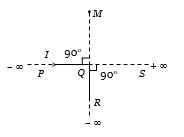
An infinitely long conductor $PQR$ is bent to form a right angle as shown. A current $I$ flows through $PQR$ The magnetic field due to this current at the point $M $ is $H_1$. Now another infinitely long straight conductor $QS$ is connected at $Q$ so that the current is $I/2$ in $QR$ as well as in $QS$, The current in $PQ$ remaining unchanged. The magnetic field at $M$ is now ${H_{2.}}$The ratio ${H_1}/{H_2}$ is given by
The magnetic field existing in a region is given by $\vec{B}=B_0\left(1+\frac{x}{l}\right) \hat{k}$. A square loop of edge I and carrying a current $i$, is placed with its edge parallel to the $x-y$ axes. Find the magnitude of the net magnetic force experienced by the loop
If two glass plates are quite nearer to each other in water, then there will be force of
The equation of a travelling wave is given by$y = 0.5\sin (20x - 400t)$ where $x$ and $y$ are in meter and $t$ is in second. The velocity of the wave is .... $m/s$
The pointer of a dead-beat galvanometer gives a steady deflection because
The work per unit volume to stretch the length by $1\%$ of a wire with cross sectional area of $1\,m{m^2}$ will be. $[Y = 9 \times {10^{11}}\,N/{m^2}]$