MCQ
Which of the following is used to detect aldehydes
  • A
    Million's test
  • Tollen's reagent
  • C
    Neutral ferric chloride solution
  • D
    Molisch's test

Answer

Correct option: B.
Tollen's reagent
b
(b)Tollen's reagent is used to detect aldehydes. Aldehyde reduce Tollen's reagent to give Silver mirror while these are oxidised to acid.

$\begin{array}{*{20}{c}}
  R \\ 
  H 
\end{array} > C = O\, + \,A{g_2}O\, \to $ $RCOOH\,\, + \,\mathop {2Ag}\limits_{Silver\,\,mirror} $

Need a full question paper?

Generate a complete, print-ready paper with questions like this in minutes — across 16+ boards, with answer keys.

Start Generating Free

Similar questions

Which of the following statement is not true for glucose?
Geometrical isomerism is not possible in
$\begin{gathered}
  \begin{array}{*{20}{c}}
  {O\,\,\,\,\,\,\,\,\,\,\,\,\,\,\,\,\,\,\,\,\,\,\,\,\,\,\,\,\,\,\,\,\,\,\,\,\,\,\,\,\,\,\,\,\,\,\,\,\,\,\,\,\,\,\,\,\,\,\,\,\,\,\,\,\,\,\,\,\,\,\,\,\,\,} \\ 
  {||\,\,\,\,\,\,\,\,\,\,\,\,\,\,\,\,\,\,\,\,\,\,\,\,\,\,\,\,\,\,\,\,\,\,\,\,\,\,\,\,\,\,\,\,\,\,\,\,\,\,\,\,\,\,\,\,\,\,\,\,\,\,\,\,\,\,\,\,\,\,\,\,\,\,} \\ 
  {C{H_3} - {\text{  }}C - {\text{ }}O - H\xrightarrow{{NaH{{\mathop {CO}\limits^{14} }_3}}}\mathop {(A)}\limits_{(gas)} \xrightarrow[{(ii){H_3}{O^ \oplus }}]{{(i)PhMgBr}}(B)} 
\end{array} \hfill \\
  \begin{array}{*{20}{c}}
  {O\,\,\,\,\,\,\,\,\,\,\,\,\,\,\,\,\,\,\,\,\,\,\,\,\,\,\,\,\,\,\,\,\,\,\,\,\,\,\,\,\,\,\,\,\,\,\,\,\,\,\,\,\,\,\,\,\,\,\,\,\,\,\,\,\,\,\,\,\,\,\,\,\,\,} \\ 
  {||\,\,\,\,\,\,\,\,\,\,\,\,\,\,\,\,\,\,\,\,\,\,\,\,\,\,\,\,\,\,\,\,\,\,\,\,\,\,\,\,\,\,\,\,\,\,\,\,\,\,\,\,\,\,\,\,\,\,\,\,\,\,\,\,\,\,\,\,\,\,\,\,\,\,} \\ 
  {C{H_3} - S - O - H\xrightarrow{{NaH\mathop {C{O_3}}\limits^{14} }}\mathop {(C)}\limits_{(gas)} \xrightarrow[{(ii){H_3}{O^ \oplus }}]{{(i)PhMgBr}}(D)} \\ 
  {||\,\,\,\,\,\,\,\,\,\,\,\,\,\,\,\,\,\,\,\,\,\,\,\,\,\,\,\,\,\,\,\,\,\,\,\,\,\,\,\,\,\,\,\,\,\,\,\,\,\,\,\,\,\,\,\,\,\,\,\,\,\,\,\,\,\,\,\,\,\,\,\,\,\,\,} \\ 
  {O\,\,\,\,\,\,\,\,\,\,\,\,\,\,\,\,\,\,\,\,\,\,\,\,\,\,\,\,\,\,\,\,\,\,\,\,\,\,\,\,\,\,\,\,\,\,\,\,\,\,\,\,\,\,\,\,\,\,\,\,\,\,\,\,\,\,\,\,\,\,\,\,\,\,\,\,} 
\end{array} \hfill \\ 
\end{gathered}$

Product $(B)$ and $(D) $ in the above reaction are

The cation that does not form an amine complex with excess of ammonia is
If the nitrogen atom had electronic configuration $1s^7,$ it would have energy lower than of the normal ground state configuration $1s^2 ,2s^2 ,2 p^3$ because the electron would be closer to the nucleus. Yet $1s^7$ is not observed because it violates
$IUPAC$ name of the following are

$C{H_3} - \mathop {\mathop {N\, - \,}\limits_{|\,\,\,\,\,\,} }\limits_{C{H_3}} \mathop {\mathop {C\,\,\, - }\limits_{|\,\,\,\,\,\,\,}^{|\,\,\,\,\,\,\,} }\limits_{{C_2}{H_5}}^{C{H_3}} C{H_2} - C{H_3}$

Match List I with List II 
LIST-I (Cell)LIST-II (Use/Property/Reaction)
A.Leclanche cellI.Converts energy of combustion into electrical energy
B.Ni-Cd cellII.Does not involve any ion in solution and is used in hearing aids
C.Fuel cellIII.Rechargeable
D.Mercury cellIV.Reaction at anode  $Zn \rightarrow Zn ^{2+}+2 e ^{-}$
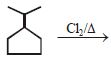
number of mono-chloro products (structural only)
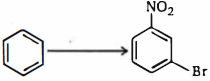
Suggest the best reaction conditions for the synthesis shown below.
In ethers, the  $C -O -C$  bond angle is ........ $^o$