MCQ
Which of the following laws of thermodynamics defines the term internal energy?
  • A
    Zeroth law
  • First law
  • C
    Second law
  • D
    Third law

Answer

Correct option: B.
First law
b
(b)

Internal energy is the sum of all the energies of a molecule in the frame of reference of the system.

According to $1^{\text {st }}$ law,

$\Delta Q=\Delta U+\Delta W$

where $\Delta U$ is internal energy, $\Delta W$ is the work done and $\Delta Q$ is the heat transferred.

$\Delta U=\Delta Q-\Delta W$

Need a full question paper?

Generate a complete, print-ready paper with questions like this in minutes — across 16+ boards, with answer keys.
Start Generating Free

Similar questions

If a gas follows Boyle's law then what will be the form of the graph between PV and V?
An inverted tube barometer is kept on a lift  with a moving downward with a deceleration $\alpha $ . The density of mercury is $\rho$ and acceleration due to gravity is $g$ . If the atmospheric pressure be $P_0$ then
For a particle in uniform circular motion, the acceleration $\vec a$ at a point $P(R,\theta)$ on the circle of radius $R$ is (Here $\theta$ is measured from the $x-$ axis)
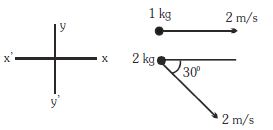
The velocity of centre of mass of the system as shown in the figure is
Three forces are acting simultaneously at one point. Two forces $\overrightarrow{ P }, \overrightarrow{ Q }$ are $(2 \hat{i}-3 \hat{j})$ and $(\hat{i}-\hat{j})$ respectively. If the object is in equilibrium then which will be the third:
The radius of gyration of a cylindrical rod about an axis of rotation perpendicular to its length and passing through the center will be $....m$ Given, the length of the rod is $10 \sqrt{3} m$.
In an experiment to find acceleration due to gravity $(g)$ using simple pendulum, time period of $0.5\,s$ is measured from time of $100$ oscillation with a watch of $1\;s$ resolution. If measured value of length is $10\; cm$ known to $1\; mm$ accuracy. The accuracy in the determination of $g$ is found to be $x \%$. The value of $x$ is
A ball rolls from the top of a stair way with a horizontal velocity $u\; m /s$ . If the steps are $h\; m$ high and $b\; m$ wide, the ball will hit the edge of the $n^{th}$ step, if $n=$
A particle of mass $200 \,g$ is moving in a circle of radius $2 \,m$. The particle is just 'looping the loop'. The speed of the particle and the tension in the string at highest point of the circular path are $\left(g=10 \,ms ^{-2}\right)$
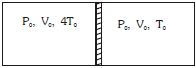
Figure shows a cylindrical adiabatic container of total volume $2V_0$ divided into two equal parts by a conducting piston (which is free to move). Each part containing identical gas at pressure $P_0$ . Initially temperature of left and right part is $4T_0$ and $T_0$ respectively. An external force is applied on the piston to keep the piston at rest. Find the value of external force required when thermal equilibrium is reached. ( $A =$ Area of piston)