MCQ
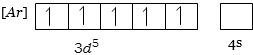
Which of the following metal ions will have maximum number of unpaired electrons
  • A
    $F{e^{ + 2}}$
  • B
    $C{O^{ + 2}}$
  • C
    $N{i^{ + 2}}$
  • $M{n^{ + 2}}$

Answer

Correct option: D.
$M{n^{ + 2}}$
d
(d) $M{n^{ + 2}}$ ion will have five (maximum) unpaired electrons

Need a full question paper?

Generate a complete, print-ready paper with questions like this in minutes — across 16+ boards, with answer keys.

Start Generating Free

Similar questions

If ethylene, carbon monoxide and water is heated at high temperature, which of the following is formed
Based on Heisenberg's uncertainty principle, the uncertainty in the velocity of the electron to be found within an atomic nucleus of diameter $10^{-15} \mathrm{~m}$ is ............. $\times 10^9 \mathrm{~ms}^{-1}$ (nearest integer)

[Given : mass of electron $=9.1 \times 10^{-31} \mathrm{~kg}$, Plank's constant $(\mathrm{h})=6.626 \times 10^{-34} \mathrm{JS}$ ]

(Value of $\pi=3.14$ )

If reaction is started with $NH_4COONH_2(s)$ and equilibrium mixture has pressure of $3\, atm$ then $K_P$ for $NH_4COONH_2(s)  \rightleftharpoons  2NH_3(g) + CO_2(g)$ is .....$atm^3$
In compound $A$, $1.00 \,g$ nitrogen unites with $0.57 \,g$ oxygen. In compound $B$, $2.00 \,g$ nitrogen combines with $2.24\, g$ oxygen. In compound $C$,  $3.00 \,g$ nitrogen combines with $5.11\, g$ oxygen. These results obey the following law
If two different non-axial $d-$ orbitals having $'xz'$ nodal plane form $\pi$ -bond  by overlapping each other, then internuclear axis will be
Among the following gases which one is damaging the ozone layer?
If isobutane and n-butane are present in a gas, then how much oxygen should be required for complete combustion of $5 \,kg$ of this gas ............ $\mathrm{kg}$
When $AlCl_3·6H_2O$ is strongly heated, then it forms
The $IUPAC$ name of compound

$\begin{array}{*{20}{c}}
  {O\,\,\,\,\,\,\,\,\,\,\,\,\,\,\,\,\,\,\,\,\,\,\,\,\,\,C{H_3}} \\ 
  {||\,\,\,\,\,\,\,\,\,\,\,\,\,\,\,\,\,\,\,\,\,\,\,\,\,\,\,\,\,\,\,\,|\,\,\,\,} \\ 
  {C{H_3} - C - CH - CH - CH - C{H_3}} \\ 
  {|\,\,\,\,\,\,\,\,\,\,\,\,\,|\,\,\,\,\,\,\,\,\,} \\ 
  {C{H_3}\,\,\,\,\,CHO\,\,} 
\end{array}$

is :

$\begin{array}{*{20}{c}}
  {C{H_2} - COOK} \\ 
  {|\,\,\,\,\,\,\,\,\,\,\,\,\,\,\,\,\,\,\,\,\,\,\,\,\,\,\,} \\ 
  {C{H_2} - COOK} 
\end{array}\xrightarrow{{elerctrolysis}}\mathop {\left( A \right)}\limits_{\left( {major} \right)} $

 Product $A$ is