MCQ
Which of the following mirrors always forms a virtual and small image?
- APlane mirror
- BConcave mirror
- CPlane and concave mirror
- ✓Convex mirror
Generate a complete, print-ready paper with questions like this in minutes — across 16+ boards, with answer keys.
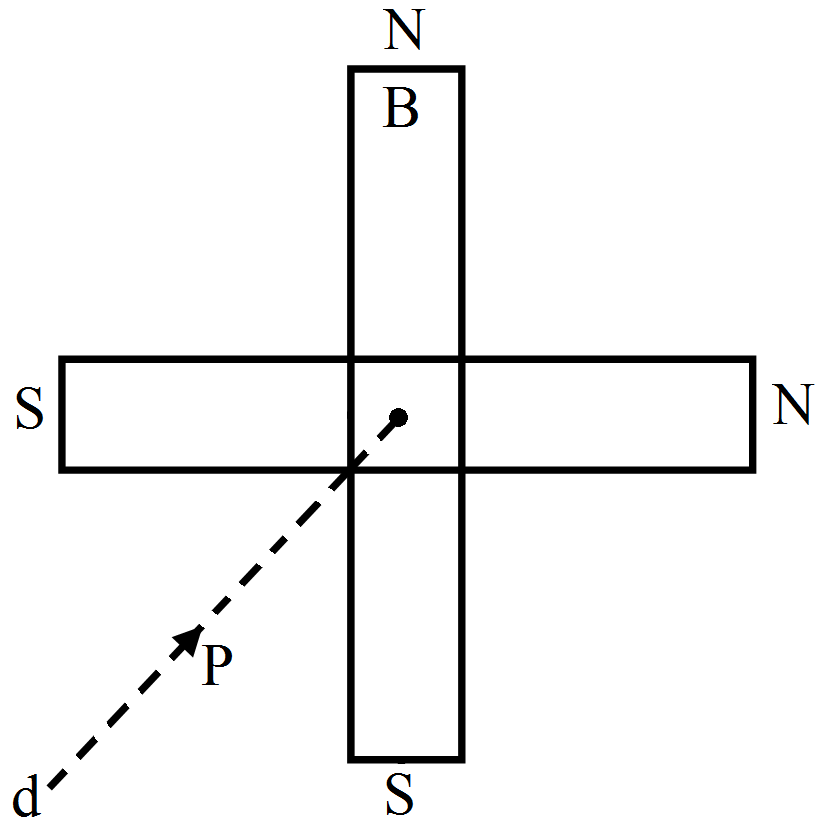
$\frac{\mu_0}{4\pi}\frac{2\text{M}}{\text{d}^3}$
When a magnet is pushed in and out of a circular coil C connected to a very sensitive galvanometer G as shown in the adjoining diagram with a frequency v, then
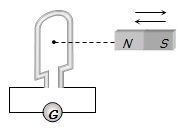
|
(a) Constant deflection is observed in the galvanometer |
|
(b) Visible small oscillations will be observed in the galvanometer if v is about 50 Hz |
|
(c) Oscillations in the deflection will be observed clearly if v = 1 or 2 Hz |
|
(d) No variation in the deflection will be seen if v = 1 or 2 Hz |
Assertion : In a movie, ordinarily 24 frames are projected per second from one end to the other of the complete film.
Reason : The image formed on retina of eye is sustained upto 1/10 second after the removal of stimulus.
|
(a) If both assertion and reason are true and the reason is the correct explanation of the assertion. |
|
(b) If both assertion and reason are true but reason is not the correct explanation of the assertion. |
|
(c) If assertion is true but reason is false. |
|
(d) If the assertion and reason both are false. |
A current carrying long solenoid is placed on the ground with its axis vertical. A proton is falling along the axis of the solenoid with a velocity v. When the proton enters into the solenoid, it will
|
(a) Be deflected from its path |
|
(b) Be accelerated along the same path |
|
(c) Be decelerated along the same path |
|
(d) Move along the same path with no change in velocity |
A luminous object is placed at a distance of 30 cm from the convex lens of focal length 20 cm. On the other side of the lens, at what distance from the lens a convex mirror of radius of curvature 10 cm be placed in order to have an upright image of the object coincident with it
| (a) 12 cm | (b) 30 cm |
(c) 50 cm |
(d) 60 cm |