MCQ
Which of the following particles will experience maximum magnetic force circle when projected with the same velocity perpendicular to a magnetic field?
- AElectron
- BProton
- CHe+
- DLi++
Explanation:
$|\text{F}|=|\text{qVB}|$
charge of Li++ > charge of ( He+, proton, electron)
Generate a complete, print-ready paper with questions like this in minutes — across 16+ boards, with answer keys.
A plane mirror produces a magnification of
| (a) -1 | (b) +1 | (c) Zero | (d) Between 0 and +∞ |
A thin rectangular magnet suspended freely has a period of oscillation equal to T. Now it is broken into two equal halves (each having half of the original length) and one piece is made to oscillate freely in the same field. If its period of oscillation is T ¢, then ratio  is
is
|
(a) |
(b) |
(c) |
(d) 2 |
The charges on two sphere are +7mC and – 5mC respectively. They experience a force F. If each of them is given and additional charge of – 2mC, the new force of attraction will be
|
(a) F |
(b) F / 2 |
(c) F/ |
(d) 2F |
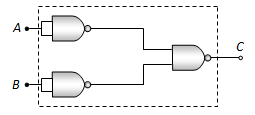
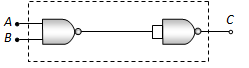
The combination of ‘NAND’ gates shown here under (figure) are equivalent to
|
(a) An OR gate and an AND gate respectively |
|
(b) An AND gate and a NOT gate respectively |
|
(c) An AND gate and an OR gate respectively |
|
(d) An OR gate and a NOT gate respectively. |
A luminous object is placed at a distance of 30 cm from the convex lens of focal length 20 cm. On the other side of the lens, at what distance from the lens a convex mirror of radius of curvature 10 cm be placed in order to have an upright image of the object coincident with it
| (a) 12 cm | (b) 30 cm |
(c) 50 cm |
(d) 60 cm |
If the binding energy of the electron in a hydrogen atom is 13.6 eV, the energy required to remove the electron from the first excited state of  is
is
|
(a) 122.4 eV |
(b) 30.6 eV |
(c) 13.6 eV |
(d) 3.4 eV |


