MCQ
Which of the following processes involves the principle of electrostatic induction?
  • A
    Pollination
  • B
    Chocolate making
  • C
    Xerox copying
  • All of these

Answer

Correct option: D.
All of these
d
(d)

These are properties of electrostatic induction.

Need a full question paper?

Generate a complete, print-ready paper with questions like this in minutes — across 16+ boards, with answer keys.
Start Generating Free

Similar questions

The length of Milky way is.......... light years
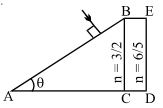
In the figure $ABC$ is the cross section of a right angled prism and $BCDE$ is the cross section of a glass slab. The value of $\theta$ so that light incident normally on the face $AB$ does not cross the face $BC$ is (given $sin^{-1} (3/5) = 37^o)$
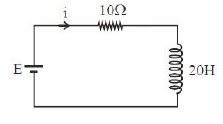
A $20\, Henry$ inductor coil is connected to a $10\, ohm$ resistance in series as shown in figure. The time at which rate of dissipation of energy (Joule’s heat) across resistance is equal to the rate at which magnetic energy is stored in the inductor, is
The objective and the eyepiece of a microscope have focal lengths of $4\, mm$ and $25\, mm$, respectively. The objective produces a real image $30$ times the size of the object.  The final image is viewed at infinity. The near point of the microscope user is at  $25 \,cm.$ The overall magnification of the microscope is
Light appears to travel in straight lines since
The formula for displacement $\left( I _d\right)$ is :
A mark at the bottom of a liquid appears to rise by 0.1 m. The depth of the liquid is 1 m. The refractive index of the liquid is
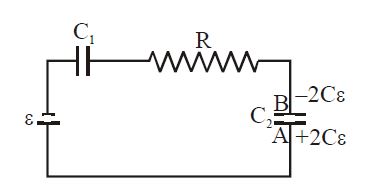
The capacitance of $C_1$ and $C_2$ shown in the diagram is $C$. $C_1$ is initially uncharged and $C_2$ is given a charge $2C_\varepsilon$  as shown. Which of the following graph represents charge on plate $B$ of capacitor $C_2$ as a function of time ?
The phase difference between the flux linked with a coil rotating in a uniform magnetic field and induced $e.m.f.$ produce in it is
A thin rectangular magnet suspended freely has a period of oscillation equal to $T.$ Now it is broken into two equal halves (each having half of the original length) and one piece is made to oscillate freely in the same field. If its period of oscillation is $T',$ the ratio $T'/T$ is :-